

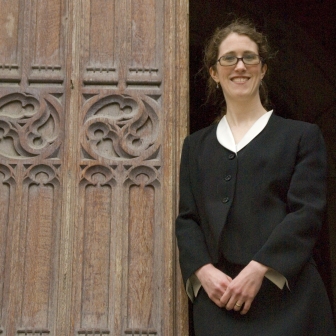
In attempting to research and write about the process and arguments in the development of women’s ordination in the Anglican Church of Ireland (which I first wrote about here on Feminism and Religion), I am frustrated by the polarization of language. While “objectivity” is fruitless, I strive for what Warren Nord calls philosophical fairness: when teaching about contested religious territory, to characterize each position in the terms they would choose for themselves.
How do I fairly label an historical debate on whether or not to admit women to the diaconate and priesthood? Using the phrase “women’s ordination” in my current Kickstarter campaign already puts me in a particular camp. The constraints of the medium require brevity. I have to make a choice.
I fret about using dualistic gendered language because of my increasing concern for the marginalization of people who do not easily fit gendered categories. I attempt to overcome some of my language difficulties through code-switching and using different words in multiple contexts.
This is easy to do as I have individual conversations with friends and family, explaining my intent and asking for their support. In one conversation, we discuss the leadership skills we use as mothers. In another we focus on whether I plan to remain a Catholic in good standing. Some want to discuss ecclesiology and others are more curious about the details of crowdfunding.
But what will I do when the time comes to craft a holistic narrative into one written document intelligible for my diverse supporters? Is this story just a collection of glass fragments, broken meanings and uprooted identities? Will my emotional and personal admiration shine through as a triumphalist historian, lauding the victors who became pioneering women religious leaders? Or by seeking to maintain my communion with Rome, will I privilege positions that are now marginalized in Ireland, but still dominate in other setting?
This is the kind of struggle, on a small scale, that I imagine must challenge any person or community attempting to codify a religious, historical narrative. Scripture can at times appear fragmented and contradictory, yet narrative aids us to become conscious of the Divine Presence in our own lives as we remember stories of past revelatory encounters. In order to write, we have to make choices.
So I am praying now to keep my various identity commitments in tension and not let the conflict tear apart my sense of self. I am praying to unlearn, to look beyond the polarities of language, to tap into the relational and connecting spirit that kept the Anglican Church of Ireland whole through this season of change.
I have to ask: Was the “stained glass ceiling” broken, or merely moved? Or can we use narrative to preserve the stained glass ceiling in some way intact, a reminder of a shared and imperfect past, without using it to bar others from encountering God?
Meagen Farrell is an author, educational consultant, and parent in Cleveland, Ohio. She is collecting pledges for her current book True Story: How Women Became Priests in Ireland until 11:53am on April 18, 2013. You can connect with her on Twitter, Facebook, and WordPress.
Discover more from Feminism and Religion
Subscribe to get the latest posts sent to your email.
 Feminism and Religion
Megan, I agree with you that one part of the “hermeneutical process,” for example as explained by Majella Franzmann in her book Women and Religion, is to think about and describe the positions the researcher thinks she disagrees with as fairly as possible–in the process of being fair, the researcher’s own position might change. “They all just hate women” might become a more nuanced statement. However, the hermeneutical process as described by Franzmann also requires the scholar to make a discernment, take a position, make a judgment at the end of the research process. This judgment might be stated at the end of a book or essay or it might be stated up front at the beginning of a book or essay.
From the point of view of feminist hermeneutics, I would argue that all tales are tales with a point of view, disguised or not. Being fair does not mean not making judgments. There might be reasons, cultural and historical, for denying women the priesthood, for slavery as the spoils of war, for forced marriages, for stoning adulteresses, and so on. As feminist scholars we attempt to understand those reasons, while at the same time, making our own judgments that these practices are wrong.
I am not sure why you are so worried about letting your interests and even your anger shape the story you tell. If “God” really is “God,” then I would assume She is on the side of those who protest injustice. In that case, I would not worry that protesting injustice will hide the face of God. On the other hand, confronting the injustice of human institutions could cause some people to leave them. But I would counsel you to trust that God will be God with or without a particular institution.
LikeLike
Maybe I shouldn’t be, but I’m surprised by what you chose to respond to in my post. I see the arch of history moving in favor of women, and I also see triumphalism impeding that shift in a post-modern, tribalist society, not helping. If I have to wave a feminist flag and use the feminist labels in all my work to be approved by a feminist in-group, then how can I communicate with those who continue to speak otherwise, even as they are won over by the substance of our claims? The proverb goes: “Until lions have their historians, takes of the hunt will always glorify the hunter.” But now that I am a lions’ historian, I am trying to make a conscious choice not to demonize the hunters. I think our minds are in different places: you are looking at the conflict from within the ongoing struggle. I am looking at it more like Mandela after he became President of post-apatheid South Africa: trying to unify and heal what was broken. What does feminism become when the victory is won? Will we continue to laud it over our vanquished to humiliate them for their sins? I’m trying to choose another path, an inclusive way of being, the ministry of reconciliation.
LikeLike
And I should have started by thanking you for this excellent analysis. Thank you.
LikeLike
Like Mandella I am in favor of making peace, but first you have to tell the truth. This is part of the S African reconciliation program. I don’t think this is about being politically correct, but about telling the truth. There are ways and ways to tell the truth, but the goal is to tell the truth and then not to hate or wish to kill the other …
LikeLike
I look forward to continuing to be held accountable to telling the truth in this excellent community.
LikeLike
Thank you, Meagan. I have been mired in how to frame my research on how the leadership of women in the Anglican Church of Canada has contributed to addressing sexual misconduct in our church. What does ordination have to do with it? Although it happened here in 1976, the leadership that brought forth meaningful policies and procedures in response to clergy sexual misconduct came from lay women, strongly influenced by second wave feminism in North America. My sense is once I receive some
input from others commenting on your question, such as Carol Christ who has already done so, my quest for an interpretative feminist perspective will be illumined.
Great to have this blog!
LikeLike
I look forward to hearing how you choose to frame your work!
LikeLike
Megan, I have learned in my life that it’s impossible to use language that’s always inclusive. I try, but my point of view in life is determined by the choices I’ve made in how I live and that will — by definition — color what I say. I remember once when I delivered a talk at a feminist conference (this was in the 1990s) and used the term “husband.” I was immediately taken to task by a lesbian who asked why I used that term when marriage was denied to her. She thought I should use the word “partner.” So I made the switch. When my (feminist) daughter came out a decade or so later, and I described her partner as a “partner,” she asked me not to use that term, because it made her feel like a middle-aged lesbian. She wanted me to speak about her partner as her “girlfriend.” Now “girlfriend” was anathema to me for two reasons: 1) it used the word “girl,” and my daughter was in her twenties, obviously a woman; and 2) friend didn’t describe the depth of her relationship. But it was her life, so I used the term “girlfriend.” What is fair, what is dualistic gendered language, as you ask? I always go with the self-definition of the person involved.
I also agree with Carol that as feminists we need to make our perspective known, to declare ourselves on the side of women/lesbians/gay/queer/etc. people. Our opponents don’t have the same scruples that we have, not that understanding this should change our scruples. But it should make us take a stand, even if we have to change that stand when we discover more information that we hadn’t known, from people who have other perspectives. Bending toward justice — it’s not a linear path.
LikeLike
I love your story of changing language! Even that short exchange highlights my same struggle with multiple identity markers: your daughter was trying all at the same time to mark herself as a young person, in a certain type of romantic relationship, and as a feminist. How to choose a label that mediates between those three very different pulls? In this case, it was a different choice than you would have made, even though you had a very good reason for your own choice.
I really appreciate your optimism that we are bending towards justice and I will cling to that hope. In my darker moments, I just think I’m working on a book that is ultimately going to make everyone unhappy. I already know that I use different language in different contexts that cannot always be properly translated or reconciled. And in these moments when I have to choose my language, I am getting a taste of the visceral experience like others have described of being a second generation immigrant: caught between two worlds, not feeling like you totally belong in your place of choice or your place of origin. That is the feeling I was trying to describe here. I think this place of tension is teaching me a deep level of compassion for those who made the language choices before me, even as I try to revise or retranslate their work (“In the name of the Creator, the Sustainer, and the Redeemer”). I don’t want to dismiss the struggle too quickly, since as you say it is always possible to discover more information. We can’t know everything, and at some point you have to trust and write, but it’s humbling and scary at the same time to know your choice of language will impact others in ways you can’t predict.
LikeLike
“I fret about using dualistic gendered language because of my increasing concern for the marginalization of people who do not easily fit gendered categories.” Since women have been excluded from christian priesthood for the better part of two millennia, we ourselves have been marginalized. It seems fair to me to address that in its own right, without agonizing over the legitimacy of naming it, and to give due attention to the way the sexual double standard has worked to keep women down is way overdue. (I use ‘sex’ here and not ‘gender’ because that is what the rigid gender system is politically based upon, the colonization of females). That does not mean that gender variant and same-sex loving people should not be considered; only that women don’t need to apologize for knocking over the longstanding barriers used to keep us down. ‘Women’s ordination’ is not an offensive term; it is a watershed change.
LikeLike
It is very exciting! Yay women’s ordination! But one of the areas I am interested in pursuing is whether this shift would make any difference in how vocations are considered for people whose gender and sex are not in alignment? Is the advancement of feminism and women simultaneously advancing equality for all people regardless of gender? I’m not convinced that is always true.
I would certainly argue even from my preliminary research that women in the early church weren’t completely excluded from the roles that have since been codified as the priesthood. And there wasn’t ordination as we know it now for most of the first millenia of Christianity. So I think the current trend towards women’s ordination is really returning to the liberating message for women that Jesus shared so many years ago. That ressourcement, to borrow a word from Vatican II, is a major driving force for the advancement of the cause of women’s ordination in traditional formfs of Christianity.
LikeLike