

This month’s Herstory Profiles are going to be on two extraordinary, courageous, and underrepresented Chinese Women. Afong Moy was the first Chinese Immigrant to America who found fame and ridicule. Anna May Wong was the first Chinese American Actress who was at the forefront of the ever-changing media and silver screen. These two women are trailblazers, revolutionaries, and have long been regulated as footnotes.
I was introduced to the history of Afong Moy by the theater company I was a past patron of Artists at Play. Their 2019 West Coast premiere of “The Chinese Lady” was a stunning two person play which chronicles Afong Moy’s time in America. The play was written by Lloyd Suh which interweaves historical facts and interpretations on the emotions and experiences of Afong Moy. You can watch a scene below.
Afong Moy immigrated to the United States in 1834. Not only was she the first ‘official’ Chinese Immigrant, but she also became the first publicly known Chinese Immigrant who would travel the Continental United States and even meet President Andrew Jackson. For 17 years, Afong Moy was a public figure and for most of that time, people could buy tickets to stare at her, watch her make tea, even just to simply observe as she walked across a room. Afong Moy experienced the Chinese Cultural practice of foot binding. *
There is so much that we do not know about Afong Moy or that isn’t recorded by outsiders. We know she was brought to the US by the Carnes brothers who were merchants. Francis and Nathaniel would capitalize on the sensation and novelty of Afong Moy to sell the goods** that they were importing from the “Orient.”***
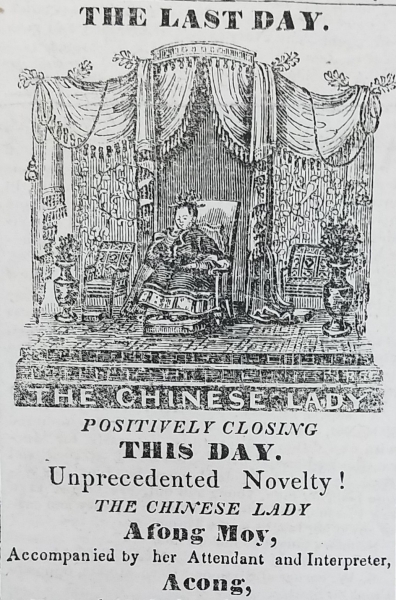
Towards the second half of Afong Moy’s public life- she became somewhat of an entertainer and sadly very much a circus spectacle. She became so popular that she would tour the United States for three years even traveling to Cuba. P.T. Barnum became her manager during the 1840s. Her acts also saw Afong Moy starting to engage with her crowd with and without an Interpreter. It was in these shows where Americans got windows into life in China, religion in gender, and what it meant to be a Chinese woman. Her life was one of liminality. She was an immigrant – removed from her birth country, she was unmarried, and all her money was controlled by her managers. This was poignantly depicted in the Lloyd Suh play. Her last appearance was in April 1850. We never hear, see, or learn about what happened to Afong Moy after 1850.

Afong Moy’s disappearance also came on the advent of anti-Chinese/anti-Asian rhetoric, policies, and treatment. This will culminate with what will become known as “Yellow Peril.” After the passing of the 1882 Chinese Exclusion Act which barred new immigration from China, outlawed permanent citizenship from those who already migrated, and even allowed businesses and communities to refuse services, work, and goods. Yellow Peril and Anti-Asian hate were strengthened with stereotypes, sexualization, and tokenization. It is this landscape of discrimination that we encounter our next leading lady.
Anna May Wong is a prolific artist and actress. She starred in over 60 movies and is the first Chinese American star in Hollywood. Over the course of her career, Anna May Wong has been considered a complete spectrum actor as she starred in Silent films, television, and on the stage. Anna May, while enduring countless instants of discrimination, starred in the first technicolor film made in Hollywood.

Anna May Wong was born in Chinatown, Los Angeles in 1905. Her parents named her Wong Liu Tsong, and her American/English name was Anna May. Anna May would visit the newly created movie sets and started to dream about becoming a movie star. In 1919, Anna May went to a casting call for the film The Red Lantern where she was picked for her first role as a background extra. She was still in school and would continue to be an extra in films. At the age of 17, Anna May dropped out of school and got her first substantial role in the 1922 film The Toll of the Sea which was also the first technicolor film. Anna May’s love of cinema and her dreams encouraged her to audition for main roles. Racial stereotypes and discrimination continued to be present for Anna May as she was never cast in main roles. Due to racist and Anti miscegenation laws, interracial marriage and kissing was not allowed to be filmed. This was the main given reason for Anna May not being cast in main character roles. In 1924, Anna May created her own production company so she could start making and starring in her own films. Unfortunately, her company failed due to terrible business partners.
Anna May left Hollywood for the European film scene and better opportunities. It is in Europe that Anna May starred in her first talking film, The Flame of Love (1930). She was approached by Paramount Pictures to come back to Hollywood. She would star in the Broadway production of On the Spot. While she was getting better opportunities, anti-Asian treatment was still prevalent. She was asked to portray a Chinese woman in Japanese dress and movement. She refused. She appeared with Marlene Dietrich in Shanghai Express (1932). She would then become the first Asian American to lead a television show, The Gallery of Madame Liu-Tsong (1951). She passed away in 1961 from a heart attack.

She never was able to achieve the stardom and popularity that she had dreamed about during her lifetime. It was only after her life and decades later that Anna May’s true stardom was realized. In 2022, it was announced that the likeness of Anna May Wong would be put onto the US quarter – making her the first Asian American to be on US currency.
Afong Moy and Anna May Wong were trailblazers in the unknown, in hostile waters, and found ways to become shining stars. While their lives seem to have ended in sorrow or the unknown, we can make sure that their lives, their dreams, their courage is not forgotten and live in the sunlight.
*Foot Binding was a practice started in the 10th Century that many upper-class families did to their women. The smaller the foot on a woman, the more refinement, beauty, and marriage eligibility. It was an extremely painful 2-year procedure. https://www.smithsonianmag.com/history/why-footbinding-persisted-china-millennium-180953971/
**The Carnes brothers would create viewings of Afong Moy where she would help to advertise, publicize, and sensationalize all aspects of foreign trade and life.
***This is an archaic term and no longer the correct way to talk about the East; however, it was the number one term that was used for over 100 years. The term also was used to describe everything beyond Europe.
Additional Resources
Hye Seung Chung, “Hollywood Asian” Temple University Press, 2007.
Jamie Ford “The Many Daughters of Afong Moy” Atria Books, 2022
John Haddad “The Chinese Lady and China for the Ladies: Race, Gender, and Public Exhibition In Jacksonian America” Chinese America: History & Perspectives —The Journal of the Chinese Historical Society of America (San Francisco: Chinese Historical Society of America with UCLA Asian American Studies Center, 2011), 5–19.
Leslie Camhi https://www.nytimes.com/2004/01/11/movies/film-a-dragon-lady-and-a-quiet-cultural-warrior.html
Nancy E. Davis “The Life of Afong Moy” https://lithub.com/the-life-of-afong-moy-the-first-chinese-woman-in-america/
National Women’s History Museum https://www.womenshistory.org/education-resources/biographies/anna-may-wong
New York Historical Society https://www.nyhistory.org/blogs/afong-moy-the-chinese-lady
UCLA Asia Pacific Center https://www.international.ucla.edu/asia/article/6590
Women and the American Story https://wams.nyhistory.org/confidence-and-crises/jazz-age/anna-may-wong/
Digital Resources
Lloyd Suh “The Chinese Lady”
Yunah Hong “Anna May Wong: In Her Own Words”
New York Historical Society Presentation https://www.youtube.com/watch?v=nlQ4C7oNh2k
Discover more from Feminism and Religion
Subscribe to get the latest posts sent to your email.

 Feminism and Religion
Thank you for highlighting these two women. It is so heartbreaking to see the history of racism in this country and how it affected and affects individual lives. We need to take notice, recognize and honor those who fought to simply be. Change is only possible if we “see” and act to make change possible. Thank you for helping us to do so.
LikeLiked by 1 person
Amazing, isn’t it? So many women have gone & still go unrecognized for their accomplishments & battles, especially women of color. (FYI, if you’re interested in on more discussion of Anna Mae Wong in film, go to the podcast of episode 24o of citizendame.pod Just copy & paste. Both Karen Petersen & Lauren Humphries-Brooks are well worth listening to.)
LikeLike
Thanks for sharing these fascinating women’s stories with us. It is a shame that Afong Moy was objectified and used to market the Carnes’ brothers’ products. I wonder if she received any money for her work. Anna May Wong was ahead of her time. She’d still face discrimination, of course, but she would be a big star today.
LikeLike