

In her FAR post earlier this year,[i] “Why Feminism Needs the Fierce Goddesses,” Susan Foster argues that a “flagging” feminist movement needs the revitalizing energy of the “fierce goddesses” of ancient times to challenge the patriarchal forces that seem to be on the rise as increasingly we find women’s lives and freedoms constrained. She writes, “the dark goddesses of ancient times have been submerged in our psyches, but they serve as a repository of fierce energy, of female rage against injustice.” She continues, “It’s important and healthy for us as women to reclaim our anger, using it to protect ourselves and fight for our rights in systems that are oppressive.”
Reading this, I immediately thought of Beverly Wildung Harrison’s, “The Power of Anger in the Work of Love,” and China Galland’s, The Bond Between Women: A Journey to Fierce Compassion. Anger as the work of love; fierce compassion. In this time of mass shootings, insurrection, the ongoing assault on women, LGBTQ, and BIPOC peoples, when rage seems so easily fueled by hate, envy, and greed, it is the rage based in love and compassion that is most needed. This is the rage of the fierce dark goddesses who are moved to act against injustice, the rage of the feminism I love. With its source in love and compassion, it is a rage that rebels in the best sense of the word – that at once refuses injustice and affirms dignity and respect, that speaks truth to power, that is grounded in solidarity and friendship, and values the immanence of the earth, the water, the body, and the divine spark in all beings.[ii]
“Anger signals something amiss in relationship . . . that change is called for,” wrote Harrison. “Anger denied subverts community. Anger expressed directly is a mode of taking the other seriously, of caring.”[iii] We can call upon this anger not to destroy, but to create.
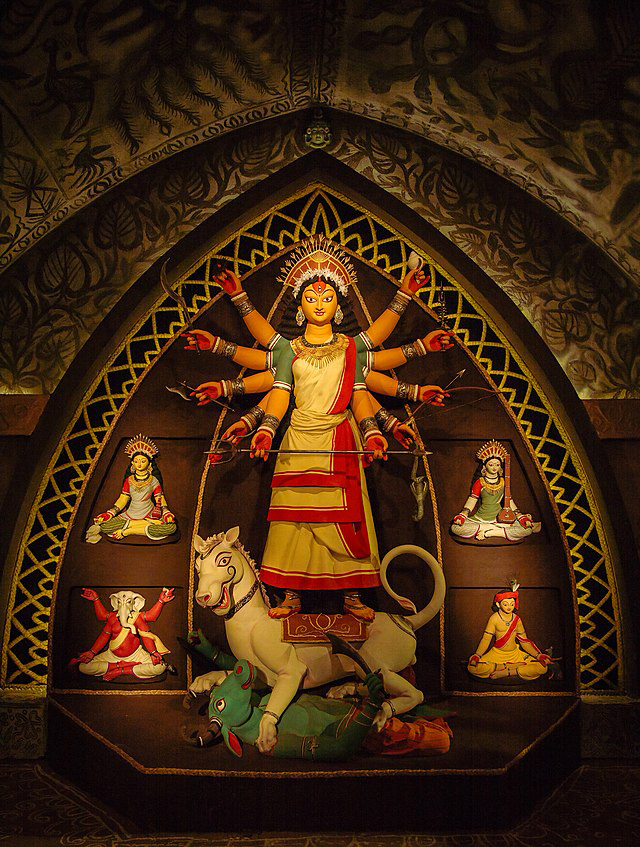
This anger based in love is the fierceness born of compassion. In her pilgrimage “to find the waters of fierce compassion,” China Galland sought out the faith, spiritual practices, and actions of women engaged in the work of saving the world they love. She began with the mother of fierce goddesses – Durga –the great goddess who rose out of flames to defeat Mahisasura, the demon intent on destroying the world. Every time she and her female warriors defeated him and his warriors, he rose again in different forms, until Sumbha, the Lord of the Demons, sought her out. Ultimately, Durga defeated even Sumbha, and once again rivers flowed, trees blossomed, and song and dance returned to the earth. The people begged Durga to stay and rule the earth, but she wanted none of the praise or the power. She withdrew, promising to return if ever the earth was in danger of being destroyed again.
Galland regards the demons as symbols of the most serious of human failings – hatred, greed, cruelty, enemy-making. The centerpiece of the prophecy that foretold of the time of destruction by these demons was that only a woman could save them. Symbolically, woman represents compassion — the one who tends those who suffer with care and understanding. But Galland went to explore a different aspect of compassion – its fierceness. As Buddhist nun Sister Chân Không reminded her, the statues of Tara, the bodhisattva of compassion, appear in both her fierce and kind forms, “’because out of compassion, sometimes you have to be very fierce.’”[iv] Galland went on to witness the work of fierce compassion in the work of Aruna Uprety aiding women and girls sold into prostitution at ages as young as six, in the weekly vigil on behalf of their missing children of the Mothers of the Disappeared in Argentina, in the work of Yvonne Bezerra de Mello caring for the street children of Rio de Janeiro, and more.
Thinking of where we witness this fierce compassion at work in the world today, my first thought is of Patrisse Khan-Cullors, who from early childhood had watched the brother she loved dearly be harassed and beaten by police, thrown into juvie again and again, and had his life destroyed by the resultant mental illness that left him in tortured conditions in prison for many years; who had watched so many of the lives of black women and men in her life be similarly destroyed. So that when the white man who shot and killed Trayvon Martin, “sixteen and skinny, carrying iced tea and candy . . . walking home to his own house”[v] was acquitted of all charges, in her outrage fueled by love, she and two friends formed Black Lives Matter. “In every demand . . . I see the faces of my mothers and my brothers, my father and my sister. . . . we are firm in our conviction that our lives matter by virtue of our birth.”[vi]
I think of Jen Cousins, leading the fight against book banning in Florida schools.[vii] She was moved to act out of fierce love for her non-binary child and others like them, so that in books like Gender Queer[viii] “they could find acceptance and confirmation and know they were not alone,”[ix] and so that all children might grow up in an atmosphere of love and understanding, rather than hate and fear.
And I think of the Water Protectors. As Robin Wall Kimmerer and Kathleen Deane Moore wrote of the women of Standing Rock, “The land is sacred, a living breathing entity, for whom we must care, as she cares for us. And so it is possible to love land and water so fiercely you will live in a tent in a North Dakota winter to protect them.”[x] Love so fiercely you will sit in ceremony occupying sacred ground as it is being dug to install oil pipelines. Love so fiercely you will risk arrest. Love so fiercely that you will dedicate your life to walking and praying by the waters.[xi]
In these efforts of fierce compassion led by women, Durga rises again.
References
Fleischmann, Jeff. “Two Moms Are at the Center of Book Banning in America: ‘It’s Exhausting’.” Los Angeles Times, May 15, 2023.
Galland, China. 1998.The Bond Between Women: A Journey to Fierce Compassion. New York: Riverhead Books.
Harrison, Beverly Wildung. 1989. “The Power of Anger in the Work of Love.” In Judith Plaskow and Carol Christ, Eds. Weaving the Visions: New Patterns in Feminist Spirituality. San Francisco: HarperSanFrancisco, 214-225.
Khan-Cullors, Patrisse & Asha Bandele. 2017. When They Call You a Terrorist: A Black Lives Matter Memoir. New York: St. Martin’s Publishing Group.
Kimmerer, Robin Wall and Kathleen Deane Moore, “The White Horse and the Humvees.” Yes! Magazine. 11/05/16.
[i] Why Feminism Needs the Fierce Goddesses by Susan Foster (feminismandreligion.com)
[ii] See my Rebellious Feminism: Camus’s Ethic of Rebellion and Feminist Thought.
[iii] Harrison, 220.
[iv] Galland, 271.
[v] Khan-Cullors, 189.
[vi] Ibid., 203-204.
[vii] Jen Cousins is one of the co-founders of the Florida Freedom to Read project.
[viii] Maia Kobabe’s Gender Queer is the most banned book in America. For more information, see How a Debut Graphic Memoir Became the Most Banned Book in the Country – The New York Times (nytimes.com).
[ix] Fleischmann, Jeff. “Two Moms Are at the Center of Book Banning in America: ‘It’s Exhausting’.” Los Angeles Times, May 15, 2023.
[x] The White Horse and the Humvees—Standing Rock Is Offering Us a Choice – YES! Magazine (yesmagazine.org)
[xi] The Standing Rock encampment began on April 1, 2017, when a few women from the Standing Rock tribe formed a prayer circle, praying that their land not be invaded by the “black snake” of the Dakota Access Pipeline. Among them are LaDonna Brave Bull Allard and Phyllis Young are among the leaders of the movement. Krystal Two Bulls, now the Executive Director of Honor the Earth, began the NO DAPL global movement. The Women of Standing Rock – WOW (wowblog.me) Native women water protectors, among them Winona LaDuke of Honor the Earth and Tara Houska of the Giniw Collective, were at the center of the struggle against Line 3 in northern Minnesota and continue their efforts against Line 5 that crosses Wisconsin, the UP of Michigan, and the Straits of Mackinac. Josephine Mandamin, a member of the Wikwemikong First Nation, began the water walker movement, walking around Lake Superior in 2003, and eventually all of the Great Lakes, carrying a pail of water to bring awareness to the need to protect the water. In Anishinaabe culture, women are the protectors of the water. “As women, we are carriers of the water. We carry life for the people,” said Mandamin. Meet Josephine Mandamin (Anishinaabekwe), The “Water Walker” – Indigenous Rising. Mandamin died in 2019, but others continue to walk for the water. The Nibi Walk around Lake Superior, led by water walker Sharon Day, will begin on August 1 of this year in Duluth, Minnesota, and they invite others to join them.
Discover more from Feminism and Religion
Subscribe to get the latest posts sent to your email.

 Feminism and Religion
“It is the rage based in love and compassion that is most needed”. Not for me…. I have too close a relationship with nature and am in a constant state of fury – fighting back through words is something I have been doing most of my life – it’s exhausting and it’s getting me nowhere – I am more than ready to lean into grieving without the outrage… I see no way through our present predicament unless those in power break down – and how realistic is that?
LikeLike
I understand the exhaustion. I feel it, too. I should probably clarify that I meant to contrast rage based in love and compassion with rage based in hate and fear, not with other emotional responses such as grief.
LikeLiked by 1 person
Thank you for this insightful and passionate essay. I had forgotten the part of Durga’s story that says she will return if needed. I do believe that means us — her energy is certainly needed now and the people you mention are all showing us all how to be Durga at this time wherever we may be, however we may make a difference. Putting ourselves in the context of Durga’s story definitely clarifies who we are, what we need to be doing and how we need to be doing it with compassion for ourselves, other living beings, and the Earth.
LikeLiked by 1 person
Thank you, Carolyn. I especially appreciate your last sentence — a fitting final sentence for the piece itself.
LikeLike
Greetings,
another popular, fierce goddess Kali,the re birthing goddess,
Dance in Destruction’s dance,
To him the Mother comes. from link,
https://media.belurmath.org/kali-the-mother-a-poem-by-vivekananda-40/
regards,mkyogi
LikeLike
I’m familiar with Kali. Thank you for the poem.
LikeLike
Beth, Thanks for this wonderful post reminding us of the two sides of Goddess. The dark goddesses never act out of hubris or pride but as you so beautifully point out their rage is born out of the hatred of injustice and compassion for life on Earth.
LikeLiked by 1 person
I appreciate your reference to my post “Why Feminism Needs the Fierce Goddesses.” My hope is that many other women will resonate with the fierce goddesses and use their energy to restore justice to oppressed peoples. You are exactly right in explaining fierceness in terms of love and compassion. We already have too much hatred in the world.
LikeLiked by 1 person