

Part 2, Part 1 was posted yesterday
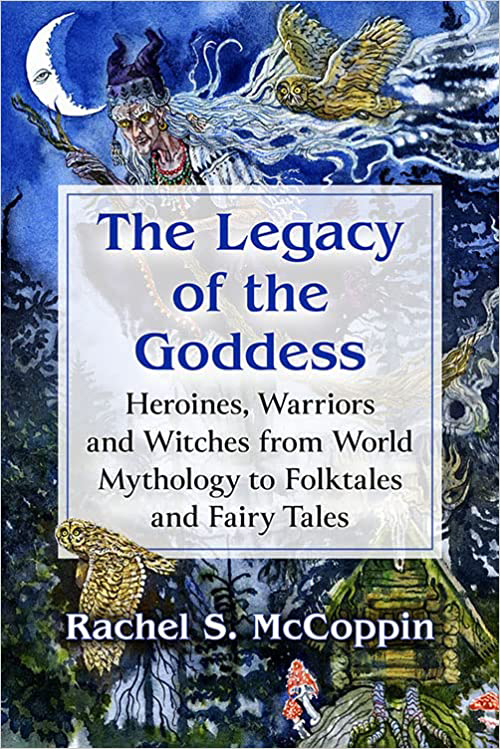
Chapter 4, “Monstrous Females and Ghost Women,” “traces the many female characters within folktales and fairy tales who appear as monstrous, materializing in the forms of giantesses, succubi, mermaids, rusalki, etc. Just as in many ancient myths, even though these monstrous women appear in folktales and fairy tales as hindrances to the quest of the hero, they ultimately serve to educate male heroes about the true meaning of their quest, which again often aligns with concepts associated with mythic goddesses. The many ghost women who appear in folktales and fairy tales around the world are also discussed in this chapter, as they often serve as agents to teach male heroes about how they, particularly as females, have been wronged by males or by patriarchal systems, and thus have been thwarted from completing their own heroic quests” (McCoppin, p. 9).
Though most myths around the world display male heroes partaking on heroic quests, and seldom focus on heroines who participate in their own heroic journeys, this is not at all the case with folktales and fairy tales, as hundreds of folktales and fairy tales portray strong, independent female heroines who indeed partake on their own heroic quests. Therefore, the second half of Legacy of the Goddess focuses on the formidable heroines found in many folktales and fairy tales from around the globe.
Chapter 5 of Legacy of the Goddess, entitled “Defiant Women and Women Warriors,” “displays myriad folktale and fairy tale women who defy patriarchal social, political, and religious structures, and thus serve to become heroines within their tales. Like their male heroic counterparts, the heroines of folktales and fairy tales are also often guided by powerful female characters, who again resemble ancient goddesses” (McCoppin, p. 9).
Chapter 6, “Heroines on their own Quest,” Chapter 7, “Mothers and Stepmothers,” and Chapter 8, “Witches,” all “trace the quests of many folktale and fairy tale heroines who are guided upon their journeys by female teachers who appear in the roles of mother, stepmother, wise old woman/grandmother, or witch. Folktale and fairy tale female educators teach heroines tenets associated with goddesses of many ancient myths, such as skills associated with nature and mysticism. For instance, many heroines of folktales and fairy tales around the globe learn how to command natural elements or perform acts such as reanimation or resurrection; these mystical acts are directly connected to abilities of mythic goddesses. In this way, the folktale and fairy tale heroine realizes that she, like her female educator, comes from a long line of powerful mythic women. Therefore, the last three chapters of this book show that the heroines of folktales and fairy tales often learn elements associated with the quintessential heroic quest displayed by mostly male heroes, such as autonomy, the facts of mortality, and the wisdom of self-actualization, but they also move beyond these common elements of male heroic quests into a heightened apotheosis, which appears as a realization that they are representations of goddesses themselves” (McCoppin, p. 9-10).
I wrote this book because after writing my book Goddess Lost: How the Downfall of Female Deities Degraded Women’s Status in World Cultures, which outlines how the eradication of many goddesses throughout the world directly caused the demotion of women’s societal roles in many civilizations, I felt that there was a need to recount what happened to these lost goddesses of history. The Legacy of the Goddess thus allowed me to show that the goddesses of old have not disappeared; their stories live on in the folktales and fairy tales that are often as well known by the people as any religious text.
For me, “Recognizing the strength of women within folktales and fairy tales encouraged the women of bygones eras, as well as today, “to learn from the older women in their lives, especially the ones who live alone in isolated, natural locations, to listen to their mothers and stepmothers, even the ones who teach harsh lessons”, to be transformed by “the women in their lives who appear monstrous” and to be brave and partake on adventures of their own (McCoppin, p. ). Folktales and fairy tales “reminded women, and continue to remind us today, that it is our duty to pass on to our daughters and granddaughters the wisdom that is imparted in the myths, folktales, and fairy tales of bygone days, as well as in their many renditions today, so that we can preserve the connection that all women hold with the highest envisioning of feminine power, wisdom, and spirituality—that of the Goddess” (McCoppin, p. 245).
Available to purchase on Amazon or McFarland Publishing.

BIO: Rachel McCoppin, Ph.D. is a Professor of literature at the University of Minnesota Crookston. She has published the books: The Legacy of the Goddess: Heroines, Warriors and Witches from World Mythology to Folktales and Fairy Tales (MacFarland 2023), Goddess Lost: How the Downfall of Female Deities Degraded Women’s Status in World Cultures (McFarland 2023), The Ecological Heroes of Amerindian Mythology (Kendall-Hunt 2019), The Lessons of Nature in Mythology (McFarland 2015), and The Hero’s Journey and the Cycles of Nature (McFarland 2016). She has also published many scholarly articles in the areas of mythology and comparative literature. Her work has appeared in journals including: Symbiosis, Studies in American Humor, Studies in the Novel, World Literary Review, etc.and in many scholarly books published by Palgrave Macmillan, McFarland, Atlantic, Greenwood Press, etc.
Discover more from Feminism and Religion
Subscribe to get the latest posts sent to your email.
 Feminism and Religion
Your book sounds fascinating! I’ll have to add it to my library. I love folklore and fairy tales with strong females in them, especially when they are connected to the Goddess.
LikeLike