

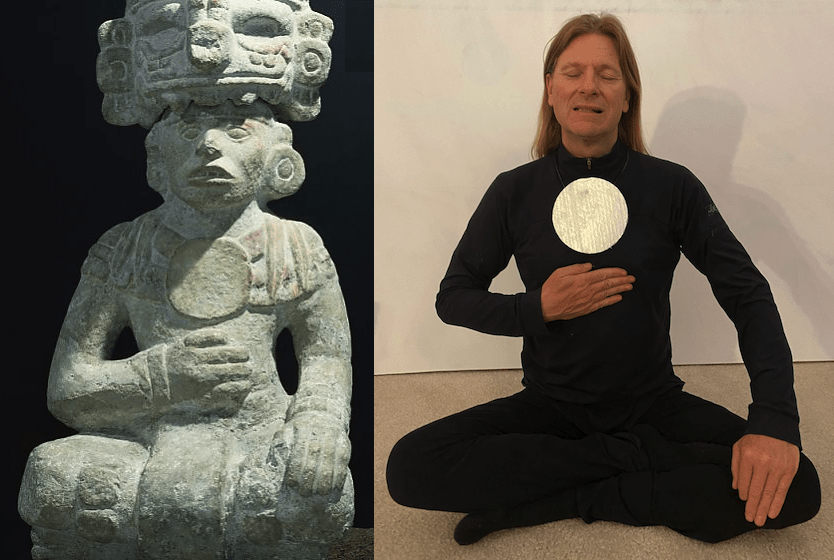
The Cuyamungue Institute was founded in 1978, in Santa Fe New Mexico by Dr. Felicitas Goodman. It is based on work that Dr. Goodman was doing with ritual trance poses as a means to encourage ecstatic states, gain knowledge, and have otherworldly communications and experiences. The poses Dr. Goodman studied are based on early statues and images found in various cultures. She became aware that these poses of ancient sculptures and drawings were often ritual instructions that people could replicate. By holding these positions in a ritualist manner, she found that people had these common or related experiences which she characterized loosely as healing, divination, metamorphosis, and/or spirit journeys. This 2-part blogpost is about her journey and what she discovered. It is based on an interview I did with Laura Lee, who along with her husband Paul, are directors of the Cuyamungue Institute.
I only just learned about the Institute recently. I wrote a blogpost about an experience I had with my spirit group at the Morgan Library Museum in NYC. The exhibit was about the ancient priestess/writer Enheduanna. In the blogpost, I wrote about how we took on the body positions of the exhibit’s statuettes as we stood in front of them. My many thanks to Judith Maeryam who read the blog post and wrote to me about the institute, now in Arizona, that studies this very topic. I sent them the post and we began comparing notes. They felt the posture from the museum was a ritual instruction pose. That means that it is body position had been used by our ancestors to achieve various goals of religion, spiritual or mystical nature. The Institute has a library of over 125 such postures that they work with to continue research and experience with these forms. To my delight, they added “my” posture to their files.
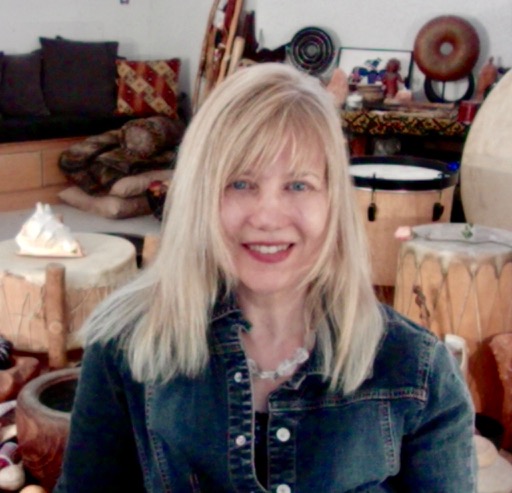
Laura Lee and her husband Paul are continuing the work of Dr. Goodman. I interviewed Laura for this post. She began by pointing me to Dr. Goodman’s fascinating book about her own journey, Where the Spirits Ride the Wind. In it, she describes her pathway to discovering this work. She notes that when she hit puberty, she got a clear message that “the magic time is over.” It felt like a sudden disability for her to not be able to call up the magic times she had experienced as a younger child. She wanted to reclaim these experiences as an adult. The Ecstatic Trance Postures proved to be a doorway, a key to re-discovering this part of herself. Dr. Goodman spoke eight languages and as an anthropologist studied various cultures. These skills gave her a pathway inward to discovering and deeply understanding the work which has become the foundation of the Cuyamungue Institute.
In my interview with Laura I asked her what she was looking for in her own life that brought her to Dr. Goodman’s sphere. “In 1993,” Laura told me, “I was hosting a radio talk show. And I was talking to so many folks about their indigenous traditions. I wondered, where are mine, as part of a European family that came over from Switzerland and England, about 100 years ago? Where are my indigenous roots? I felt it was so important for me to seek out my indigenous ancestors, tracing them back, without stepping on any other cultures’ toes.”
Laura found the answer to her own indigenous quest in Dr. Goodman’s work. She says (Laura’s quotes are edited for clarity, longer quotes are highlighted in blue).
[My husband] Paul and I are not shamans, we’re not anthropologists — we’re storytellers and educators. We come from a media background. We were fascinated by finding this capacity within to be self-empowered. And we realized that this is there for the asking, filling us up at our core. It feels like putting your finger into the socket for bliss, understanding, insight, and self-revelation. This is juicy, delicious, wonderful work. The senses that we encounter, that we have within us, can be flipped on and we can discover vivid, bright colors, the feeling of a flight on the back of a bird, a bird that might even invite you to see through its own eyes. It is possible to experience the expansion, the contraction, the feeling that we’re a tiny point, yet the immense universe, all at once. Oh so many times, the goddess just comes and I have merged with her, feeling, just the most potency of feminine wisdom, grace, understanding, nurturing and being nurtured, being held. I mean, it’s just so glorious . . .I left a wonderful radio career. I had top ratings. I was nationwide, I had millions of listeners. And yet I thought, okay, just as Buckminster Fuller instructed us, ‘find what you and you alone, can do. If somebody else can do what you’re doing, fine. Find your unique role in the world.’ So Paul and I started to interview Goodman, and we started to teach her work. We spent some time with her every year, over the last 10 years of her life, till her passing in 2005. We thought, ‘Wow, this is work that we can’t just set on the shelf.
In our interview, Laura explained to me how natural this practice is and how we use poses in our everyday lives without being completely aware of it. As she notes, “[Certain postures can give us] a sense of empowerment, a sense of ease and comfort.”
In this Laura shared notes from Ann Cuddy author of the book. Presence: Bring Your Boldest Self to Your Biggest Challenges. Cuddy speaks to women in business recommending power poses as a way to stand your ground in a business meeting or as she puts it, to be better prepared for fighting on the battlefield of the boardroom. Cuddy cites four power poses and Laura noticed that these postures are all ones used at the Institute.
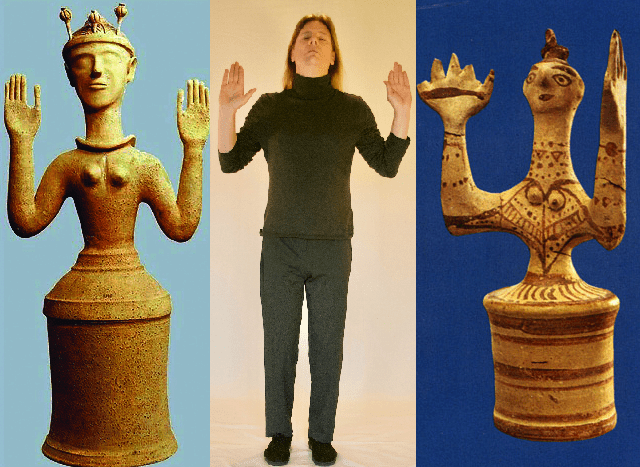
The power poses are about making yourself feel bigger, raising your arms up splaying your fingers, that’s a petroglyph found around the world. There is another one of standing with your arms on your hips or your waist and elbows out to the side. This is called the “wonder woman” pose. It’s also the posture of Yul Brenner in The King and I. My mother did that mostly with a wooden spoon in her hand when I was a kid. This was her powering up pose and she was in good company. We see this all over Europe, Siberia, Africa. Mesoamerica, the Salish coast all over the place. It’s a natural body language.
Tomorrow, more on the Institute, my interview with Laura and a few of my thoughts about why this work fits in so well with what we do here at FAR.
Discover more from Feminism and Religion
Subscribe to get the latest posts sent to your email.

 Feminism and Religion
Interesting Janet – will be looking forward to hearing more – there’s definitely something important about the stance we embody
LikeLiked by 1 person
I agree Sara, I think it’s really important how we inhabit our bodies. It is through our bodies that we experience our Earthwalk.
LikeLiked by 1 person
Yep…
LikeLiked by 1 person