

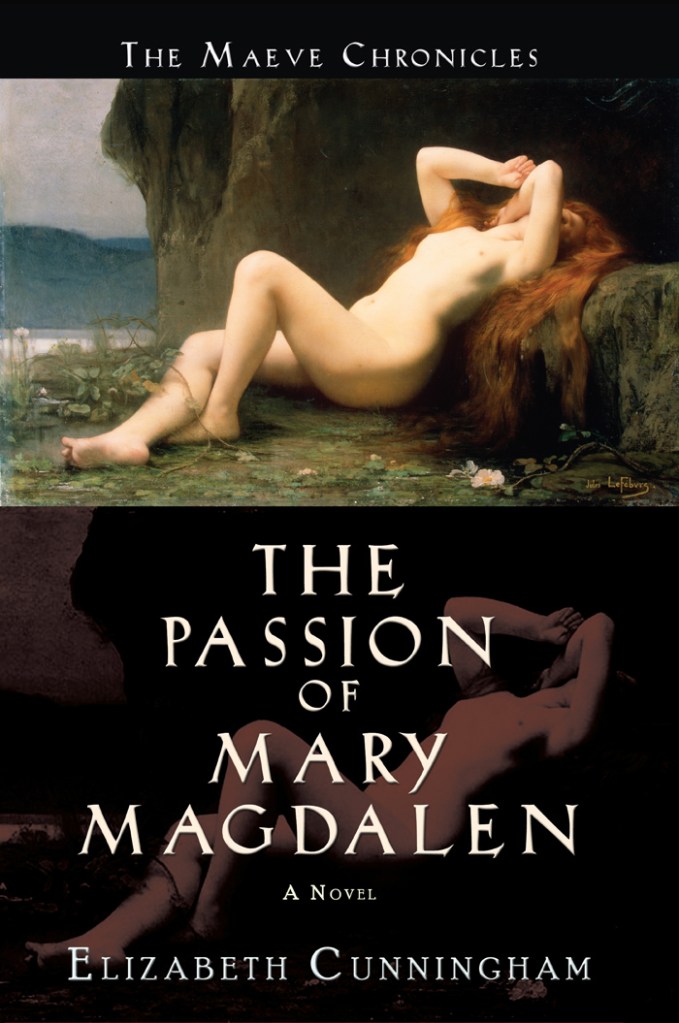
(Author’s note: Mary Magdalen, or Magdalene, comes to people in many ways. To me, she came as an unconventional, fictional character. I worked hard to get the first century setting of her story as accurate as possible. Otherwise, I make no claim to historicity. I respect all the ways in which others know her.)
When I finished writing my novel Return of the Goddess in 1990, I thought I had nothing more to say. Yet, I sensed there was something—someone—missing.
An artist friend suggested I take up drawing or painting for a time—visual art being a form in which I had no experience, skill, and best of all, no ambition. I dabbled in paint and charcoal but soon reverted to magic markers, my childhood medium.
One day a line drawing in brown marker took shape. An ample woman sat naked at a kitchen table having a cup of coffee. The round clock on the wall read a little after three in the afternoon. (The same time of day I was born.) She told me her name was Madge.
(Later I reflected on that name, the sound a syllable in key words: magic, imagination. No wonder magic markers brought her to life.)
Her next portraits took on color. She used up many peach markers for her abundant flesh. She chose neon orange for her hair. She had green eyes. She soon needed speech balloons.
In one early drawing she lolls in the bathtub, over her head the caption:
“Madge listens to Christian radio on the theory that amoral indignation keeps you spry.”
Balloon from the radio: “We are all members of the body of Christ. Some of us are hands, some of us are feet, some of us are…”
“Kneecaps,” thinks Madge.
She goes on to wonder about other members of Christ’s body, the twelve-year-molars, the colon….
I might think I had nothing more to say, but Madge was just getting started. She sprawled naked in a red velvet chair and pontificated about the meaning of life while eating chocolates. She was an unsold, unsung painter who invented the whole-body-no-holds-barred school of art. Since painting did not pay very well, she supported herself as a prostitute.
I was enchanted with Madge. Surely she would star in my next novel.
“Maybe,” said Madge.
I began to ransack my mind for plots.
“How about,” I said, “you’re a retired prostitute, who moves to the coast of Maine to paint.”
“Honey,” she answered, “I am not ready to be a retired anything. First, I want my own book of cartoons. Then we’ll talk.”
That Christmas a friend gave me a bound book with blank pages. On the first page, along with a peacock feather and some other decorations, I wrote: The Book of Madge, Her Book. In early 1991, as I listened to the Congressional hearings about the First Gulf War and followed the unfolding news, a novel-in-cartoon came into being featuring Madge, the Peace Prostitute, founder of TWAT (Tarts with Attitude Triumph) and WITCH (Women Inclined to Create Havoc). And POWER (Prostitutes Opposing War Everywhere Rise).
Magic marker, in my hands especially, is a crude medium. Yet somehow with a slant of an eyebrow or the jut of a hip, character and humor came through. I also discovered the pleasure of sharing the latest drawing with friends. Unlike a daunting pile of painstakingly-typed manuscript pages, a cartoon can be taken in at a glance. Most people were as charmed by Madge as I was.
“But,” one woman objected, “you can’t make her a prostitute!”
(Not that I made Madge a prostitute. I was never closer to being a channeler than during my brief stint as a cartoonist.)
“Why not?”
Because: prostitutes are products of/enable the patriarchy. They play to male fantasy (now called the male gaze) wear too much makeup and skimpy garments. They sell their bodies (as distinct from their minds?). All things feminists stand against. The goal of feminism should be to end prostitution. And it is undeniable that many women, children, men and people of all genders are victims, trafficked in a brutal, global industry that exploits their poverty, oppression and desperation.
I didn’t know any prostitutes at the time. As soon as Madge mentioned her profession, I began reading books by prostitutes. Many of the sex workers (the preferred term) I encountered in print and later in person define themselves as sex-positive feminists, the other side of a divide that endures to this day. Sex work remains a complex issue, running the gamut from slavery to agency.
For her part, Madge was not in the least apologetic about her day (or night) job. She was not given to apologies—or apologetics.
As the Gulf War went on and the pages filled up, The Book of Madge became a witness for peace. My artist friend encouraged me to submit it to The Center for Book Arts in New York City. It was accepted and displayed in a show called “War and Peace.”
I had more than met Madge’s conditions.
One night I had a conversation with my husband about Mary Magdalen. I don’t remember why or what we said. It was late February 1991. The moon was full, and the temperature unseasonably mild. After dinner I went outside to moon gaze. The air was so balmy, I took my clothes off and lay naked in the moonlight.
All at once, it came to me that the name Madge and Magdalen had many letters in common. With her flaming hair Madge could be…a Celt!
“How about that?” I asked her. “A novel starring you as the Celtic Mary Magdalen? Would you be in that novel?”
“Yes!”
I did not know on that moon-flooded February night that I would spend the next twenty years of my life researching and writing the story of Maeve, the Celtic Magdalen, but I did know:
It would be her story, not just his story through her eyes.
She would be his lover, not his follower.
She might become a prostitute, but she would never, ever be a repentant one. (A distinction the outraged did not understood. “But she was a disciple, a spiritual teacher, his true successor!” And why can’t a sex worker be a spiritual teacher?)
Since the advent of the Goddess in my life, I had been missing the Incarnation, central to Christianity. Now I knew: I had been missing not only him but her, the Goddess Incarnate, a mortal woman whose dusty feet would also blister, who would know suffering and joy, who would undergo her own apotheosis, just like her beloved.
(End note: though I completed The Maeve Chronicles years ago, Mary Magdalen—aka Madge aka Maeve—is always with me—and with us, however we know her.)
Elizabeth Cunningham is best known for The Maeve Chronicles, a series of award-winning novels featuring a Celtic Magdalen. My Life as a Prayer: A Multifaith Memoir, coming November, 2023, is her debut work of nonfiction. Her first novel The Wild Mother was re-released in April 2023 in a 30th anniversary edition. The Return of the Goddess will be re-released in August, 2023. For more about Elizabeth, or to purchase any of her titles, visit her website: https://elizabethcunninghamwrites.com/
Discover more from Feminism and Religion
Subscribe to get the latest posts sent to your email.

 Feminism and Religion
” prostitutes are products of/enable the patriarchy. They play to male fantasy (now called the male gaze) wear too much makeup and skimpy garments. They sell their bodies (as distinct from their minds?)”
Yesterday I went to see the film Oppenheimer bizarrely juxtaposed with pink Barbies… and barbie movies … the unredeemable prostitution posited as female power today.
LikeLike
Thanks for reading, Sara, and for your thoughtful comment. I hope this response gets through. I am having trouble signing in! I still read FAR and am a fan of your writing.
LikeLike
My youngest daughter married on this day in honor of the Celtic Magdalene. When I was told recently that there was a rumor being spread by the Christian patriarchy that I was a member of sex cult, she said, “Mother, at one time, we all were members of that sex cult…Ark of the Covenant and all!”
LikeLike
Aleta, I hope this comment comes through. How I love your daughter’s comment!
LikeLike
Elizabeth has been having some trouble posting herself and so she asked me to share these words with everyone:
Happy Mary Magdalen’s Feast Day. I am unable to sign in to respond to comments. Thank you all so much for reading! All the best, Elizabeth
LikeLike
How wonderful to read about the genesis of The Maeve Chronicles! I was mesmerized by the series and still remember many parts very well.
LikeLike
Thank you, Judith! Maeve loved hanging out with you. Again I am hoping this response goes through!
LikeLike
Your responses do seem to be going through. How irritating that you have to try multiple times. Technology – love it and hate it – LOL!
LikeLike
Trying again. Thank you Judith!
LikeLike
Well, now I’m just going to have to go back and reread all the Maeve novels while I wait for your memoir to be published! I’m so happy to see you back on FAR and to know that your next book will soon be out into the world! I’m fascinated that Madge’s literary life included a book about peace given that the Celts were a warlike people who also had a love of beauty and storytelling, a reverence for truth, a deep connection to the wild world around them, and so many other things that are so essential for bringing about peace. Her evolution from your magic markers to your amazing series of novels shows the power of listening to those voices and intuitions that we so often ignore. You never know who you will find knocking on the doors of our souls! Thank you for sharing this part of her and your lives with us.
LikeLike
Thank you, Carolyn! I am still having trouble commenting. I so want to thank you for your kind words!
LikeLike
The Magdalene was called a prostitute by the first pope. It says nowhere in the Bible that she was. She simply suffered from a hemorrhagic condition. Many women suffer from this at one time or another.
LikeLike
Elizabeth has been unable to comment directly due to WordPress challenges, Susan Perry, here is her response to you: Thank you! Agreed. I know about Pope Gregory who cast Mary Magdalen as a repentant prostitute. I know there are fourteen references to Mary Magdalen in the Gospels and none of them say she was a prostitute. As noted Maeve is a character in a novel. She embodies a different archetype. I was very careful in the novel to include the points you’ve made here.
LikeLike
Thank you all! Judith, forgot to say, Maeve remembers you, too. It takes me about three tries to post. I had to change my password. You can imagine what it might now be…..Love to you all on Maeve’s feast day!
LikeLiked by 1 person
Thank you, everyone. I just tried to approve a comment that doesn’t seem to appear here. Getting ready to do some feasting! Will check back tomorrow!
LikeLike
I love it! Madge is wonderful she is every woman but more so. I look forward to reading the chronicles.
LikeLike
Thank you! That is how I feel about Madge. I hope you enjoy her as Maeve in the Chronicles.
LikeLike
Thank you! That is how I feel about Madge. I hope you will enjoy her as Maeve in the Chronicles.
LikeLike