


Mary Daly and other feminist scholars of her time knew that taking away the power of naming, whether oneself or the world, is one of the primary ways to take a people’s power away, to subjugate them to a world they do not help form or create.[1] Control over their bodies, their sexuality, and their relationships, is another. It has happened throughout history that not all people are allowed the same level of sovereignty over their bodies. Women, children, black people, indigenous and enslaved people, and whoever is deemed a threat to the social, economic, and cultural status quo being advanced (enforced) at a given place and time, have been forcibly and violently legislated against and policed into submission through varying implicit, explicit, informal, and institutionally sanctioned ways.
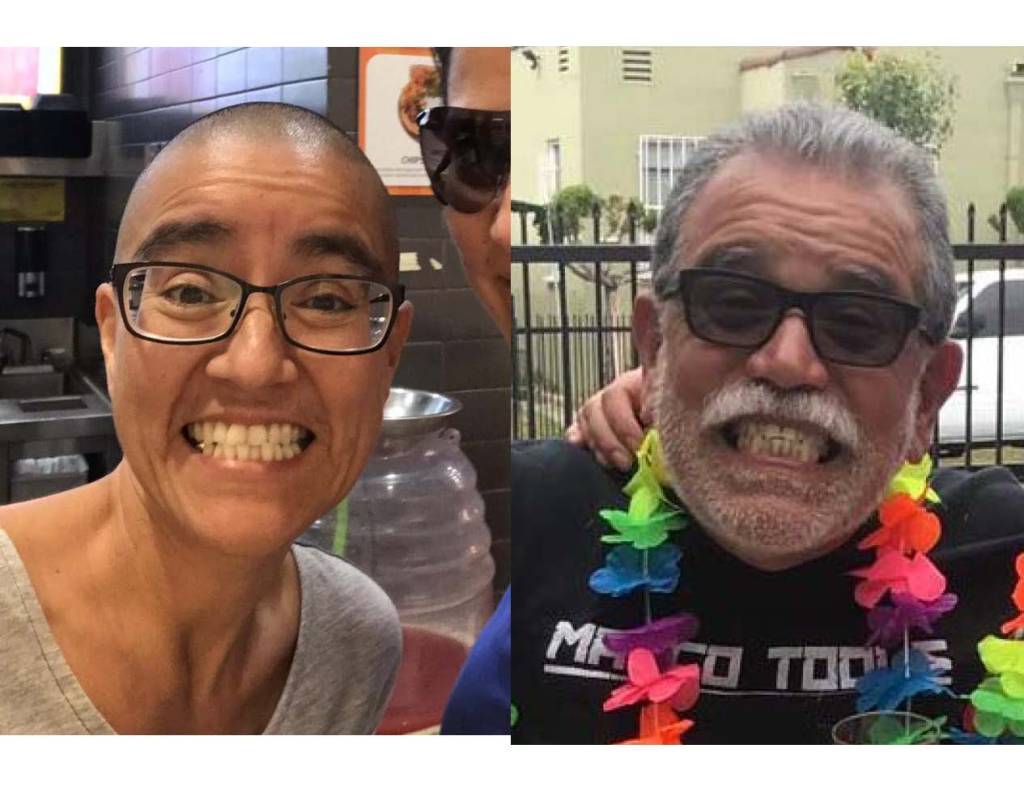
Nonetheless, naming (of the world and of oneself), self-identity, and sovereignty over one’s body—in other words, how people get to live out their humanity, is part of one’s fundamental human right. In my previous post, I wrote about how my dad eschewed labels, how he would sometimes grumble if I referred to myself with a particular identity-label, such as Mexican American or lesbian or feminist, for example, preferring that I name myself in the way he saw as most expansive, “human, just, human.”
For my dad, to say we are, “human, just, human,” was to affirm the fundamental equality/sameness among us all and to guard against the limiting ways people tend to see and box one another. But part of what my dad’s position neglects to attend to is the reality of power relations in and between human identities – the reality of how we are each positioned within structures of power that do not serve us all equally, much less equitably. So, I understand and appreciate his point, but I also appreciate 1) the fact that “human” as a universal category doesn’t account for the real power dynamics of the systems within which we all exist; and 2) we as humans have the need and right to variably name ourselves as a way to communicate, participate in, and contribute to shaping and forming the world we live in from our particular expression of values and commitments—and to get to do so as our full bodily selves.
The world is terribly complex with its many structures of meaning-making, governance, power, and economics, and the related injustices that are embedded therein. As such, who we are and who we get to be as humans is a political question that we must answer for ourselves within this complex web of realities – we do this both socially and communally, but at the same time, no other should get to do that for us; it really is our own personal process. And so, while at a fundamental level we are as my dad would say “human, just human,” knowing and defining ourselves is not as straight-forward as one might think in a world where we are not all equally regarded or respected. As we each struggle to form and actualize our own sense of self in the places, communities, power structures, and relationships within which we exist, language (labels) and bodily sovereignty help us to express and manifest our value-laden existence. And our possibilities are many!
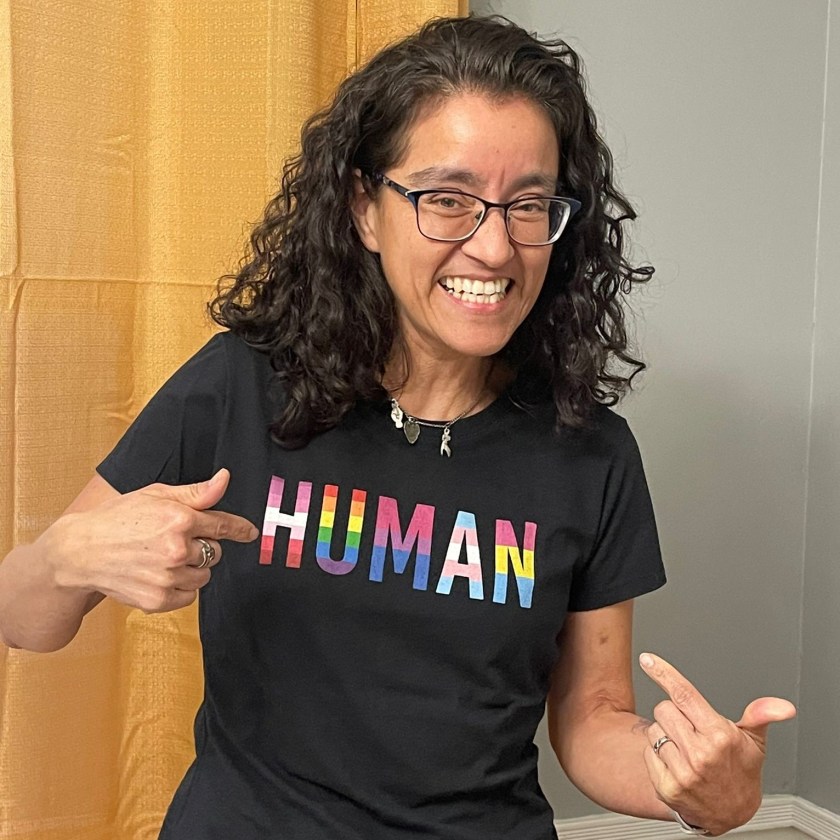
My human t-shirt has the colors of various LGBTQ identity flags and is designed to celebrate LGBTQ folks explicitly because this world is not yet one in which all of our various sexualities and gender expressions are accepted, much less celebrated. Certain categories of human kinfolk among us are marginalized and, worse, targeted. The very nature of our existence is contested—up for ontological debate (ontology: the study of the nature of being and existence). As much as I agree with my dad that we all are “human, just human” and I really do agree with him, part of getting to live into our humanity is getting to define ourselves, for ourselves, and language, our identity labels, helps us do that. So, I would tell my dad, “Yes, I’m just human, but I happen to be a Mexican, feminist, lesbian one.” He didn’t argue too much 😊
Our self-identify and discovery is not a straight-forward and easy path – it wasn’t for me and it hasn’t been for many others. In her stand-up comedy Netflix show, SAP, Mae Martin talks about their identify as a trans person. They are 35 years old and only recently began their transition to their greater and fuller sense of self (*sidebar on this below). They share that they recently had top surgery and began a low dose of testosterone. They are vulnerable in their sharing, explicit in their understanding that this country is in the midst of proposing an inordinate number of laws to restrict their sovereignty and choices over their own body. Restricting sovereignty and choice over their bodies—this is how our country is responding to some people’s journey of self-identification and expression – and it’s a very familiar story to us FAR readers.
My inclination and commitment is always to support every person’s full human dignity and especially their bodily sovereignty because as a woman I know the history of how this has been denied us and continues to be an ongoing struggle. I will do the same for trans folks and fight for their full and equal rights to self- and bodily sovereignty. It is not up for debate, the nuances of our gender and sex/uality – of this important aspect of our humanity – just is. As Mae said in their comedy show, “You just have to take my word for it that I know who I am.” And to be able to know and name oneself in ways that capture our many nuances – especially as a person not given the same rights and dignity as other humans in this power-laden world – is an important form of awareness and resistance to rigid categories that do violence to a person’s humanity and to their full dignified rights.
Human, just human…yes! – even, or especially, when we don’t fully understand another’s journey or know how to explain our own yet either. Let’s err on the side of solidarity. All of us have the right to our process, our self-naming, and our bodily sovereignty.
* Sidebar: I can relate to being a late bloomer as someone who only at the age of 34 came to realize my own sexual identity as lesbian. I wasn’t one of those folks who “always knew” I wasn’t heterosexual – I sincerely did not know. It wasn’t until a friendship with a woman developed into more (she made the first move to kiss me), that I later realized, “Oh, I’m not (sexually) broken (which is what I had assumed about myself), I’m just lesbian!” – and what a relief that was! Seriously, coming from a family with a very healthy relationship to sex and that shared about it openly, I was the odd duck who struggled to understand what in the world people found so enjoyable about sex. But as it turned out, I was just having sex with the wrong sex! Late bloomer, indeed!
[1] A note to acknowledge that Mary Daly was not writing within the context of what I’ll be addressing, and there is a valid history of critique against Daly’s contributions to what eventually developed into a very violent and problematic anti-trans position – I acknowledge that truth. I also think that Daly’s philosophy of liberation is bigger than herself, and I respectfully use her own words against her when needed. I did this with her in person when I worked as her assistant, and I do so here now.
Discover more from Feminism and Religion
Subscribe to get the latest posts sent to your email.


What an excellent essay! Thank you. So important–this ability for us to name ourselves and our own experiences–not have someone do that for us. The patriarchal social system we live in is all too willing to do that. Through your work I was also reminded of the popular phrase, “Black Lives Matter.” Many folks pushed back with “All Lives Matter.” And, of course, that’s true, but insisting that “all lives matter” covers Black lives is a distraction to the injustices that Black people–specifically–have endured within our racist society. I like the specificity of how you describe yourself: “…part of getting to live into our humanity is getting to define ourselves, for ourselves, and language, our identity labels, helps us do that…, Yes, I’m just human, but I happen to be a Mexican, feminist, lesbian one.”
LikeLike
this ability to name ourselves and our experiences – oh yes Esther…
LikeLike
“It is not up for debate, the nuances of our gender and sex/uality – of this important aspect of our humanity – just is.” “Human just human” – such beautiful wise words bringing us all under one roof… as usual Xochitl your attention to the unequal power structure helps us all. Thank you.
LikeLike
“We are human, just human,” and within that statement, I can also agree on each person’s right to define themselves is a basic human right, given that I tend to view individuals as both works of art, and artists painting their paths. Discovering the resonant notes within makes us harmonic in the created world, part of the solution, rather than the problem. How far can we expand being human?
LikeLike
Beautiful essay on the truth of how we are all “human, just human” but we are diverse and certainly must have the right to define ourselves and how we choose to live within our bodies. I really love your sharing of your own coming to understand yourself – “Seriously, coming from a family with a very healthy relationship to sex and that shared about it openly, I was the odd duck who struggled to understand what in the world people found so enjoyable about sex. But as it turned out, I was just having sex with the wrong sex!”
LikeLike