

“[T]he Old European sacred images and symbols were never totally uprooted; these persistent features in human history were too deeply implanted in the psyche. They could have disappeared only with the total extermination of the female population.” Marija Gimbutas, The Language of the Goddess, 318.
August 15 is known to Greek Christians as the date of the Koimisi, “Falling Asleep” or Dormition of the Panagia, She Who Is All Holy. December 25 is a minor holiday in the Orthodox tradition, while Easter and August 15 are major festivals. The mysteries of Easter and August 15 concern the relation of life and death. In Orthodox theology, both Easter and August 15 teach that death is overcome: Jesus dies and is resurrected; Mary falls asleep and is assumed into heaven. These mysteries contain the promise that death is not the final end of human life. Yet this may not be the meaning of the rituals for many of those who participate in them.
In Christus Victor, Gustaf Aulen argued that Eastern (Orthodox) and Western (Catholic and Protestant) traditions understood salvation differently. The Western Church focuses on salvation from sin, while the Eastern Church focuses on transcending death. This contrast is not absolute, as for the Western Church sin is the cause of death and when sin is overcome, immortal life is restored. While Orthodoxy has strong ascetic and monastic traditions, it does not teach ordinary Christians to focus on sexual purity and impurity as Western traditions have done. Nor is there a strong emphasis on transforming collective sin in movements for social justice. Significantly, though Roman Catholics and others consistently refer to the “Virgin Mary,” Orthodox Christians prefer “Panagia,” She Who Is All Holy.
In Greece the ordinary rhythms of life are disrupted at Easter and in August. During lent, many women (and some men) fast, while in August women named Mary and Panagiota–as well as others who wish to honor or petition the Panagia–wear black for two weeks.
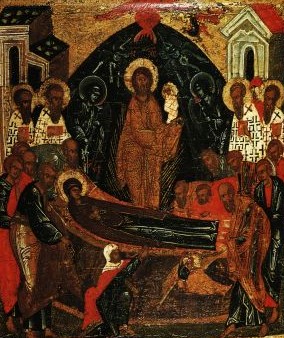
Throughout the first 2 weeks of August, Greek Christians focus on the death of the Panagia. According to theology, her Son appears after her death and “assumes” her into heaven. The Orthodox icon depicts Mary surrounded by the Apostles, while Jesus holds the assumed body of Mary depicted as an infant wrapped in swadling clothes.
When she first saw this icon, my friend Naomi Goldenberg commented that it is an example of the widespread attempt on the part of men to appropriate the power to give birth. The icon reverses the symbolism of the nativity where the baby wrapped in swadling clothes is held in the hands of his mother. Christian baptism described as re-birth through the Father, Son, and Holy Spirit is another version of “male birth.”
In his study of The Death Rituals of Rural Greece, Loring M. Danforth found that few Greeks have a strong belief in immortality. Rather he concluded that “in the world inhabited by Greek villagers, hard white bones are the purest state into which the body can be transformed.” (69) Greek Orthodox funeral customs include the exhumation of the body after 3-5 years, at which point, ideally, only the bones remain. The bones are washed and placed in an ossuary. According to Danforth, touching the bones of the dead makes it clear that there is no resurrection.
If it is true that most Greeks do not hope for eternal life, then why are they fasting and wearing black at Easter and in August?
One answer is that the rituals are situated at the time of the rebirth of nature in spring and at the time of the death of nature in August. Significantly, these are also times when Greeks return to their ancestral villages. On Easter Sunday Greek families eat lamb together out of doors, where the hills and fields are vibrant with spring flowers. In Mediterranean climates, August is the death time, when all life seems to be expiring from the heat. The rituals of Easter and August 15 mark humanity’s participation in the processes of birth, death, and regeneration in nature. In Old Europe these processes were understood to be “the language of the Goddess” whose body is the earth.
There is more. The liturgies of the Easter cycle which include the 40 days of lent culminating in the death and resurrection of Jesus, are called the “Theodrama,” the Divine drama. The 4 Fridays preceeding Good Friday are dedicated to the grieving Mary who must “say goodbye” to her Son. The deep emotion many Greek women express in the Easter rituals prompted me to reflect on Aristotle’s statement in The Poetics that the purpose of the Greek drama, the tragedy, is to “purge pity and fear.” The “Theodrama” evokes deep feelings of loss and disappointment that all human beings inevitably experience.
Psychologists have taught us that the repression of feelings can cause physical and mental illness. In relation to the Easter drama women have the opportunity to identify with and to mourn the losses experienced by Mothers, including but not limited to the loss of a beloved son. Women can also use this time to mourn the loss of their own mothers and fathers, the loss of daughters, the loss of lovers or husbands, and every other loss in their lives. In August it is the Mother heself who is facing death. At this time, women may contemplate their own mortality and the finitude of all living things.
The “Theodrama” of Christianity is said to focus on the male figures of the Father, Son, and Holy Spirit. The priests and religious authorities are men. In this sense Orthodoxy is a patriarchal religion that provides divine sanction for male power and domination in family and society.
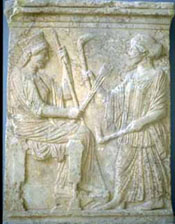
At the same time, the rituals of Easter and August focus on the experiences of women in ways that might not be expected in a patriarchal religion. This suggests that the religion and rites of the Mother have not been forgotten. The role of the grieving Mother Demeter whose rituals were practiced for over 1000 years was “assumed” by Mary. This is the hidden meaning of the rituals of the Assumption. Though they may not ever have heard of the Goddess Demeter, Greek women continue to re-enact the rituals of separation, loss, and reintegration, birth, death, and regeneration that their mothers and grandmothers have practiced from time immemorial.
Discover more from Feminism and Religion
Subscribe to get the latest posts sent to your email.

 Feminism and Religion
As usual Carol gets it – the Rebirth of Nature… the dying away…”At the same time, the rituals of Easter and August focus on the experiences of women in ways that might not be expected in a patriarchal religion. This suggests that the religion and rites of the Mother have not been forgotten. The role of the grieving Mother Demeter whose rituals were practiced for over 1000 years was “assumed” by Mary. This is the hidden meaning of the rituals of the Assumption.” We also the see the universality of these times in all earth based rituals of Indigenous peoples
LikeLike