

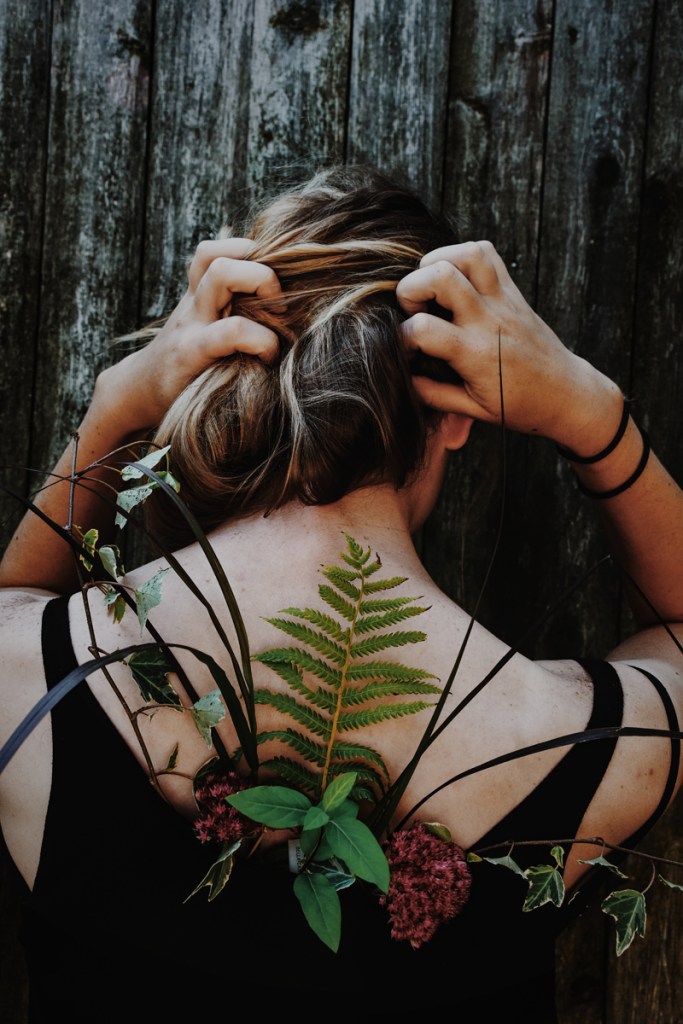
I am my Mothers
My Mothers are me
I am the Goddess
the Goddess is within me
As blood
as bone
as the spirals
of nuclei
as ova
as tears
as breath
I carry my Mothers
as my Daughters will carry me
And the Goddess carries us all
What do I mean by roots, and how does this inform my thealogy? Roots to me means two things – blood and land. By blood I mean ancestral lineage, not limited to but particularly that which comes through my mitochondrial DNA – the Motherline. Recently, meditating on the motif of the Triple Goddess I came to new understandings of and musings about this oft cited model of Goddess. This refrain kept coming to mind; ‘I am Kelle, daughter of Daniela, mother of Atalanta,’ and it occurred to me that the faces of the Triple Goddess also correspond with our female lineage relations and a matrilineal focus. Maiden, Mother, Crone becomes Daughter, Mother, Granddaughter in a visceral and embodied way.Of course, this does not apply to all women, all of the time (we do not all become mothers, or mothers of daughters, neither do all of those with vaginas and wombs and female coded chromosomes identify as such) yet in a very real way we all carry this lineage in the sense of our mitochondrial DNA. We all carry our mothers, grandmothers and beyond, and we all carry the potential for daughters, whether these incarnate physically or not. And we were all once the beginnings of an ovum inside the embryos of our mothers inside our grandmother’s wombs…Here it seems to me that thealogy becomes biology, much as spirit becomes creation.
Our Motherlines are often all too blocked by trauma stretching back over the last five thousand years of a patriarchal dominator society. Recent breakthroughs in epigenetics tell us that trauma is both stored in our bodies and passed down through the generations. We literally carry the wounds of our foremothers.
Yet we also carry their wisdom. And surely if our very cells can in some strange way remember the killings and the gendercides and the long slow torture of millennia of oppression they also remember a time when it was not this way? When we lived in greater harmony with nature and each other? And we can pass that on too to our daughters. Honouring the ancestors and ancestral wisdom, particularly of the Feminine, is therefore important in my spirituality and thealogical view of the world. In my very body I carry not just my connection with Earth, with Goddess, but that of my foremothers and daughters also. This is embodied thealogy.
I also envision roots as literally the land on which we stand – the place we put down roots. For me this means honouring my Celtic ancestors and paying homage to the ways the Goddess was worshipped in these lands. It means finding an affinity with the city I was born and live in; a small, industrial city that seems to offer little in the way of connection to nature or Goddess – except only in the sense that it too is part of the All. Yet a small mount of research uncovered the fact that the Midlands was once home to the Celtic Dobunni tribe – interestingly, the Saxon name for them was Hwicce (pronounced witch-a) and they were later described as the ‘Tribe of the Witches’ – and the area until relatively recently was covered by the Forest of Arden, named for the Gaulish goddess Arduinna. The remains of a holy spring now lie buried in the middle of a car park and our river – once sacred to the goddess Cuda – is now largely covered over. Cuda’s memory may live on in the medieval mythology of Lady Godiva, for this medieval lady on a white horse has often been equated by scholars with horse goddesses, and her name is believed to derive from ‘Goda,’ a Saxon interpretation of Cuda. A Green Man sits in our oldest church. This land, like all land, is sacred land, and a spirituality which recognises this means both my thealogy and spiritual practice intertwine with my sense of belonging both to the land and my ancestors. I actively work with local groups on a campaign to restore our river and wellspring.
Sharon Blackie’s first work ‘If Women Rose Rooted’ explores this sense of place and the roots we put down, and stresses the traditional role of women in being protectors of the land. In a beautiful retelling she discusses the Celtic myth of the ‘Voices of the Wells’ the priestesses that once guarded the sacred springs. When the priestesses were raped – the patriarchal ‘takeover’ – the springs dried up and the land became a Wasteland. As the daughters of these priestesses, it is our role now to restore the wells and the land. I find this a beautiful myth that has much to offer a conceptualising of both the Goddess and the role of her priestesses in a life-honouring, creation-affirming spirituality that recognises this rootedness in the land, and adds a poignancy to local environmental work that aims to restore our own sacred waters.
Of course, roots are complex. Sense of place can all too often, in the wrong hands, become nationalism and result in hostility to those from other places with different ancestral roots. This is where the pantheistic Goddess reminds us that we are all interrelated, all interconnected, often on a very practical level. Few of us, particularly in the West, can lay claim to a singular heritage or piece of land. We are all part of a complex and multi-layered web, and the part of it on which we stand is at once intimately sacred to us and yet indivisible from any other. This is an honoring of roots and land that echoes and seeks to learn from indigenous peoples all over the world. To remember that the Earth does not belong to us, but we belong to the Earth.
Bio: Kelle ban Dea is an interfaith scholar and celebrant living in the UK. She has a DMin in Thealogy/Goddess Studies and is passionate about bringing knowledge of the Goddess back to the world to heal our fractured relationship with it.
Discover more from Feminism and Religion
Subscribe to get the latest posts sent to your email.
 Feminism and Religion
Thank you Kelle, for this beautiful reminder. I truly believe that our roots can be found in sacred places like our bodies, and that our local environs can adopt us.
LikeLike
I certainly feel we are drawn to the places that nourish us. I too would like to see the wells renewed and the return of the Goddess to our lands. I was interested in the rose rooting Kelle talked about because once in a meditation I had an impression of a wild rose tree growing up through my feet. The feminine needs to be brought back into balance for humanity to survive.
LikeLike
I certainly feel we are drawn to the places that nourish us. I too would like to see the wells renewed and the return of the Goddess to our lands. I was interested in the rose rooting Kelle talked about because once in a meditation I had an impression of a wild rose tree growing up through my feet. The feminine needs to be brought back into balance for humanity to survive.
LikeLike
So nice to hear from a Brit on this site. Some of my most powerful energy-filled spiritual experiences happened while I was in your land, visiting sacred wells and stone circles. It helped me to find those sacred places in my own country.
LikeLike
Thank you for your beautiful post. I agree that we need to remember that we are part of the web of life and we’re rooted to the earth and each other and we belong to the earth. .
LikeLike