

As the story was told to me, my parents were listening to composer Claudio Monteverdi’s Lamento d’Arianna when my name was decided. I would be called Arianne, after mythical Ariadne’s melancholy refrain, sung to the heavens after being abandoned on a deserted island by her lover, Theseus. Raised on the Greek myths as bedtime stories, my father regaled me nightly with tales of gods, goddesses, and mortals twirling in the maelstrom of life. I was in awe of Cyclops and Sirens, but it was the myth of Ariadne and the Minotaur that I requested most often.
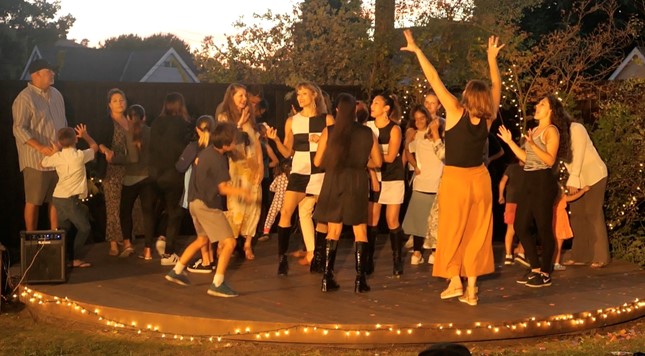
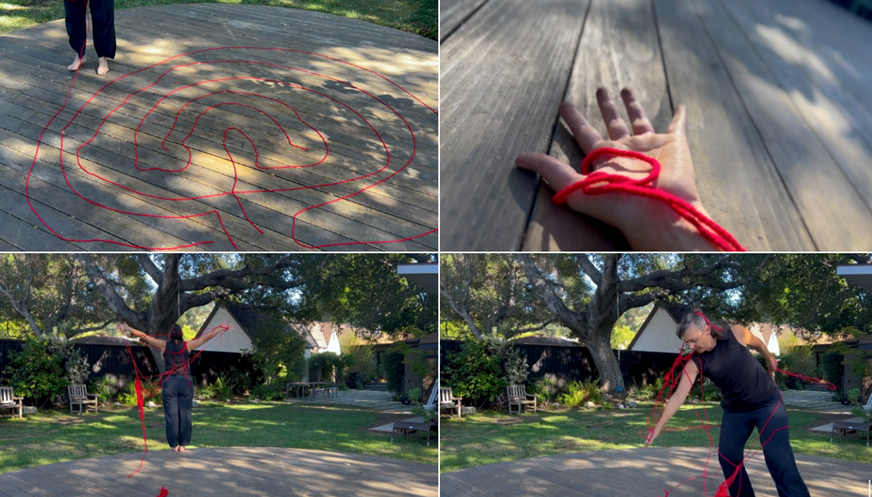
When we bought our house eighteen years ago, the backyard was dirt with a chain link fence around it. I remember standing in this large vacant lot, surveying the space. I said to my husband, “Let’s put a big, raised wood deck over there, in the corner, and let’s make it a circle.” We built it, but when it was finished, we knew it was not a deck, it was a stage. Our daughters were naturally magnetized to this circular platform, which became a dancing place not only for the family, but for our neighbors, friends, and family. For over ten years, we hosted an annual Backyard Big Show on this stage where everyone brought a dish and performance to share. It became a meeting place to laugh, play, and get down. I always choreographed a dance for my women friends, many of whom did not consider themselves dancers, but nevertheless committed to our “Moms Dance.” The moms always brought the house down. Every year, we closed out the evening by playing the song “I’ve Had the Time of my Life” from the movie Dirty Dancing, and the crowd filled the stage with exuberant movement. Our community relied on the stage as a place to gather, grow, and move together. How could I know, that decades later, as I re-traced the mythical mazes of Ariadne’s story, I would find we were connected not only by name but also by dance?
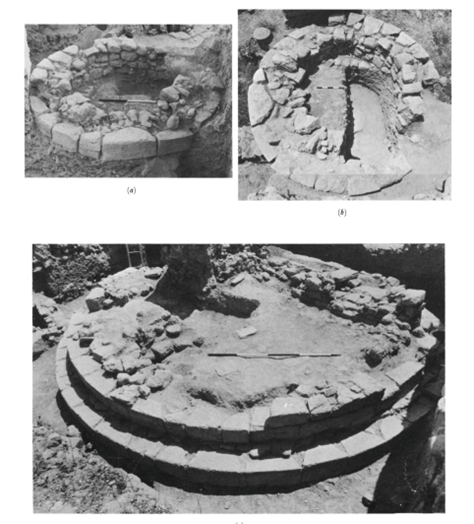
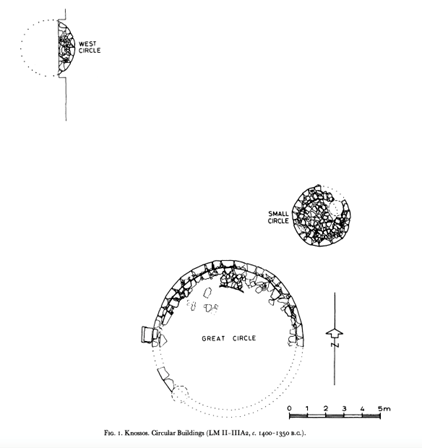
In the early 20th century, archeologist Sir Arthur Evans discovered circular-shaped raised areas at the edges of the city of Knossos on Crete that mimicked some of the circular dances Homer described in his epic poems. Archeologist Peter Warren later interpreted Evans’ discovery of clearly delineated circular platforms as dancing places. Along with the unusually large number of seals depicting women gesturing and dancing that were found in the excavation, Warren also noted that many seals found next to the biggest circular platform showed women in ritual action. He called these three round stages, the dancing place of Ariadne, and based on his significant archeological findings, set forth a convincing vision of the round platforms being places of great importance in Minoan ritual life
Three years ago, I went back to school to study depth psychology. After years of teaching dance and making dances, I knew movement had inherent healing qualities, but I needed the language to understand what was happening within the psyche. In my experience, movement, and its inherent ephemeral quality, activates the “neither here nor thereness” of being. When moving, as soon as a person leaves one position or space, they enter another, never really arriving. I believe it is here, in the dynamic agency of movement, where we can experience our own liminal immanence, or divine self. I know, and have experienced, the agency and awe that Evans and Warren imagined occurring on those ancient Cretan dancing floors—a space where there is movement between symbols, between the self and the divine, the conscious and the unconscious.
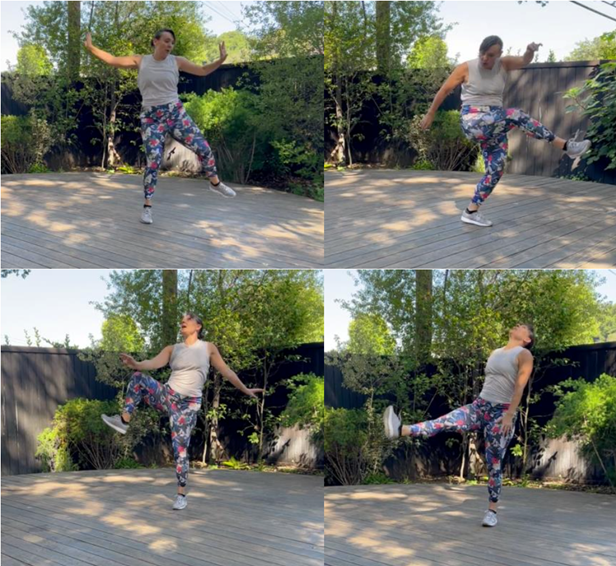
During this time, I became inspired by the work of contemporary choreographer Jeanine Durning, who developed a somatic practice of non-stopping. I found myself on my backyard stage practicing three minutes of non-stop moving, then three minutes of non-stop talking, then five minutes of simultaneous non-stop moving and talking. As this continued, I spent longer amounts of time non-stop moving and talking, allowing my unconscious material to bubble up, surface, and be expressed, full-bodied, loud, and alive. I would record these sessions as part of an exercise in active imagination, what founder of analytic psychology C.G. Jung used to communicate with the unconscious mind.
Both Ovid and Catullus write of Ariadne from the uncommon first-person narrative perspective, allowing much time and space for her full embodiment of emotions and actions. The island of Naxos where Ariadne awakens after being abandoned is like the circular dancing floor, separated from daily life. Ariadne’s free movement atop the contained and isolated island illustrates a blending of the profane and the sacred. She shrieks, exudes guttural sounds, waves, and makes signs, all to be perceived by her abandoning lover. Little does she know that it is the divine God Dionysus that will hear her call. Ovid writes,
Hence (for the winds also were cruelly unkind) I could observe your sails full-stretched by stiff southern gales. I either saw, or, when I thought I saw, remained cold as ice, and half-dead with concern. Nor did grief long permit this indolent respite: I was roused by that sensation; I was roused, and in a loud complaining strain called upon Theseus: “Whither do you fly? Return, perjured wretch, change your course; the ship has not her complement.” Thus I complained: I made up in shrieks what was wanting in articulate sounds, and mingled my words with repeated blows upon my breast. My hands, waved high in the air, made signs, that, if you could not hear, you might at least perceive me.[i]
In Ovid’s description of Ariadne, I found myself. I found the words and movements in my own non-stopping practice, which brought up deeply rooted rage. While Ariadne moved and yelled to be perceived by her lover, she caught the heart of a God. I moved and yelled to be perceived by my true self and discovered my connection to the divine thread of Ariadne. I had unknowingly abandoned parts of myself, parts of my own divine beauty, that I re-discovered as I danced, sang, and cried on my own circular dancing place. In this liminal immanence I was threaded back to Priestess Ariadne’s ancient dances, her circular stages, her myth, my myth. I was lucky to go to Crete on a Goddess Pilgrimage in September 2023 with the Ariadne Institute. I was not able to see the dancing floors in Crete. But I don’t need to. I have my very own. I know what Ariadne did. I do it myself.
[i]. Ovidius, “The Epistles of Ovid,”lines 28–38.

BIO: Arianne MacBean is a writer, educator, and Artistic Director of The Big Show Co. – an LA-based dance-theater group. She recently graduated with an MA in Counseling Psychology from Pacifica Graduate Institute and is currently an Associate Marriage & Family Therapist (License #139718) in Los Angeles, CA employed by Here Counseling and supervised by Connor McClenahan, PsyD.
.
Discover more from Feminism and Religion
Subscribe to get the latest posts sent to your email.


I love this! In numerology, there is a belief that we choose our names, parents are channels to this choice. Your story seems to be an extraordinary example of this.
I did not know about the circular stages. so very interesting! Non-stopping seems like a wonderful way to access the psyche. Years ago (decades now) I participated in InterPlay and that proved to be a much-needed access as well.
Congratulations on your MA from Pacifica!
LikeLiked by 1 person
Thank you, Jan! I love the idea of parents channeling the names we choose for ourselves.
LikeLike
I have been studying Benebel Wen’s Spirit Tarot Deck and Medea has shown up several times.
Your post made me wonder and sure enough there is a DEEP connection between your namesake and Medea.
Medea, Ariadne, and Dido by Myra L. Uhlfelder “The Classical Journal” Vol. 50, No. 7 (Apr., 1955), pp. 310-312 (3 pages) Published By: The Johns Hopkins University Press
This blog post is one I think you might want to read.
And yes, your parents named you well. Don’t know if you believe in reincarnation or not, but I assume you’ve delved into Jungian archetypes. Seems to me you were once THE Ariadne and in this life you’ve found true happiness and are healing the pain through the centuries so many have felt from reading the ancient classics.
LikeLiked by 2 people
WOW. This is awesome. Thank you so much for the connection. I will look into this more deeply. I also found out recently when I did DNA testing that I am 1% Cypriot. Ariadne was called a Cyprian by Plutarch who said she died on Cyprus and was buried in a grove dedicated to Ariadne Aphrodite. The mysterious labyrinthian thread continues to unravel!
LikeLike
I will definitely check out these references, thank you. Funnily, I recently found out that I am 1% Cypriot and some versions of Ariadne’s myth have her buried there in a grove devoted to Ariadne Aphrodite. :)
LikeLike
Dear Arianne, how wonderful to see a fellow pilgrim sharing her deepening experience of her namesake. This is just such a transportive piece of writing and I am grateful that you shared this. I felt lightened and hopeful to read how you actually lived out your process on the dance platform in your community and in your personal psyche.
LikeLiked by 1 person
You inspired me to write, Terry! xoxo
LikeLike
What an amazing story on so many levels! Thank you so much for sharing it with us. I am especially fascinated by the profound effect your circular stage had on your community, having a place where people felt they had permission to dance, truly a liminal space between the worlds. Every village, town, and city needs one (or lots!) of those! Imagine the possible change in our world if everyone had access to a space where they could dance, along or with others, in the way you do, whether through non-stop movement and action, or just joyful unchoreographed ecstasy.
LikeLiked by 2 people
all the years at University I taught in the round until the last year for that very reason – relationships thrive in that environment – the last year computers were stuck between me and my students and the classes were rectangular – yuk – time to leave . I did.
LikeLike
I so agree, Carolyn. I often say we could find world peace if we were just to dance together.
LikeLike
What a wonderful piece of writing and story about your journey with your namesake, Ariadne! I too was recently in Knossos but didn’t see the circular stages you have written about. I also loved your quote about Ariadne’s self-expression on Naxos drawing Dionysus to her, all so powerful and thankfully with a happy ending. I will try some of this no-stop dancing and talking myself some time. Also hope to see some of your Big Show productions.
LikeLike
Thanks Sally! You can see some of my past works at http://www.thebigshowco.com. :)
LikeLike
You’re right, Sally, the circular platforms are not on public view. They are located behind the Villa Ariadne which was Sir Arthur Evans’ original home, and currently the site of the Knossos Research Centre of the British School of Athens.
LikeLiked by 1 person
Thank you, Laura. I hope to get back to Knossos again, possibly with one of your groups.
l
LikeLike
You’d be welcome anytime on the Goddess Pilgrimage! I’m working now on gaining access to the circular dance platforms for our Ariadne groups…
LikeLiked by 1 person
I have also been a student of depth psychology and a psychotherapist. My own work has always been with dreams and I am surprised and delighted to read of your body and movement work. I can see exactly how your description of moving from one position to another creates a liminal state where the unconscious can speak.
LikeLiked by 1 person
Congratualtions, Arianne, on writing such a beautiful and personal piece! I am so glad the information and images I gave you from Peter Warren’s article ‘Circular Platforms at Minoan Knossos’ could be useful to you! I only archaeologists and historians were dancers themselves, these amazing finds would be much better known and understood. As you know, I believe that the Central Court in all the main sacred centres (Knossos, Phaistos, Malia, Zakros, Gournia, etc., wrongly called ‘palaces’) of Bronze Age Crete were gathering places for communal dance, and that the ‘labyrinth’ of Crete was originally a dance. Like you in your backyard, where your circular stage is a literal platform both for solo explorarion and community celebration, the artwork of the ancient Cretans reveal the importance of both individual and collective dance. I believe ritual dance was the main way that the healthy, woman-centred, earth-reverent, Goddess-worshipping, nonviolent culture of Bronze Age Crete kept its values alive – creating the peaceful world through dancing together which you talk about. It existed! And we can bring it into being again. Blessed be.
LikeLike
Yes, thank you, Laura for the wonderful info and images of the ancient circular dancing places. They helped coalesce my thinking about the experience of movement on circular spaces. xo
LikeLike
Love this, Arianne❤️. Also makes me think — throw your hands in the air like you don’t care!
LikeLike