

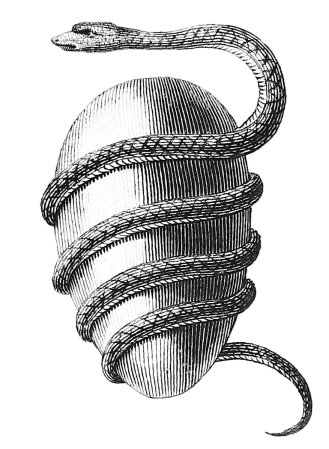
The Greek Eurynome, one of the most ancient Goddesses who emerged before patriarchal times, rose from chaos and began to dance, separating “light from darkness and sea from sky”1 whirling to create a great wind. She faced it, grabbed it and “rolled it into clay like a serpent”2 . She made love with the serpent, “transformed herself into a dove” and “laid the universal egg from which creation hatched”3 Eurynome was a goddess who embraced and created change, bringing the universe into being in the process.
She would have been at home in a 21st century physics lab where scientists are learning that the nature of reality is constant change. According to physicist Carlo Rovelli, “The entire evolution of science would suggest that the best grammar for thinking about the world is that of change, not of permanence. Not of being, but of becoming”4. He further explains, atoms “move freely in space, colliding with one another; they hook onto and push and pull one another. Similar atoms attract one another and join. This is the weave of the world. This is reality. Everything else is nothing but a by-product—random and accidental—of this movement”5. Even our human bodies, which we tend to think of as a single object changing very slowly over the years, are really a maelstrom of molecules, ever-transforming and renewing.

This perspective of reality as not only vastly changeable, but in a constant state of becoming, reflects not only Eurynome, but also other Goddesses.. The Apache and Navajo Changing Woman6, the Celtic Cailleach7, the Slavic Ved’ma8 and other goddesses who constantly revolve from old women to young women and back again express change as ongoing and cyclical, much like the spiral that is symbolic of goddess spirituality in Old Europe and elsewhere. The Welsh Cerridwen, who turned herself into a hare, a greyhound, otter, hawk, and hen in pursuit of a boy who stole wisdom9, is only one of many shape-shifters who express our ability to act effectively when we are able to leave behind rigid views of our identity. The Japanese Yamanokami is “a shape-shifting mountain goddess who can appear as any kind of animal or dragon…In human form, she is often a friendly young woman. But she can also become an old woman”10.
And so we learn both from 21st century physics and from ancient stories of Goddesses that change is the way of the universe, the very essence of who we are. Yet, among the greatest obstacles to making progress towards a peaceful, equitable, just, environmentally sustainable world is resistance to, even terror of, change. In our western society, we equate change with uncertainty, with the possibility that what will be might be even worse than what we currently have. We are afraid that to change is to lose, whether we are wealthy or just making ends meet and afraid that we will lose the little that we have. And so, it is difficult to present visions that can motivate large numbers of people to try new ways of being.
What can we learn from the ubiquitousness of change in nature and also in ancient Goddess myths and societies about how to effect positive transformations of ourselves and our society? First, we need to look at our own perspective. Are we afraid of change, even when we see it is needed? Are we so committed to a vision of ourselves as we are that we hinder our own progress, placing obstacles in our path towards who we can be if we let ourselves unfold? What if we realize that that person who we think ourselves to be does not exist except at this moment, that tomorrow we may wake up to find our bodies have become ill or maybe we will have a brilliant insight that will completely transfigure our lives for the better. What if we teach ourselves to become resilient and flexible, knowing that we are strong enough to get through the next day, whatever it holds?
Next, what can we learn about how to change the world? If we are in a constant state of change, so is the world. We will never be able to fully understand every factor or force, but we can be aware that millions of interactions create and maintain our society every moment. Then, instead of seeing our task as moving the proverbial mountain and wondering if it is possible or being discouraged that it seems to remain the same, perhaps we can realize that if enough people give little pushes in the right direction, perhaps we can propel the world towards kindness, compassion, and responsibility for the well being of all. Perhaps any action, small or large, puts a spin on the tides of change in the right direction. This also means that none of us has an excuse to not be aware of what needs to change and doing what we can to make it happen. Everyone can be a co-creator of a changed universe because we already are, with everything we think, say, and do.
Sources:
Monaghan, Patricia. Encyclopedia of Goddesses and Heroines. Novato, CA: New World Library, 2014.
Monaghan, Patricia. New Book of Goddesses and Heroines. St. Paul, MN: Llewellyn Publications, 1989.
Monaghan, Patricia. Red-Haired Girl from the Bog. Novato, CA: New World Library, 2003.
Rovelli, Carlo. The Order of Time. New York NY: Riverhead Books, 2018.
Rovelli, Carlo. Reality Is Not What It Seems. New York, NY: Riverhead Books, 2017.
- Monaghan, New Book of Goddesses and Heroines, 119. ↩︎
- Monaghan, New Book of Goddesses and Heroines, 119. ↩︎
- Monaghan, New Book of Goddesses and Heroines, 119. ↩︎
- Rovelli, The Order of Time, 97. ↩︎
- Rovelli, Reality Is Not What It Seems, 20-21. ↩︎
- Monaghan, New Book of Goddesses and Heroines, 84. ↩︎
- Monaghan, Red-Haired Girl from the Bog, 41-42. ↩︎
- Monaghan, Encyclopedia of Goddesses and Heroines, 308. ↩︎
- Monaghan, New Book of Goddesses and Heroines, 82-83. ↩︎
- Monaghan, Encyclopedia of Goddesses and Heroines, 146. ↩︎
Discover more from Feminism and Religion
Subscribe to get the latest posts sent to your email.

 Feminism and Religion
I love reading our Blog the first thing in the morning, Carolyn. And this morning, as the light as yet lays sleeping, I journeyed HERe and read your words and are awe-FULL. Such Wisdom. Such clarity. Such a rich a deep and profound reminder, “Everyone can be a co-creator of a changed universe because we already are, with everything we think, say, and do.” Your words HERe, “…BECAUSE WE ALREADY ARE…” jolted my HEaRt with sheer gratitude. Brava! And many thanks for putting your pen to the page/fingers to the keyboard.
Sawbonna,
Margot/Raven Speaks.
LikeLiked by 1 person
Thank you, Margot! I so appreciate your kind words. Yes, I also love to read FAR first thing in the morning when I can. It is always a great start to the day to hear what others have to say and to gain some insights on so many different topics!
LikeLiked by 2 people
You are so very welcome, Carolyn!
LikeLiked by 1 person
Beautiful informative post Carolyn -I love the reference to the snake – the life force and the dove – not the insipid white dove but the dove that births humanity and all life… Doves that are except for metaphor generally despised and shot as a game bird in most states – What’s the message there?
As for witnessing changes I don’t need any goddess to tell me what I am witnessing before my eyes – the destruction of the earth all around me – of course this has been happening all over the world – India for example – for decades but now it[s happening to Americans – floods rot our timbers, pull soil and sand into the sea pollute our air on a regular basis, draught steal our water, we burn billions of trees and slaughter billions more – January thaw in Maine lasts all winter long, less than 1 percent of old growth forest in all of New England should give us pause, but it doesn’t. The catastrophic loss of birds and and non humans species should be making front page news EVERY SINGLE DAY but isn’t…. we are like zombies ignoring every sense we were born with.
LikeLiked by 1 person
Thank you, Sara. One of the reasons I decided to write the post was that I do think that fear of change, the profound resistance to questioning our perspectives and the desire for everything to always be the same, is one reason people ignore the environmental catastrophe we all see all around us every day. People don’t want to see is that the Earth is changing much faster than before and that we can do what we can to make the world whole again, whatever those actions may be for each person, or we can close our eyes and let the destruction continue.
LikeLiked by 1 person
Yes, I couldn’t agree more but I question the catastrophes that are now reaching New England (for example) and impacting folks we know – and still silence???
LikeLiked by 1 person
There is so much I love about this post Carolyn. The piece I am thinking about first is right at the beginning: The Greek Eurynome, one of the most ancient Goddesses who emerged before patriarchal times, rose from chaos and began to dance, separating “light from darkness and sea from sky”
I did not know this story. I love the aspect of the dance creating the separation. In the bible when separation occurs it is worded in such a way that it feels like there is not more communication creating “walls of separation” and thereby forestalling the possibilities of change. But with the dance creating the separation that creates life (and can still be found in eastern religions) it creates an intermingling and interpenetration of aspects that communicate, respond, and allow space for continued movement. Just beautiful.
LikeLiked by 3 people
Thank you for this insight! I hadn’t known that about the separation in the bible, but I see exactly what you mean. So many goddesses have dance as part of their creation and sometimes destruction (thinking especially of Kali here) and that does change the dynamic totally. I’m also thinking of how important dancing is to so many ancient traditions, especially those that revere Goddess. Maybe we are all dancing positive change into being when we do our dancing in a sacred way!
LikeLike
This is a profound post. I am struck by the image that “atoms move freely in space, colliding with one another; they hook onto and push and pull one another. Similar atoms attract one another and join.” This reminds me of a folk dance, where bodies move towards one another, separate, link and the move together. If we could only dance this dance in our hearts and minds, be more accepting, more honest, perhaps change would just be a part of the human dance.
LikeLiked by 1 person
A beautiful comment about folk dance — I do see how the atoms and folk dances have the same kind of energy! “If we could only dance this dance in our hearts and minds, be more accepting, more honest, perhaps change would just be a part of the human dance.” I love this very profound statement! Thank you!
LikeLike
Carolyn, I appreciate you drawing on our beloved Monaghan for this piece. I teach that the reason why people struggle with change is because it is essentially a grief process. All change is grief in that you must let go of one way of being in order to embrace another. I think this is why change is difficult for so many. I think that the collective has been traumatized by grief. We struggle.
LikeLiked by 1 person
Thank you, Terry! Yes, Patricia’s work, especially in her New Book and Encyclopedia of Goddesses and Heroines, is so important to being able to see common themes as well as the delightful diversity among Goddesses and Goddess stories across time and cultures. I use her books just about daily! I love your insight about the connection between resistance to change and grief. That makes so much sense. I can see it in our own times, when we, as a species, are grieving so many things – loss of life in the pandemic and wars, the destruction of our beautiful Earth, the difficulty is creating the kind of world we want even though we can visualize it in our minds and hearts — and yet there is so much resistance to changing the world to address our grief and prevent more grief. Thank you for this comment!
LikeLike
good point – change always involves grief
LikeLiked by 1 person
Very well said. This is, in fact, the reason I write. Everything affects everything. There are no closed systems. Our journey of becoming is fractal, not linear. Thank you for these insights.
LikeLiked by 1 person
Thank you, Camilla! That’s a wonderful statement about our journey of becoming is fractal – I hadn’t thought of fractal! I’ll have to think about that more!
LikeLiked by 1 person