

A few weeks ago I was on Crete, having coffee with an archaeologist friend. She happened to mention something strange. Crete has always been a seismic zone, with lots of earthquakes, yet remarkably, in Minoan times, no one was killed in collapsing buildings; they were never taken by surprise.
We pondered this – it seems astounding. They must have had some means of warning. Perhaps the serpents sacred to them could have given them some sign?
After all, snakes can sense many subtle seismic changes that precede an earthquake, including increases in positive ions, infrared radiation, subterranean vibrations, underground temperatures, and shifts in the earth’s magnetic field. In response, they become restless, with erratic haphazard movements knocking against walls and rocks in their quest to get away. Vicki Noble, for example, tells how her boa constrictor, Bacchus, showed ‘ceaseless agitation’ before the 7.1 San Francisco earthquake in 1989 [Shakti Woman, pp. 65-66].
How might this have worked on Crete?
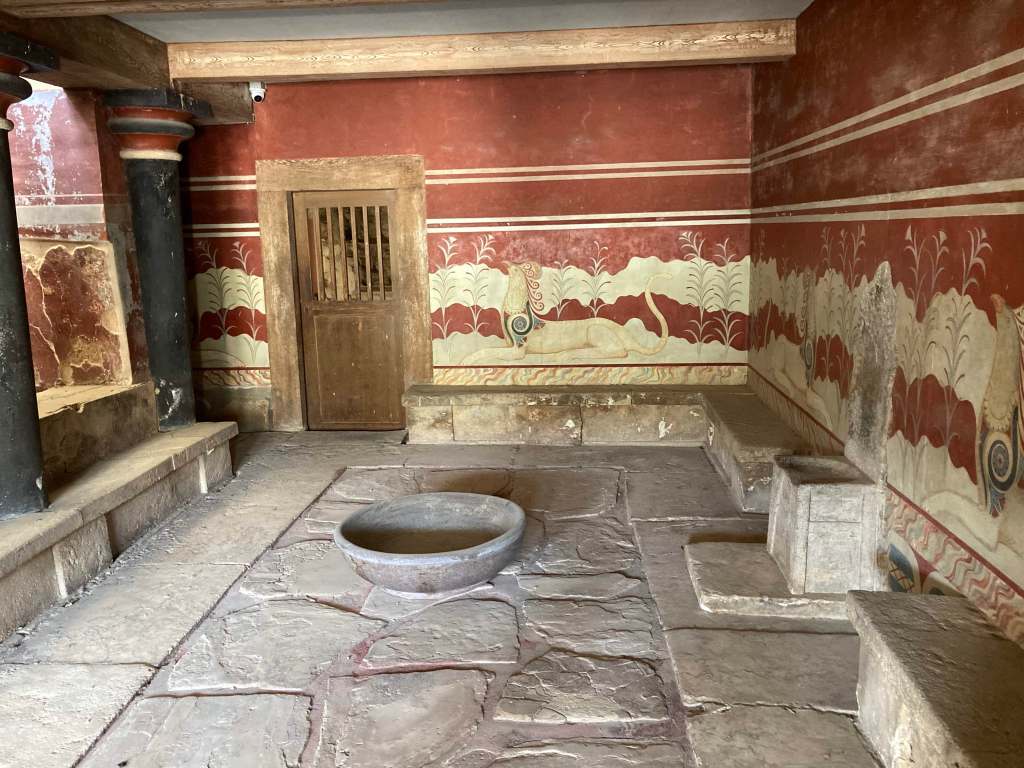
The following day, I went to Knossos. Out of season, the place was empty, so I could linger undisturbed in places usually dense with crowds. In the silence of the Throne Room, standing by the ‘lustral basin’, I had a sudden flash of insight, seeing how snakes might have given warnings, how priestesses might have received them, and might have passed the message on.
First, a bit of context. Many readers will be familiar with the advanced Minoan culture of Bronze Age Crete (3000-1100 BCE). Evidence suggests it was a peaceful egalitarian matriarchal society (see ‘What If We Begin from the Hypothesis that Ancient Crete Was Matriarchal, Matrifocal, and Matrilineal?‘ by Carol P. Christ and Matriarchy in Bronze Age Crete: A Perspective from Archaeomythology and Modern Matriarchal Studies by Joan Cichon) – the last flowering of the pre-patriarchal Old European civilizations articulated by Marija Gimbutas (The Living Goddesses) and Riane Eisler (The Chalice and the Blade)
Settlements had no fortifications. There is no sign of slavery or war. Resources were shared. Grave finds show that everyone had enough to eat. Their art does not glorify violence; it celebrates nature, women, ritual and dance. Artistic expression was highly valued, in elaborate frescoes, clothes and jewelry. Women are shown in positions of power. Goddesses were honoured, and so were snakes.

Many Goddess figures are shown with serpents, or integrate their physical attributes, as in this Neolithic Goddess figure from Ierapetra explicated in detail by Carol Christ. Serpents symbolized transformation, through shedding their skin; regeneration, because they lay eggs; and the underworld, because they burrow underground. Snakes also served the household, hunting rodents drawn to stores of grain. I believe they also provided earthquake warnings.
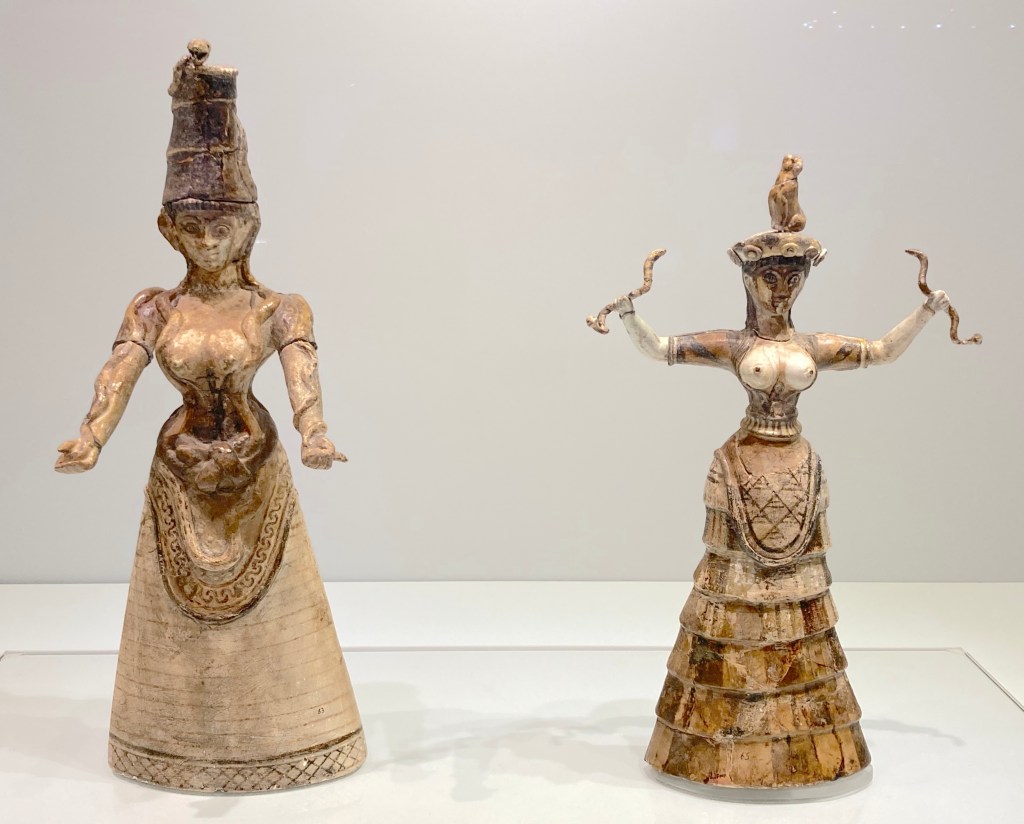
The Snake Priestesses or Snake Goddesses are among the best-known artworks of Bronze Age Crete. These superb faience figurines were found with other exquisite treasures in the Temple Repositories of Knossos, deep, stone-lined, lidded storage spaces, a few metres from the Throne Room and the central shrine.
Neither one was found intact; the figures now in the Heraklion Museum were ‘reconstituted’ by Sir Arthur Evans – the British archaeologist who excavated Knossos in the early 20th century – and his team. Although many of his reconstructions have sparked controversy, still, the original ‘Snake Priestess’ finds clearly show two separate figures of bare-breasted women holding snakes: one has her arms lowered, with serpents entwined around her arms and waist, and the other has her arms raised, with a serpent writhing in either hand.
Let’s go back to the ‘lustral basins’. These are uncovered, sunken spaces (named by Evans, who thought they were bathtubs), with steps leading down, but with no drain. All the villas and sacred centres had one or more, with several at Knossos, including one right by the ‘throne room’, flanked with benches, which I find important. Their walls were often finely painted, with themes linked to the underworld and renewal of nature. Though scholars agree that they were sacred, perhaps for anointing or initiation, their purpose still remains a mystery.
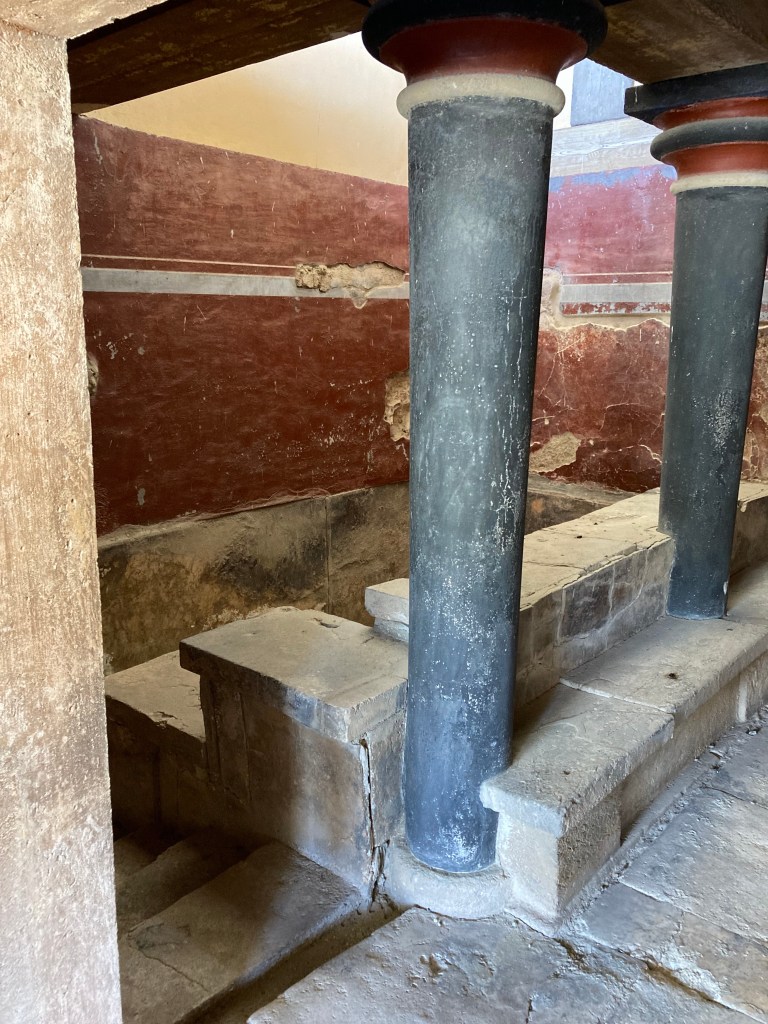
Now I think they were homes for snakes, tended by priestesses who came to know them, and would notice any change in mood. I imagine the basins lined with earth and rocks, so the snakes could comfortably live and burrow, hibernate and shed their skins, kept in by the high steep sides, easily witnessed from above. The ritual vessels and offering tables often found in the lustral basins may have held their food and drink. I imagine that every day, priestesses picked up their snakes, to discern any change in mood.
Relaxed and happy snakes are calm. Moving slowly, they wrap around the person they know, whose touch they trust. This is the state I see depicted in the taller priestess figure, whose hands are low, snakes wrapped tightly around her arms and around her waist.

Agitated snakes are different. If they sense an earthquake coming, they move and strive to get away, to leave their dens and escape from people, even those they know and like. In this state, snakes might well try to climb the walls of the lustral basin, a clear sign shown to those nearby. And in the hand, an upset snake would writhe and wriggle, it would not cling calmly. This is what I see in the other priestess.

All those benches around the basin would have made an ideal place to gather, so people could observe the snakes. Maybe a priestess brought the snakes out every morning, to show their mood? I imagine her standing with hands held low if the snakes were calm, and hands held high if they showed disturbance. Either stance would give a signal, for everyone to be informed. I think she wouldn’t hold them long; I think she’d return them to their basin. So perhaps the daily ‘serpent news’ might be announced with a little statue, at the door of the council chamber, by the main stairs and central court. The statue with her hands held low, shows snakes content, no need to fear. The statue with her hands held high, snakes twisting and writhing, would be a warning of an earthquake coming soon – in which case people could leave the buildings, and gather in the open spaces of the central court and other plazas, perhaps with awnings up for shade, until the earthquake passed and the snakes relaxed, showing the danger had truly passed.
Did it happen like this? It might explain why major dwellings had lustral basins, and how earthquakes did not surprise the people. It would also give another reason for Cretans to tend and worship snakes, and to revere the serpent Goddess, in her many faces, names and forms.
Discover more from Feminism and Religion
Subscribe to get the latest posts sent to your email.

 Feminism and Religion
That’s an interesting angle. I have quite a different view about the the Snake Goddesses, here in my article “The Artifice of Daidalos: Modern Minoica as Religious Focus in Contemporary Paganism.”
https://www.academia.edu/37973812/Tully_C_J_2017_The_Artifice_of_Daidalos_Modern_Minoica_as_Religious_Focus_in_Contemporary_Paganism_International_Journal_for_the_Study_of_New_Religions_8_2_183_212
LikeLike
Thank you for leaving your comment, Caroline Tully, and the link to your 2017 paper ‘The Artifice of Daidalos’, which FAR readers may well find interesting to read.
You have not actually commented on the theme of my post, namely the possibility of snakes as earthquake predictors, but since you have offered FAR readers the link to your own article I will take the opportunity to respond.
Actually, our thoughts on the Snake Goddesses are not that far apart. It’s true that the figures Evans called Snake Goddess and Snake Priestess were found in pieces and were ‘reconstituted’ by his team; still, the original finds clearly show two separate figures of bare-breasted women holding snakes in two separate arm positions. I’m aware of Bonney’s 2011 contention that the smaller of the two figures is holding a rope rather than a snake, because of the way the lengthwise stripes spiral around the snakelike object; however, she overlooks the fact that snakes twist, especially when agitated – precisely my point about the smaller figurine. Of the 4 types of snake found on Crete (all essentially nonvenomous, as Paula points out), the cat snake (Telescopus fallax) and leopard snake (Elaphe situla) have markings which might be represented visually as horizontal spots or stripes; the whip snake (Coluber gemonensis) and dice snake (Natrix tessellate) lack distinct markings, however, the curve of the snake’s body often creates elongated scale alignments along its length which would certainly visibly spiral along with the snake. In any case, the Minoan artists who painted fantastic creatures like the griffins, not to mention the blue monkey, might not have been too hung up on depicting snakes with perfect realism.
I agree that we can’t know with certainty whether the figurines represent priestesses or goddesses, as Evans believed, but I also think that doesn’t matter much, since what the figurines do indisputably represent is a model of close communication between the human world and the animal world, in a relationship of mutual respect. People are right to find this inspiring and significant in the present day.
Beyond these instances of overlap where the figurines are concerned, though, our ideas and interpretations diverge considerably.
As a matter of principle I welcome discussion and debate from different perspectives, however I find your article problematic in that you seem to paint an artificially distorted picture of Goddess spirituality and Carol Christ’s own perspectives on Crete. Carol’s actual ideas are easily available on this website, e.g. ‘What If We Begin from the Hypothesis that Ancient Crete Was Matriarchal, Matrifocal, and Matrilineal?’ and ‘The Mountain Mother: Reading the Language of the Goddess in the Symbols of Ancient Crete‘, among many posts touching on Crete.
I note with concern your failure in your paper to correctly define key terms such as matriarchy (which is not a mirror image of patriarchy, as Goettner-Abendroth, Christ, Sanday and others have pointed out), and your many inaccurate claims and assumptions (e.g. that ‘members of the Goddess Movement’ share a belief in a dual divinity, ‘a Mother Goddess and her Dying and Rising Consort/Son’; that egalitarian matriarchal culture would need to have been indicated by frequent depictions of ‘human motherhood’ in Minoan iconography; or that there were ‘only two examples of these figurines’ depicting women with snakes or their physical attributes – your own Figure 4 shows one more arm fragment with an evident snake; the Neolithic Ierapetra Goddess is another example; the poppy-goddess type votive figure with snakes from Gortyna is also well known; and there are others.) A number of the authors you cite, e.g. Goodison, Eller, Hutton, make similar errors in their own scholarship targeting feminist-spirituality or Goddess-theology interpretations of Cretan culture.
Your characterisation of Minoans as ‘disappointingly warlike’ is far-fetched anyway (given that the few ceremonial weapons found at Malia and elsewhere were largely unsuited to warfare), but, more crucially, misses the point that the rich art and iconography of the Minoan culture do not depict or glorify violence or war. That is indeed a huge divergence from other cultures contemporary with or immediately susbsequent to the Minoan era, and people of today are right to find that inspiring and interesting also.
Particularly disingenuous is your reference to ‘human sacrifice’, repeating the sensationalist claims made in 1991 by Sakellarakis and Sakellarakis, based on dangerously flawed methodology. A far more logical and likely analysis of the evidence from Anemospilia may be found in ‘Caring for the Dead in Minoan Crete’ by Sylvie Müller Celka.
There are literally dozens of further points I’d like to address, but I will leave it here, with a heartfelt recommendation of Joan Cichon’s excellent book Matriarchy in Bronze Age Crete: A Perspective from Archaeomythology and Modern Matriarchal Studies, which presents the evidence for Bronze Age Crete as an egalitarian matriarchal society (with a thorough definition of terms).
Perhaps other readers would like to take a look at your article and add their own commentary? It’s ‘The Artifice of Daidalos: Modern Minoica as Religious Focus in Contemporary Paganism‘.
Wishing you all the best with your research, L.
LikeLike
Excellent – most excellent critique Laura. THANK YOU. I did read the article and could add my own perspective but it pretty much mirrors yours… how I wish Carol was still around to respond to this additional article.
LikeLike
Your response is right on target, Laura, and I especially appreciate your pointing us to the article by Sylvie Müller Celka, ‘Caring for the Dead in Minoan Crete.’ I’ve been following the claims of human sacrifice in Crete, always accompanied by a quick “That disposes of any notion of a peaceful matriarchal society, then,” but keeping an open mind about looking at the actual evidence. Celka’s hypothesis that the presumed “human sacrifices” were actually preparation for secondary burial makes total sense, especially as she points to the binding of the lower jaw, a known funerary procedure in many cultures.
I also agree with you about the ceremonial weapons (which are in any case far, far less prominent than weaponry in Mycenaean art, and never accompanied by battle scenes). The fact that Knossos and the other cities were unfortified speaks volumes. The sea protected Cretans for a long time, until the IE-dominated Helladic cultures began raiding, conquering and colonizing from ships.
The caricature of Goddess feminism in Frazerian terms of Mother Goddess and Dying God is way off. Graves did influence many women with the Maiden Mother Crone meme, but this is not universally accepted. I’ve been challenging it for decades, and will add that I was one of the first, back in 1973, to insist that matriarchy is an entirely different paradigm, and not the reverse of patriarchy. But I did so in the oral tradition, which goes unheeded by academics who are not actually grounded in the Women’s Spirituality movement. Certainly not by the likes of Ronald Hutton, who is not above distorting our positions with reductionist characterizations.
Even in academia I see the tide turning, with more openness to considering the uniqueness of Crete (and parts of the Aegean) in the late bronze age. Along with this, scholars are listening as Indigenous elders and scholars affirm matricultural traditions, falsifying the claim of universal transhistorical patriarchy that has been common coin in historical discussons for so long. I addressed this in my own critique of Cynthia Eller (“Knocking Down Straw Dolls,” 2000). https://www.suppressedhistories.net/articles/strawdolls.html Her use of ridicule (and her open admission that she feared it were she to advocate a matriarchy hypothesis) discredits her.
Finally, your point about defining terms is important for having a real discussion about these issues. Broadbrush generalizations get in the way of that. I’ve had to intervene against such generalizations in less-informed sectors of the Goddess community, such as overhyping a Gravesian view of the threefold goddess (as age-marked, there are certainly loads of triads globally, the vast majority of which don’t fit his framework), or challenging spurious etymologies such as those put forward by Barbara Walker (Kali = Cailleach, and many other examples). Still, Carol Christ, Joan Cichon and others, not least Laura herself, who have worked on this issue cannot be accused of being uninformed.
My own take on the snake-wielders is that they belong to a broad global pattern of ecstatic women’s religion that takes in Canaan, various parts of ancient Iran, Dahomey, Nigeria, Britain, Scandinavia, Guatemala, Panama, Ecuador, and Midé birch scriptures of the Anishinaabe. Oh, and in the Chen Jinggu iconography in China. I documented this archaeology in my 2013 video Woman Shaman: the Ancients. https://veleda.net/product/woman-shaman-the-ancients-dvd/
Max Dashu, Suppressed Histories Archives
LikeLike
Thanks, Max, for your articulate and thoughtful response. I am so glad to know that you were ‘one of the first, back in 1973, to insist that matriarchy is an entirely different paradigm, and not the reverse of patriarchy’. Astounding that 50 years later this still needs to be said!
Thanks also for the link to your excellent paper, ‘Knocking Down Straw Dolls: a critique of The Myth of Matriarchal Prehistory by Cynthia Eller’. I recommend that everyone read this, along with Joan Marler’s equally valuable work: ‘The Myth of Universal Patriarchy: A Critical Response to Cynthia Eller’s Myth of Matriarchal Prehistory‘, published in Prehistoric Archaeology and Anthropological Theory and Education, Reports of Prehistoric Research Projects 6-7 (2005): 77-85. L. Nikolova, J. Fritz, and j. Higgins, eds. Salt Lake City & Karlovo: International Institute of Anthropology, also published in Feminist Theology 14, 2 (2006): 163-187. London: SAGE Publications. I don’t have an online link to Joan’s paper, but I hope people can find it and read it too.
Of course, you are right, the ‘snake-wielders…belong to a broad global pattern of ecstatic women’s religion’ – you are uniquely placed to understand global patterns in women’s art. I don’t have a problem with the idea of snake/woman figurines representing ecstatic dance/trance/oracular states, and I think one possible interpretation doesn’t preclude others. Gimbutas and others make the very important point about Goddess symbols being polyvalent. Carol Christ addressed this in her post The Mountain Mother: Reading the Language of the Goddess in the Symbols of Ancient Crete‘: ‘The idea that symbols have more than one meaning can be difficult for scholars trained in rational analysis to comprehend. Several years ago, I sent the blog I wrote about The Turtle Goddess of Myrtos to a colleague. When I saw him a few months later, I asked what he thought of my interpretation. He responded: “I did receive the link but I deleted it because the image is a Goddess, not a turtle.” For him, apparently, it could not be both a turtle and a Goddess. I wonder if scholars of classics and archaeology dismiss the work of Marija Gimbutas in Language of the Goddess in part because they do not grasp the concept of the multiplicity of meanings encoded in symbols. When she deciphered “the language of the Goddess,” Marija Gimbutas did not find one meaning per artifact; rather she found many meanings in each of the images she studied.’
I’m not particularly attached to my hypothesis about the serpent priestess postures (‘hands down = calm snakes = no earthquake’ vs. ‘hands up = agitated snakes = earthquake coming’). I do think I am right that Minoans kept snakes as earthquake predictors, and that this was an essential task considered sacred. I also think it’s very likely that the lustral basins served the purpose of holding snakes. However, there are all kinds of ways people might have transmitted the ‘serpent news’, not necessarily via Goddess figures: blowing loud horns, raising flags, or perhaps placing enormous standing labryses where they could be easily seen.
Another possible support for the serpent priestess posture part of my theory comes from the Egyptian wooden statuette of a woman holding metal snakes, from a tomb at Thebes dating to Dynasty XIII (1786-1633 BCE), which I am sure you know. This figure holds metal snakes in each hand, and the arms are moveable: they could be lowered to the position of the larger Knossos figure or raised to hold the snakes up in the position of the smaller Knossos figure.(see http://arthistoryresources.net/snakegoddess/snakesegypt.html)
LikeLike
Thank you for this wonderful hypothesis. I’ve wondered what a “lustral basin” is. I’m imagining that certain priestesses were charged with bringing the snakes out of the building when earthquakes were threatening.
It’s almost an obsession with me, trying to imagine what life was like in that time of our past. I would love to have some moments in Knossos during a quiet time, to feel the spirits that have gone before.
LikeLike
Yes, Annelinde, I am sure you are right, people would have removed the precious snakes from the buildings if earthquakes were expected – I wonder whether some of the ritual pots with holes all over may have served this purpose. Some of them are tall cylinders – hard to imagine how they might have served as ‘strainers’.
I can definitely recommend making the effort to visit these sacred sites out of season or in inclement weather, and/or very early or very late in the day. I hope you make it to Knossos and the other sites sometime!
LikeLike
We may never know how the “lustral basin” feature was used by the residents of the five known sacred centers (misnamed as palaces) and the smaller so-called villas. Laura has imagined one possibility which connects the known skills of snakes to respond to seismic activity to the Snake Goddess (or Priestess) figurines. Each figurine is a vivid representation of women interacting with snakes in a personal manner which gives us, thousands of years later, insight into a strong connection between women and the snakes of Crete (which has no poisonous snakes).
Perhaps the snakes roamed the premises at will, perhaps they adopted certain women as confidants–many possibilities exist. I appreciate the picture of snakes serving as a central part of an “early warning system” sending everyone to the central plazas to be together to stay safe during earthquakes.
LikeLiked by 1 person
Thank you, Paula, you are right that we will probably never know for certain, either about the lustral basins or about the snakes, so it’s good to keep our minds open and continue to speculate about all possibilities. And you are right, my speculation about the snakes in lustral basins does come from my imagination, yet it is based on the facts, e.g. ‘the known skills of snakes to respond to seismic activity’ and the otherwise inexplicable absence of people killed by surprise inside collapsing buildings. I also like your image of the snakes roaming the palace at will and/or ‘perhaps adopt[ing] certain women as confidants’. It may have been all of the above – with snakes in lustral basins or other contained space being the ones people could reliably observe for the purposes of earthquake forewarning.
LikeLiked by 1 person
Laura, I always enjoy your writing and your thoughts. This was no exception, especially since what Jung called your ‘active imagination’ was on fire! An imagination fed with factual details, intuitions, and synthesis. That snakes became so maligned in some faith traditions is a reflection, in part, to the incredible power they held and the importance they served in women’s spirituality. That they also served a practical purpose only adds to their power.
LikeLike
Yes, you are right, Terry, it is exactly that combination of practical and metaphorical/symbolic value which we see in women’s spirituality, insofar as we can discernhow it might have been in the ancient past. Living in Greece has shown me that Greeks today and in antiquity were/are immensely practical people. It makes sense that the ‘power’ of a symbol, a being, a role, or an idea would draw on the value it has in both realms. Thanks for your comment.
LikeLiked by 2 people
This hypothesis makes a lot of sense to me! I have always wondered why the interaction between the priestesses and the snakes were so different in the two statues and this is a great explanation. And what a fascinating commentary on the losses of our time when our connection to non-humans has been so severed that these priestesses may have had a relationship with snakes that warned them about earthquakes before they happened, something that, as I understand it, is still not possible with our technology millennia later that only sends out signals once an earthquake has started.
LikeLike
There is some new technology which appears to have some predictive capacity – e.g. seismic precursory ionospheric anomalies in lithospheric and ionospheric processes, also electrical phenomena (‘earthquake lights’) sometimes activated by stress in certain types of rocks (basalts and gabbros). So who knows what will be possible in the future? For now I think it would be simpler to get a snake.
LikeLike
I have no doubt that you are correct – ALL animals can sense seismic and other weather changes before humans can, and snakes who were associated with the priestesses might have been kept for a multitude of reasons including their ability to sense earthquakes. Snakes are very friendly to those who like them and my guess is that these priestesses may have had very complex relationships with their snakes!
LikeLike
Yes, absolutely! Cats and dogs are known to possess a degree of earthquake-predictive skill also. Vicki Noble’s account in Shakti Woman, of her boa ‘Bacchus’ giving warning of the Loma Prieta quake – standing straight up for almost his entire 3-foot length, with his ear pressed to the wall as if ‘listening’! So, I don’t know if the lustral basins necessarily played a part, but I think snakes as earthquake oracles is a pretty good guess.
LikeLiked by 1 person
thanks so much Laura for this insightful exploration of the Snake Priestesses and Crete. It has stimulated such an interesting discussion as well. I love feminist research like this!
LikeLike
Great to hear from you here, Vicki. Do you still have snakes, and do they still give warning of imminent seismic activity? xx
LikeLike
No, no more snakes for me. I gave my beautiful snake to a belly dancer when my school closed in 1991; she danced with Bacchus and another boa constrictor for years. (Bacchus was given to me when I had the school and helpers to aid in his care; he grew up with all of us.)
You know, in China until fairly recently the government used snakes as seismic warning systems and when they had earthquakes, they weren’t so devastating to the population. Now when they have earthquakes, they cause a lot of damage and loss of life. I don’t know why they stopped. Christianity?
LikeLike
So interesting! I saw this 2006 article, https://www.independent.co.uk/news/world/asia/headbanging-chinese-snakes-can-predict-earthquakes-days-in-advance-say-scientists-430093.html , saying
“Nanning is one of 12 Chinese cities monitored by hi-tech equipment. It also has 143 animal monitoring units. “By installing cameras over the snake nests, we have improved our ability to forecast earthquakes. The system could be extended to other parts of the country to make our earthquake forecasts more precise,” said Mr Jiang.
It’s not just snakes – dogs and chickens also behave abnormally when an earthquake is about to happen.”
But I did not realise China had stopped this monitoring! You are right, this will cost lives. Ah, how much we all need to rekindle these values of co-creating with nature and other living beings…
LikeLike
I think this is a phenomenal theory. I never thought about this. But is definitely worth looking into.
LikeLike
Thanks! Yes, I like my hypothesis because it neatly ties up several separate mysteries: what was the purpose of the lustral basins? Why did the very special and rare faience figurines show two different positions of both priestess and snakes? And how did the entire Minoan civilisation manage to avoid anyone ever being crushed in a building which collapsed in an earthquake? It offers a practical explanation for the large court or plaza areas in all the temple complexes too – not just for ceremony and ritual gatherings, but as assembly spots in case of imminent earthquake.
LikeLiked by 1 person
I have read your post several times. I am absolutely blown by it. I have also been reading what other users have said, and looked at some of the links and I think you are def. on to something. It actually makes a lot of sense, and it ties religion into every day life, not some mystical thing detached from reality as most modern historians seem to view it. Truly phenomenal work!
LikeLike
Thanks for your feedback. I did spend more than 30 years (with many visits to Crete and lots of reading) reflecting on these questions before this idea emerged in my mind. I completely agree with your point about ‘religion’ being part of everyday life. I believe that the people of Bronze Age and Neolithic Crete did not create a separation between sacred and secular in the way that we have come to take for granted.
LikeLiked by 1 person
I think that is an interesting idea considering how prevalent they were. Sometimes pools were used to mirror the stars to make it easier to observe. Not sure if that was possible with those pools.
LikeLike
I agree, observation of the night sky would have been very important to all civilisations in antiquity. The problem with the so-called ‘lustral basins’ is that they were lined with slabs of gypsum, a mineral which degrades or even dissolves through exposure to water, which is why Evans’ initial theory that these were bathtubs did not hold water (sorry, couldn’t resist).
Also, the lustral basins have no drains, impractical for bathing and cleaning, especially when you consider the incredibly advanced plumbing systems the Minoans developed. In Evans’ reconstruction of the throne room complex at Knossos, the lustral basin remains in the spot where it was found, but I don’t know if it’s certain that there was originally a light well above it – Evans took a lot of liberties in his reconstructions. That would be a good research question.
The flat roofs of the Knossos and other temple complex buildings would have been good places for astronomical observation – I wonder if there were waterproof basins or pools up there??
Those who constructed these temple complexes chose their sites according to sacred landscape features (as per Scully) and also according to rising constellations in the landscape at certain times of year (as per archaeoastronomers such as Boutsikas).
LikeLike
I was surprised to read your article as I had the same thought a while back, having read that snakes are used, or have been used in China for their predictive abilities. I am more inclined to imagine them wandering the temple complex, as they did much later at the Aesclepion, to help heal those sleeping on the floor. I will be returning to Crete in March. Are you on Crete? Is it totally inappropriate to offer a coffee? I will be in Heraklion taking day trips to various Bronze Age sites…or for any reader to meet and explore together?
LikeLike
Well, one doesn’t preclude the other – the idea of snakes-as-healers, as in the later Asclepieia, makes sense to me, and most likely there were also snakes wandering in the storage areas of houses and temple complexes to keep the rodents down. However, if one response of snakes sensing imminent seismic activity is to *hide*, there is the chance that the people might miss the message of the wandering snakes. Hence my hypothesis of the lustral basins as places to keep snakes where they would be easy to observe, with ample bench space beside so there could always be watchers. I imagine the importance of earthquake prevention in sacred centres like Knossos (built 3 and 4 stories high) would be paramount – so it would make sense to have the snake basin and benches adjacent to the throne room, central court, and main stairs at the very heart of the temple complex.
So sorry I will not be on Crete in March – I’d have enjoyed meeting you over coffee! Hope you have a wonderful trip anyway.
LikeLike
Laura, and Max,
I would like to add to the excellent critiques you have written regarding Caroline Tully’s article.
First, I want to emphasize that in my analysis of Bronze Age Crete, I do not “rely on out-dated archaeological and scholarly data as well as blasé interpretation of iconography and later Greek myth.” (Tully, 200).
Thank you for pointing out that it is a falsehood to suggest that within the Women’s Spirituality Movement, it is believed that the Bronze Age Cretans worshiped a rising and dying god. In my experience, such a claim is unsupportable. On the contrary, in my experience, the understanding of the Cretan Goddess is that she was the central deity and had various aspects and forms—not only that of the Snake Goddess. In my work, I have argued that a Mother Goddess was the central deity worshipped in Bronze Age Crete (in my reading of current archaeological scholarship, I have found that most Aegean archaeologists agree that a Female Divine was the central deity worshipped—the iconography overwhelmingly supports this), and that god iconography is late and much rarer.
Dr. Tully makes the same mistake as many archaeologists in thinking that one must find iconography of nursing mothers or mothers with children to determine that a Mother Goddess was worshipped. Part of the problem is their failure to define terms. In my work, I define the Cretan Mother Goddess as a Goddess of Life-Giving, Death-Wielding, and Rebirth, at one with Nature and all the cosmos. This definition is based on Gimbutas’s scholarship as well as the scholarship of Anatolian archaeologist Lynn Roller. I contend in my book that the iconography, the archaeology, and the artifacts of Bronze Age Crete support this understanding of the Cretan Mother Goddess from the Neolithic to the Post-Palatial Period.
As for the subject of the role of women in Bronze Age Crete, the author while stating that “Minoan iconography does suggest that some female figures appear to be important and possibly of higher status than some male figures” (192) goes on to dismiss the immense importance of this statement. Tully also notes, no ruler iconography has been identified in Bronze Age Crete. Indeed, a panel of distinguished Aegean archaeologists at the 1992 Archaeological Institute of American conference made that observation, and they went on to affirm that only important women appear in the iconography. If rulers are impossible to identify, and if there are only important women in the iconography, I believe this (along with other evidence that I detail in my book) points to a society in which women were central, a matriarchal society such as that defined by modern matriarchal studies. The Bronze Age Cretans need not have had a queen. I believe it likely they governed themselves by consensus with a council of important women leading the way.
Joan Cichon
LikeLike
Love all of this conversation and important factual information. Honoring of the power of the snake as an earthquake alert in ancient Minoan society reminds me that the sound of bulls hooves hitting the ground when they run is similar to the sound of an earthquake. When we were in Crete for the Goddess Pilgrimage last year, I remember talking about this being perhaps another reason bulls were revered. In any case, it is clear that the natural world and its delicate balance of life-giving and life-taking was experienced by the ancient people in all that was around them – the animals, the environment, and each other.
LikeLike
This is a wonderful article Laura! So insightful! Were the snakes also used for hallucinations? I have heard of this in other cultures, although sounds very dangerous. :)
LikeLiked by 1 person