

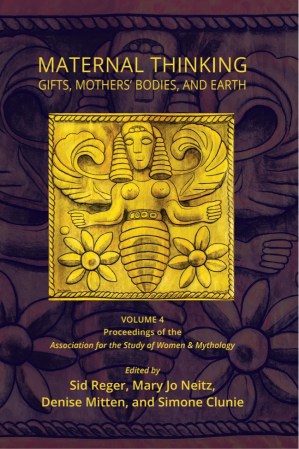
Maternal Thinking: Gifts, Mothers’ Bodies, and Earth, the fourth book of proceedings of conferences held by the Association for the Study of Women and Mythology (ASWM), is an instructional guide to saving ourselves and our planet. Many pre-historic, and even contemporary cultures, especially Indigenous communities, feature “Maternal Thinking.” Such cultures perceive that societies are successful when they center qualities associated with mothering: care, nurturance, cooperation, and meeting everyone’s basic needs while respecting the Earth and reciprocating nature’s generosity. Some 5000 years ago, Maternal Thinking was superseded in many societies by a perspective valuing instead competition, exploitation, and domination, and we and our planet are now facing the catastrophic consequences.
The fifteen contributors and four editors represent myriad disciplines and life experiences. They are academic researchers in wide-ranging fields, artists, activists, a storyteller, a therapist, scientists, educators, and more. This diversity reflects the expansiveness of the book’s vision, including many layers and facets of “mothering,” and the need for as many voices as possible to be heeded if we are to envision and birth a peaceful, just, equitable, compassionate, and environmentally balanced Earth.
The editors lay the foundations of how we begin to rebuild a Maternal Thinking worldview with Lynne Thomas’s artwork “Land Is Our Home,” presenting a landscape from an Indigenous perspective and revealing the importance of Traditional Ecological Knowledge (TEK). Genevieve Vaughan then grounds our exploration by explaining how the Gift Economy, a system based on the mother-child relationship in which everyone freely gives and receives, ensures that everyone has enough for basic needs while avoiding material inequality.
As we begin to settle into our Maternal Thinking perspective, founding FAR contributor Carol Christ initiates our next task of re-examining old stories to see what new insights they offer. Her essay takes a fresh look at the religion of Minoan Crete, finding that at its heart is “the Goddess or Mother Earth” (54) symbolizing “the cycles of birth, death, and regeneration” (49) and that “the power to nurture children and plants was understood to be a reflection of the life-giving power of Mother Earth (53)”. Lisa Lubar further demonstrates that Bronze Age Greek goddesses linked healing with snakes and water, with their influence continuing into our own times, offering an understanding of promoting health that is both ancient and fresh.
Hannah Irish helps us take a new look at the Biblical story of Queen Michal, who was often portrayed as a passive victim of David. Irish’s analysis shows instead her agency within the patriarchal society, including the possibility that she bore children which is unclear from the Bible. Finally, Dilsa Deniz introduces us to Shaymaran, an androgenous snake goddess central to Kurdish culture from 5000 years ago to the present day. The persistence of Shaymaran presents “not only as resistance against the new(er) masculine/monotheistic form of religion, but definitely, if only partially, an insistence on the Kurdish ancient-time form of religion” (114).
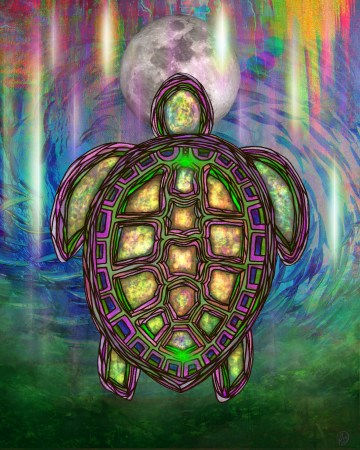
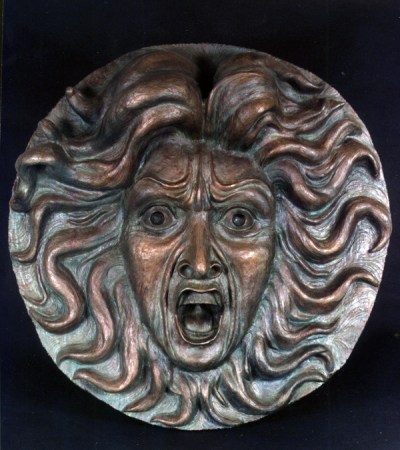
In the next section, “Myth and Grief: Rewriting the Stories, Healing Our Wounds,” we move from excavating new messages in old stories to finding meaning in them for the healing we must do as individuals and as a global community if we are to transform our society. Lushanya Echeverria describes the trauma of being excluded from Indigenous rituals when first her mother, then she, came out as two-spirited. Hearing and heeding the creation stories she heard from her mother in the womb, she offers her own story of Grandmother Turtle bringing a piece of soil from under water on which to rebuild the Earth. Jaffa Frank expresses her experience of living with endometriosis and how, by re-examining the myths of Athena and Medusa and engaging her body, creative imagination and mind with them, she “transforms the experience of hardship without destroying the truth of suffering” (133).
Angelina Avedano directly addresses the suffering of grieving mothers by pondering the stories of Inanna, Demeter, Anticlea, and Mary. These offered her a way through the trauma of witnessing her son’s mental illness and the means to “facilitate change in the world through research, study, application, and most importantly, embodiment and compassionate engagement” (148). Finally, Karen Nelson Villanueva shares with us “The Mother of the Buddhas,” who “is envisioned in Tibetan Buddhism as love and compassion through her mythology, a debtor to be repaid, the embodiment of wisdom, the mother of all the Buddhas and Bodhisattvas, and, through emptiness, as the mother of us all” (165).
In the last section, “Contemporary Engagement: Critique and Reclamation,” we get a glimpse of how we can begin the work of both assessing the shortfalls of our present and co-creating a future based on Maternal Thinking. Ceardai Demelza, an Australian artist, offers the painting “The Goddess Dandelion: First of the Weed Women,” connecting the devaluation of both women and weeds while still finding hope for the future. Miriam Irene Tazi-Preve deconstructs “Patriarchal Motherhood,” critiquing the lack of support for mothers in Euro-American societies but then providing a vision of matriarchal motherhood where children are cared for by many supportive, responsible adults in a matrilineal, subsistence economy.
In a compelling description of successfully bringing Maternal Thinking to San Juan Baptista, California, Jennifer Colby shares her experience leading Indigenous, Latina, African American, and Anglo women in creating temporary mandalas together in ceremony. Each mandala representing one of the four seasons, they reminded people of the continuous presence of the Amah Mutsun Indigenous people and “the people of the corn.”
In the words of Dr. Vandana Shiva in her Afterword, “The essays in this volume … are a gift by the contributors to the world to create another future” (119), citing, in particular the importance of a “circular economy” based on gift giving and receiving. “Mothering shows us the way home to oikos, to Gaia, to Mother Earth ” (226).
Maternal Thinking is a courageous volume written and edited by a sisterhood of women who dare to look at our world and not only see the possibility of a future very different from our present but do the hard work of laying its foundation and beginning its construction. Their strength is that they each boldly speak the truth of their own experience and discoveries, but ultimately harmonize into one voice leading us from our current catastrophic challenges to a world we would wish to live in and gift to our children, grandchildren, and future generations. This volume is only the beginning.
Reger, Sid, Mary Jo Neitz, Denise Mitten, and Simone Clunie. .Maternal Thinking: Gifts, Mothers’ Bodies, and Earth. Brooklyn, NY: Women and Myth Press, 2023.
Discover more from Feminism and Religion
Subscribe to get the latest posts sent to your email.

 Feminism and Religion
great
LikeLiked by 3 people
Thanks!
LikeLiked by 2 people
Wonderful review Carolyn…I guess my question remains: How do we get this perspective into the dominant culture that pays no attention to women except as objects? One way that might help – invite men who stand behind women as lovers, friends protectors to speak up. It seems to me that in general men listen to other men but not to women.
LikeLiked by 3 people
Thank you for your kind words – it is a fabulous book so it was an easy review to write! You raise a really important point. There certainly are some men, including both contributors and readers here at FAR, who do understand the importance of the “maternal thinking,” but it would certainly help to have more. I love your idea of having everyone who feels this work is important engage with the people they know. There really is nothing more persuasive than having someone you love express the truth of their lives.
LikeLiked by 1 person
Love this, it’s an amazing work!
LikeLiked by 1 person
Yes, it really is ground-breaking!
LikeLiked by 1 person
I may have to buy this book and add it to my library.
LikeLike