

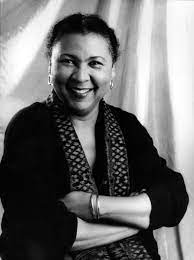
I was recently asked: Who is a theologian you admire? Since I’ve been deeply steeped in the Christian tradition, plenty of Christian theologians could come to mind—Christian theologians, that is, in the sense of humans educated in the Christian theological academy with the theology PhDs to prove it.
But when I think of theology, these days, I find myself thinking more broadly. Like Kat Armas, who wrote Abuelita Faith as a way of reflecting on and honoring the theological contributions of marginalized women, rather than men who sit in the seats of academic power—and like Sarah Bessey, who writes that theology, at its best, is a field where “everyone gets to play”[1]—I am skeptical of the assumptions Christians often make about who is or isn’t a theologian. And so, when I thought of theologians I look to for wisdom, I thought outside the box. I thought of writer and activist bell hooks.
Hooks may have earned her PhD in English rather than theology, but her work has influenced my own theological thinking profoundly. What is a theologian, after all, if not someone who helps us reflect with depth and precision on who God is, who we are in relation to God, and what it means to live well in our world? Hooks certainly does this.
I think, for example, of how Jesus taught his followers to love others as we love ourselves.[2] It’s a lovely teaching, one I embrace. But unpacking the specifics of what this most basic and most crucial commandment means is often messier than we might have hoped. Different Christians have all sorts of different opinions about what love looks like in different scenarios.
In her book All About Love, hooks speaks into this milieu with clarity. To her, love is an action more than a feeling,[3] and it consists of a mix of identifiable ingredients: “care, affection, recognition, respect, commitment, and trust, as well as honest and open communication.”[4] We need all of these ingredients. And we need the specificity with which hooks speaks. In a society where some versions of Christian “love” cause serious harm, especially to minoritized and oppressed people, the care and precision with which hooks examines love feels like a balm that could cultivate healing in our world.
Looking at hooks’ work that focuses more directly on patriarchy and feminism, then—books such as Feminism Is For Everybody, Feminist Theory: From Margin to Center, and The Will to Change: Men, Masculinity, and Love—I see hooks casting a compelling vision of power shared among people of all genders. I think of this often, as I work and write toward gender equity in faith communities. I think of it as I read the apostle Paul’s vision in the New Testament of communities brimming over with all sorts of people freely and joyfully offering their God-given gifts for the common good.[5] Spiritual power, shared. Communal power, shared. People of all genders free to be exactly who they are, bring what they have to offer, and be valued for it.
Hooks puts it beautifully: “Imagine living in a world where there is no domination, where females and males are not alike or even always equal, but where a vision of mutuality is the ethos shaping our interaction.” She invites us to “imagine living in a world where we can all be who we are, a world of peace and possibility.”[6] If I had to pick a few words that shape my theology, or at least what I want my theology to be, these would be among them. Mutuality. Peace. Possibility. An end to domination. Freedom to be who we are.
I think Jesus imagined this kind of world; as did the Hebrew prophets who called their people to return to the ways of justice, again and again; as did the New Testament writers, as they built the earliest Christian communities.[7] Hooks’ vision of the end of patriarchy—along with all other intertwined oppressive systems that hinder the flourishing of people and communities—sits at the deepest core of my theology. God’s image-bearers deserve no less. And our rapidly-warming, often-violent world desperately needs the full contributions of every person of goodwill toward restoration, healing, and peace.
May we learn, together, not only to admire but also to embody bell hooks’ theological vision of love, care, and shared power.
[1] Bessey, Sarah, Out of Sorts: Making Peace With an Evolving Faith (New York: Howard Books, 2015), 41.
[2] See, for example, Matthew 22:34-40.
[3] hooks, bell, All About Love: New Visions (New York: William Morrow Paperbacks, 2001), 13.
[4] Ibid., 5.
[5] See, for example, 1 Corinthians 12:4-31.
[6] Hooks, bell, Feminism Is for Everybody: Passionate Politics (Cambridge: South End Press, 2000), x.
[7] See, for example, the unity, sharing, and equity that marked the community described in Acts 2:42-47.
Discover more from Feminism and Religion
Subscribe to get the latest posts sent to your email.


great
LikeLiked by 1 person
<3
LikeLike
I love bell hooks – always have… her words tear me apart… ““Imagine living in a world where there is no domination, where females and males are not alike or even always equal, but where a vision of mutuality is the ethos shaping our interaction.” She invites us to “imagine living in a world where we can all be who we are, a world of peace and possibility.” It is getting harder for me to imagine such a possibility – and oh how I wish this wasn’t so.
LikeLike
I hear you! So good, and so hard.
LikeLike
Thank you! bell hooks’ thorough investigation of the meaning of love as a verb brings clarity and action to a word that can often be amorphous. I so appreciate your naming her as a theologian and keeping her work alive.
LikeLike
Thank you, Beth!
LikeLike
All about Love is one of my favourite contemplative reads, it is so full of nourishment and uplifts the soul.
Riane Eisler also writes on nurturing our humanity through partner’s and collaboration and an end to the system of domination we have been under for 5,000 years.
I do believe we are on our way there, both humanity and the planet, it may not look that way right now, but peace and freedom will eventually prevail, we will embody it. 🌱🌿🌸🕊️
LikeLiked by 1 person
Partnership…
LikeLike