

Moderator’s Note: This is part 1 of a 2 part series. A version of this article first appeared in The Charlotte Post on March 25
In her paradigm-shifting book, Why I am No Longer a Feminist: A Feminist Manifesto, Jessa Crispin reminds us that having token “female representation” does not solve the problem of systemic oppression or marginalization. I was recently reminded of this truth when a female co-panelist attempted to silence me twice, when I shared my perspective on women’s challenges in Gaza.
On March 20, I joined an all-female interfaith panel for an elite retirement community center in Charlotte, NC in honor of Women’s History Month. As three female panelists, we were invited to represent our respective faiths, Judaism, Islam, and Christianity. After we each responded to the scripted questions posed to us, community members began to ask us questions. One man stood up and said, “I have visited Jordan, Egypt, and Israel. Will it be safe to travel to Israel again given the current situation?”
Taking the mic from the panelist next to her, a female co-panelist, who is currently running for public office in my state of North Carolina, stated, “I guess that question is for me.” She stated that this was a difficult time for Israel, but that trips to Israel would continue and that her community was actively raising funds for different causes.
As a Muslim American with roots in the West Bank, the unstated fact that Gazans could not leave Gaza was screaming at me. I motioned to the moderator that I would like to chime in, so she gave me the second mic, the one in her hand. I explained that my brother-in-law and a colleague had both visited Israel after October 7 with relative ease, but that Palestinians in Gaza were trapped. Referencing the Israeli historian Ilan Pappe and American Jewish professor, Norman Finklestein, I noted that scholars have described Gaza as an open-air prison or even worse, concentration camp.
While I was in mid-sentence, the panelist running for public office rudely interrupted me and stated, “there is no need for that.”
Shocked by her attempt to deny me, a Muslim woman, the equal freedom to respond to the question posed to all of us, I continued to speak. “My friend’s cousin in Gaza needed a cesarian section because she had a high-risk pregnancy and we had to raise $10,000 to get her out of Gaza due to the lack of anesthesia in Ga…” Interrupting me in mid-sentence for a second time, the panelist with the mic stated more firmly, “there is no need for that!”
This female co-panelist’s attempt to police my speech and silence me, as a Muslim Arab American woman, was jarring and offensive. As a professor who has been committed to anti-racist pedagogy, the racism of the moment was more than palatable. What made this female panelist believe she had the authority to interrupt me, to decide what I am allowed to share and what I am not allowed to share, as a Muslim Arab American female? Did this interfaith panel truly seek a diversity of perspectives or just a diversity of optics? Was my presence as Muslim female being tokenized to give the guise of diversity without doing the hard work of listening to divergent perspectives, even if we disagree?
Although the moderator did not intervene, I persisted to complete my story, asserting my equal right to contribute to the conversation as an invited panelist. “I am speaking about my friend’s relative,” I said, with a quivering voice, trying to suppress the emotions rising inside me. “Luckily, we raised the money she needed to leave Gaza and she had a healthy pregnancy and delivery in Egypt,” I concluded.
The irony of this moment was not lost on me. On an interfaith panel to celebrate Women’s History Month, a Jewish female co-panelist running for office could not tolerate hearing me share the challenges of a friend’s pregnant relative in Gaza. What was so intolerable about this story to her that she cut me off mid-sentence, insisting “there is no need” for my perspective? I have spoken on countless interfaith panels and could never imagine in my wildest dreams cutting off a speaker simply because I disagreed with his or her political views. This act of explicit racism and marginalization distresses me more, knowing that the panelist is running for political office in my state. If she has no tolerance to listen to diverse perspectives as a political candidate, while still courting votes, would she tolerate “difference” once elected to office?
After two more questions from the audience, the event ended, photos were shot of the panelists and organizer, and this incident entirely ignored, until I addressed it with the organizers later. My body was shaking, as I felt mixed emotions of anger and humiliation. I ran to my car, pulled out my laptop, and wrote a complaint to the organizers about my shock and dismay. They subsequently apologized to me and admitted they were shocked by her rude behavior.
The current violence in the Middle East has weighed heavily on many Jewish and Muslim Americans, yet the inability to listen to each other’s perspectives does not help anyone. Silencing each other does not help the cause of cultivating peace or building understanding between our religious communities. This alienating experience on a women’s panel affirmed for me the truth of Crispin’s idea: giving women more access to power won’t result in “a more egalitarian world, but the same world, just with more women in it,” because we haven’t addressed the underlying causes of systemic marginalization. Until we, as women, do the hard work of interrogating the ways in which we uphold and maintain hierarchal structures that privilege some at the expense of others, our progress will be limited to optics, not real change.
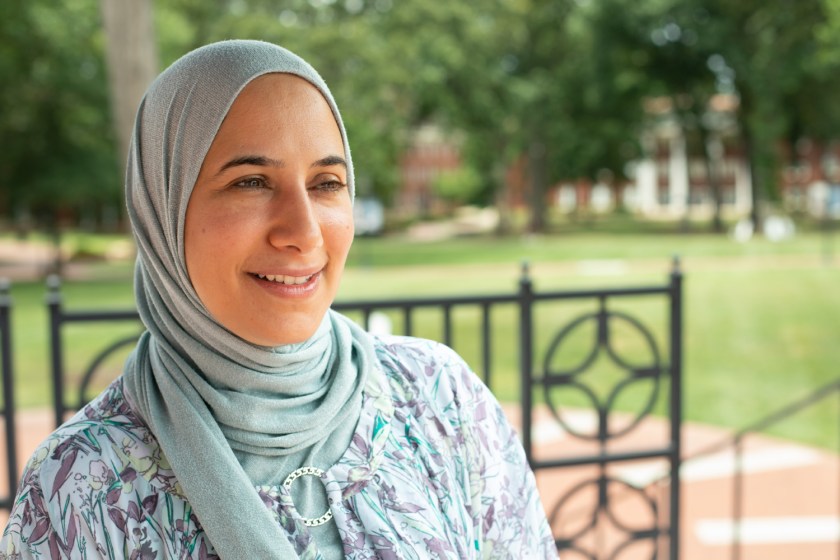
BIO: Dr. Hadia Mubarak is Assistant Professor of Religion at Queens University of Charlotte and the author of Rebellious Wives, Neglectful Husbands: Controversies in Qur’anic Modern Commentaries.
Discover more from Feminism and Religion
Subscribe to get the latest posts sent to your email.
 Feminism and Religion
Your last sentence is golden: ”Until we, as women, do the hard work of interrogating the ways in which we uphold and maintain hierarchal structures that privilege some at the expense of others, our progress will be limited to optics, not real change.” Thank you, Hadia, for this articulate example of patriarchy at its “finest!” I’m glad you persisted with your comment on the panel and happy you addressed the issue with the organizers of the event. It’s hard to permeate the status quo.
LikeLiked by 2 people
I’m so sorry this happened to you, Hadia. Like Esther, your last sentence went right to the heart of the issue. Coincidentally, I have been in the midst of writing on post for FAR on listening to one another, which requires that we recognize those underlying power dynamics that privilege the speech of some over others. I had hoped that as feminists we had made progress in that regard. Clearly we have a long way to go.
LikeLiked by 1 person
Thanks for speaking out about this terrible experience on a women’s panel, Hadia. Every day I am just so horrified to hear about the terrors unleashed on the people of Gaza by Israel with full support of the U.S., and like what happened to you, when people speak out about this, they are shut down and silenced. Bravo to you for speaking up in the first place and for talking about how they shut you down. It is completely unacceptable.
LikeLiked by 1 person
Hadia, I’m so sorry that happened to you. What an appalling thing for that panelist to do! She was so disrespectful an rude, to put it mildly. The moderator should have stopped her. I’m glad you complained to the organizers and that they apologized. You’re right that feminists can play power games and try to silence others, too, sadly.
I am horrified at what Israel is doing to the people of Gaza, and what it has done to them in the past. I know someone who went on a tour of Israel and Gaza and she told a group of us about Israel’s oppression of the people of Gaza. What Israel is doing now is nothing short of genocide and my heart breaks for the Palestinians.
LikeLike