

This was originally posted on Feb. 6, 2012 with updates added later.
I believe that we should we care about birds because it is right to do so. If we do not, we will contribute to extinction of species, and we will leave a diminished world to those who come after us. We must not give up hope that we can save the world for birds, for other wildlife, and for our children’s children.
On February 2, 2012, the International Day for Wetlands, the Greek government signed into law a Presidental Directive mandating protection of the small wetlands of the Greek islands. There is no assurance that this law will be enforced. There are still no measures in effect to protect most of the larger wetlands in Greece, even though this is required by the European law Natura 2000, which requires all of the countries in the European Union to protect bird and wildlife habitats.
When I became a birdwatcher, I could not have told you what a wetland is. Now I know that wetlands are fragile bodies of water shallow enough for wading birds from flamingoes to sandpipers to stand in “without getting their bottoms wet” while feeding on shrimp, small fish, frogs, and other watery treats. Wetlands often take the form of pools near the sea, but they also include the deltas at river mouths and seasonally flooded fields. In the twentieth century and today many wetlands were designated “swamps” and drained.
The extensive wetlands of Lesbos provide “rest and recreation” for thousands of birds making the arduous journey from Africa to their breeding grounds in Europe. They also provide homes for year around residents and summer breeders. In recent years global climate change and environmental destruction of African habitats have induced over 1000 flamingoes and a few families of black storks to stay in Lesbos permanently.
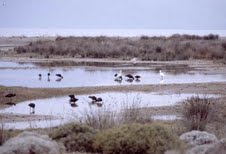
I became a serious birdwatcher in 1999. I was captivated by the beauty and habits of the more than 300 birds that live in or visit the island, including large wading birds like egrets, herons, and storks, small wading birds like black-winged stilts, avocets, and godwits, passerines like buntings and warblers, birds of prey like kestrels and buzzards. For me bird watching is a form of prayer for and meditation on the beauty of our mother earth. By 2000 I had already begun to witness the destruction of wetlands where I had seen birds the previous spring.
I decided to do something about it. In 2001 I wrote a petition and left it in the hotels where birdwatchers stayed and spoke to hundreds of them myself. By the end of the season I had collected 600 signatures. English environmentalist and longtime birdwatcher John Bowers was inspired to found Friends of Green Lesbos, an international internet-based organization dedicated to saving the wetlands.
A farsighted mayor of Kalloni had already sought money from the European Union to protect the wetlands of the Gulf of Kalloni. At an open meeting in the spring of 2001 where he expected to be congratulated for his efforts to save the environment and to encourage ecotourism, the mayor was greeted by a group of several hundred angry male protesters who refused to come inside the hall to learn about his plans. The problem was and is that many of the wetland areas are owned by sheep farmers who had used them for grazing, but did not want be prohibited from draining them to build hotels and villas. As Greece has no tradition of land planning or decision-making “for the common good,” the landowners could see only that their “rights” to build were being threatened.
In succeeding years John and I worked with a number of dedicated individuals in local environmental organizations. We met with numerous government officials to urge them to enforce the Natura law. In response to our second petition, the national government directed local authorities to inspect the wetlands of the Gulf of Kalloni and to fine those who had degraded them. We did not understand that the authorities had not been told to perform regular inspections, but only to respond to complaints. Once we realized that, Friends of Green Lesbos, other local groups, and World Wildlife Fund–Greece began drafting complaints.
Over the next few years we wrote close to 100 letters, specifying violations of Natura in some 50 specific locations. We were gratified when the island government accessed a fine of 10,000 Euros (more than $10,000) against a single municipality. However, we were to learn that the fines were not collected and that the issue of protecting the wetlands was a political “hot potato” the government did not want to touch. After a few years, the government official charged with inspecting violations was transferred, and the inspections ground to a halt.
After years of obsessive work on the part of several of us, we were all discouraged. Most of my Greek friends gave up. While speaking in Ireland in August 2008, I learned that I could write an official Complaint to the European Commission. I started collecting the evidence and ended up spending more than a year writing what became an informal legal brief detailing the degradations of wetlands in Lesbos and the failure of government authorities to enforce the Natura law. A lawyer at World Wildlife Fund—Greece offered to write the legal portion of the Complaint, but as he was not released from his other duties and the issues were complicated, this took him more than six months.
In December 2009, I finally submitted the nearly 100 page Complaint with two huge folders of documentation for signature by the local groups and two national groups, WWF—Greece and Hellenic Ornithological Society. To my surprise the two national groups decided they needed to revise my work into a more formal legal brief, a process that took nearly two years. Though I was upset by the delays, I believe that a stronger document was submitted in the end. I also know that it is highly unusual for the national groups to sign a Complaint they did not initiate. I feel proud that I, as an immigrant or foreigner and a woman, was able to achieve that. In September 2011, three years after I had begun writing it, I submitted the Complaint to the European Commission, which has up to two years to respond.
In the three years I worked on the Complaint, I continued to witness on-going degradation of the wetlands, including those associated with a road-building project sponsored by the government and funded in part by the European Union. My heart breaks every time I see further incursions into areas that should have been protected. As far as I know the European Union also continues to fund the draining of wetlands under its farm programs. The right hand really does not know what the left hand is doing—in far too many cases.
We expect the European Commission to decide the Complaint in our favor as our case is well-documented. If they do, they will urge the government to comply with the law. If the government refuses, it will be fined. In the best case, the Natura law will be enforced in Lesbos as it should have been all along. In the worst case, the environment will continue to be degraded and there will be fewer places for the birds to stop on their long and tiring journey from Africa. Birds will die and species will be lost. Flooding will occur in areas that have been drained, and disasters like the one in New Orleans will occur in our island on a smaller scale.
Will the wetlands of Lesbos be saved, and if not, have I been wasting my time? I long ago concluded that this is the wrong question. The right question is: Should we try to save the world we love? The answer to that question is: YES!
Because of my efforts to save the wetlands, I was asked to run on the Green Party ticket in the regional elections of 2010 where we elected our first Green representative to the Regional Council of the North Aegean. I hope to run again in the upcoming national elections. We can never know the long-term effects of any of our actions.
Update: In October 2014, the European Commission decided the case in our favor, moving it to “infringement status” and began negotiations with Greece to bring it into compliance with the Natura 2000 law. In 2016 the Lesbos case became part of “horizontal negotiations” with Greece regarding Natura sites in Greece as a whole. On February 20, 2018, these negotiations resulted in a Presidential Decree issued by Greece mandating that governmental bodies be created with the authority to manage and protect over 400 Natura sites in Greece. It has been a long struggle.
Discover more from Feminism and Religion
Subscribe to get the latest posts sent to your email.

 Feminism and Religion
“For me bird watching is a form of prayer for and meditation on the beauty of our mother earth.” Carol’s voice is my own. Does it matter that we advocate for birds and all non human beings or the mycelial network beneath our feet? YES but today it is more about process than outcome because the loss of all non human Bio -diversity is well under way and now the focus must be on mitigation of the damage Like Carol, I continue to write and write and write. Will it make a difference? Each year I become more discouraged… some days I think I keep writing about nature to keep my self visible to me…I do feel like a voice in the wilderness…
LikeLiked by 1 person
Hi Sara. Thankyou for your comments.
Sometimes I wonder if many people are reading and choosing not to chime in? That was me for years…reading on FAR before I felt comfortable enouph to comment.
Anyways I really learn from what people write and am glad you’re here.
LikeLiked by 2 people
very very kind – thank you
LikeLiked by 1 person
Thankyou Carol. How long it took to get in the right direction for the wetlands of Lesbos and the 400 Natura sites on Greece.
We miss you and in Goddess we continue to walk.
LikeLike
So many people are waking up to reality, we are nature, one is all there is. Education is key, once people understand who we really are, change happens!
LikeLike