

In the April 2024 issue of Christianity Today, Fellipe Do Vale wrote, “Gender on Earth as in Heaven: Will Our Gender be Removed or Renewed in the Resurrection?”
The entire issue was dedicated to a conversation between egalitarian and complementarian beliefs regarding gender, which I am not here to argue. However, I will wholeheartedly and fully engage with a quote in the article where Do Vale states the following.
There is a long and impressive lineage in Christian history and
contemporary theology that says the best way to envision the
redemption of our gender is to picture its removal….
They say that gender was an attribute given to us only
because God knew humanity would sin. It was meant
to sustain us only until the restoration of creation. Therefore,
attributes like gender, race, and disability, which they believe
cause the most pain and struggle in this life, will not remain
in the resurrection.
(Do Vale, “Gender on Earth as in Heaven,” Christianity Today (Aril 2024), p. 24-25.)
Thankfully, Do Vale went on to argue against this theological belief, which seems to be rooted in an understanding of sin, and Galatians 3:28: “There is neither Jew nor Greek, neither slave nor free, male nor female, for you are all one in Christ Jesus.”
What if I think that God does not see my gender identity as a flaw but rather precisely who I am made to be even if others refuse to see as I see? Then what? Or what if I delight in fully in how I show up in the world?
I know that this may not be the case for everyone. Bodies can be a place of tremendous pain. I know it can especially be painful for those whose gender identity is not affirmed, especially our trans, non-binary, gender-expansive, and two-spirit siblings. It is painful for those who have been judged as being “less-than” because of their bodies. It can be wounding for those who have been told that they cannot have fully-satisfying and fulfilling lives because of how others perceive their bodies. It is traumatizing for those who are told they need to be “cured” in order be seen as fully human. But this eschatological framework that Do Vale was speaking against is not an answer to our limited human understanding about the body and the pain that we inflict upon each other. It is simply one that perpetuates thinking that harms.
When I was in seminary, the most challenging class I took was ethics, not because of the topics, though they were difficult, but because we had discussion groups where people came up with ideas. They passed these type of ideas as theological truths that left damage in their wake. One such belief was around disability, where a classmate argued vehemently against the place of disability in the Kingdom of God. Finally, when he took a breath, I stated that I believed that God used and redeemed the parts of me that others see as broken, like the generalized anxiety that had been my constant companion for over a decade. That which others named as a flaw that needed to be “healed” allowed me to see and understand the world differently, even giving me the ability to process information differently. I didn’t need to be healed to be God’s beloved and delighted.
I am blessed to be an aunt to seven kiddos. I do not want any of them growing up thinking that their gender expression is a sign of brokenness and that God is just waiting to “fix” with the resurrection. Who believes these attributes lifted in the theological stance rebutted against in Do Vale’s writing? Those who are uncomfortable. And that is not me, as a woman. I rejoice in my gender because I believe it is part of me. The people I have found who push back against my gender the most as fallen are men, who are uncomfortable by my presence at the table, and women whose patriarchal understanding of the church has deeply impacted that my very presence challenges their understanding of their gendered presence as well.
Maybe what the church needs to be freed from is not the pain and struggle of “gender, race, and disability” but the pain and struggle of a limited theological understanding of who God is and who we are, the beloved of God. Maybe we need to redeem from a view of creation that links together gender and sin and instead teach humanity that they are valued and honored in their fullness of who they were created to be. What dialogues could change in churches then? And what holy and blessed being could we offer to the world?
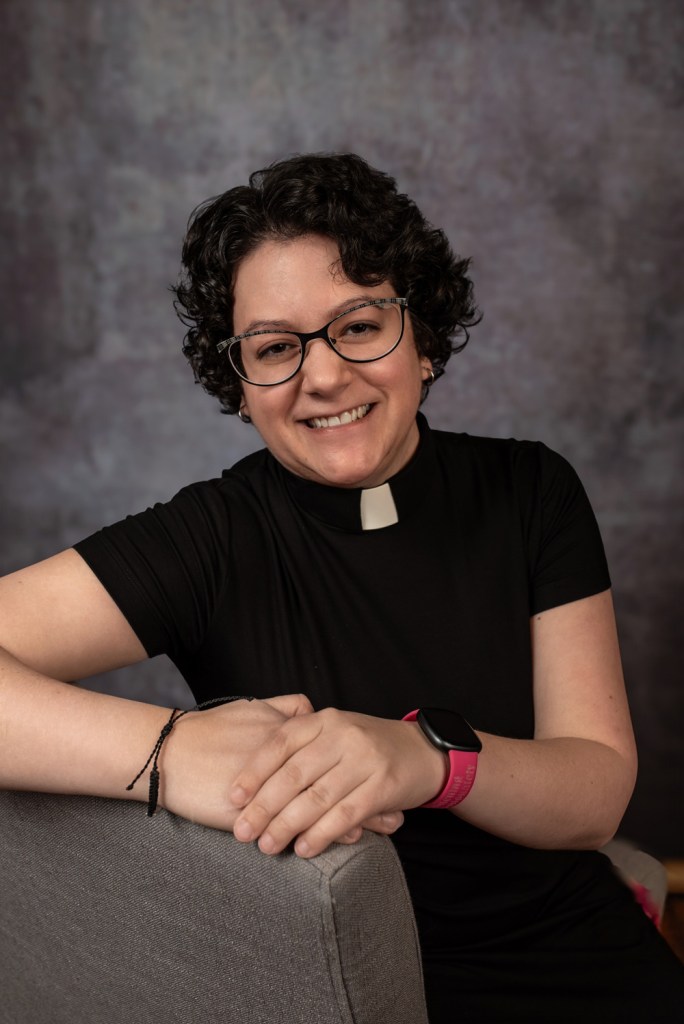
BIO: Michelle Bodle has served for over a decade as a pastor in the United Methodist Church and spiritual director. She creates sacred spaces of holy listening through Abide in the Spirit, www.abideinthespirit.com
Discover more from Feminism and Religion
Subscribe to get the latest posts sent to your email.
 Feminism and Religion
I’ve come to understand that the Church (broadly speaking) is slow in affirming what some people, especially younger people know as they live their lives. My grandchildren don’t seem to be “hung up” with how sex and gender have been defined and enforced. Gender fluidity seems to be more and more the norm. Our institutions, including (and especially) the Church continuously lag behind our human evolution. We can always dig in our religious texts and find what we need to find. It’s probably why our religious texts continue to survive.
LikeLike
Beautifully said. Thank you.
LikeLike
Dear Michelle, Thank-you for this thoughtful contribution. You pack really a lot into such a short essay! Gender and the patriarchy is a deeply troubled topic and it is rather depressing that men still object to women being “at the table”. This is an on-going battle and one that seems to renew with each rising generation.
Another topic of the essay is your objection to the logic that “gender identity” as a sign of brokenness from which a person needs some kind of divine redemption. Personally, I am not at all sure what “gender identity” means. Sex is something I understand. Sex abuse, sex privilege, sex oppression: those I understand. Identity is something I’ve always thought was a form of continual and shape-shifting “coming into being” through every day acts and intentions. For me, identity is not at all about “gender” (however that might be defined) but it does include sex. Indeed, the major international human rights law treaty for the rights of women and girls (CEDAW) aims to uproot & destroy harmful gender stereotypes. If the compassionate perspective is truly deeply accepting of all individuals, and we are not in need of a divine “cure” for “gender” then why are we in need of medical “cure” for gender? These are huge contemporary topics and I’m impressed you take them on so boldly.
LikeLike
In my opinion, most of the sex/gender discussions today are clouded by several issues. Sex is biology and gender is socially constructed. Gay issues are different from trans issues. Protecting females from male aggression and violence can lead to limiting the rights of females. We need to address how to control male aggression and violence, which underlie every discussion of feminism and women’s rights.
LikeLike