

Moderator’s Note: This post is presented as part of FAR’s co-operation with The Nasty Women Writers Project, a site dedicated to highlighting and amplifying the voices and visions of powerful women. The site was founded by sisters Theresa and Maria Dintino.
Throughout history women have found power and position in spiritual communities. They have acted as leaders, priestesses, oracles, mediums, disciples, saints, preachers and more. And yet these roles and positions of power are often overlooked in the story of women, and the general story of humans.
Still today many women function as leaders in a variety of spiritual disciplines, yet they do not receive the attention, respect and clout that men in similar positions do. More often women who hold roles of power in spiritual communities are dismissed or discredited.
If their spiritual community is not considered a formally accepted religion where their position was bestowed to them by a man ranking above them, women spiritual leaders are often ignored. This marginalization goes unquestioned.
Are women who take leadership positions in spiritual traditions outside of mainstream religion an extra special threat? If so, why is that? Is it because they are not bending to any authority but their own?
The nineteenth-century Spiritualist movement’s contribution to, and subsequent erasure from, the feminist history of that time is a good place to try to understand this phenomenon.
Ann Braude’s Radical Spirits
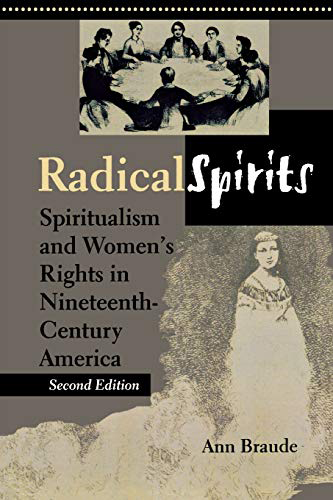
In her book, Radical Spirits: Spiritualism and Women’s Rights in Nineteenth-Century America, Ann Braude writes:
“Like the woman’s rights movement, Spiritualism dated its inception to 1848 in upstate New York. The two movements intertwined continually as they spread throughout the country. Not all feminists were Spiritualists, but all Spiritualists advocated woman’s rights, and women were in fact equal to men within Spiritualist practice, polity and ideology…
At a time when no churches ordained women and many forbade them to speak aloud in church, Spiritualist women had equal authority, equal opportunities, and equal numbers in religious leadership. While most religious groups viewed the existing order of gender, race, and class relations as ordained by God, ardent Spiritualists appeared not only in the woman’s rights movement but throughout the most radical reform movements of the nineteenth century”(3).
Not only were these powerful women allowed to speak but they were also leaders, many of them becoming well-known mediums. And yet even today in popular movies and art forms, these women are mocked and depicted as frauds, swindlers or at the very least, silly.
The Spiritualist Movement
In the Spiritualist movement power was decentralized. Anyone could be a Spiritualist and anyone with the mediumship ability could stand before a group of people and allow the spirits to speak through her. These women drew large crowds and many became highly sought after.
One could be a spiritualist and not be a public figure. Though Spiritualism had no rigid hierarchical organizational structure, which is why women had a chance at playing a part in it, Spiritualists had a variety of shared beliefs. They believed life continued after death, that one could interact with people after they died, including ancestors and spirits of place. They believed in equality and equity for peoples of all genders and races and promoted freedom and personal autonomy above all.
Spiritualists believed in the power of the natural world and all the creatures in the shared environment. They believed in angels and spirit guides. They promoted healthy diets and clean living. Some preached Christian tenets and channeled Christian saints while others allowed the voices of ancestors or deceased to speak through them or to a loved one who asked.
Women were not allowed to speak in public at this time. Because Spiritualists were considered to be channeling the voices of others, they were allowed. Through the Spiritualist movement many women found their voices and Americans became accustomed to seeing and hearing women speak powerfully in public. After that there was no going back to a silenced female populace. Women had taken to center stage. Through the Spiritualist movement women gained a voice in the United States of America.
“Spiritualists became a major—if not the major—vehicle for the spread of woman’s rights ideas in mid-century America”(57).
Why did Spiritualism become so popular?
In Radical Spirits, Braude discusses how the strict Calvinist teachings dominating the land were hard on the new Americans especially the teaching that they were inherently bad, would be saved only by God and that only a select few would be given that honor. There was also a backlash against the teaching that children and babies who died were going to hell.
Spiritualists believed that souls continue to grow after death and described them going through six celestial spheres of growth once they passed. They also believed that death was a kind of birth and it should be seen as a celebration. They encouraged people to wear white to funerals instead of the dark color previously required. Spiritualists also offered people the ability to contact loved ones after they died. All of this appealed to the populace greatly. Braude emphasizes that Americans were missing connection to their ancestors. Spiritualism helped to fill this void.
Spiritualism was not class based like many of the other traditions arising as alternatives at the same time. Intellectual snobbery and classism were present in Transcendentalism and Unitarianism. Many Transcendentalists disliked Spiritualism. Emerson and Thoreau argued against it with disdain in spite of the fact that many of Emerson’s teachings and beliefs in communion with nature were embraced and promoted by the Spiritualists.
“In place of faith in a savior, Spiritualists saw God in the harmony and beauty of the natural world and in the inherent goodness of human beings. Unlike their evangelical contemporaries, who believed that the natural person was separated from God by sin and needed to receive a new nature through conversion to be transformed into a Christian, Spiritualists believed that human nature did not need to be transformed, that human beings were born good, each reflecting the image of God, and therefore did not need to be saved. This view came as a welcome relief to Spiritualists raised in the evangelical milieu of early nineteenth-century America” (41).
Part 2, tomorrow
@Theresa C. Dintino 2023
Works Cited:
Braude, Ann. Radical Spirits: Spiritualism and Women’s Rights in Nineteenth-Century America. Indiana University Press. 2nd edition, 2001.
Discover more from Feminism and Religion
Subscribe to get the latest posts sent to your email.
 Feminism and Religion
Thanks. It sounds like this is an important root of 20th century paganism.
LikeLike
Hi Judith, yes. This is true. so much began here for so many of the spiritual and women’s movements of the 20 and 21st century.
LikeLike