

Modern science has proven what ancient myth has long told us about our Earth — billions of years ago our world was a water world. It’s not surprising then to find water-based creation stories and goddess mermaids in the myths of our ancient ancestors.
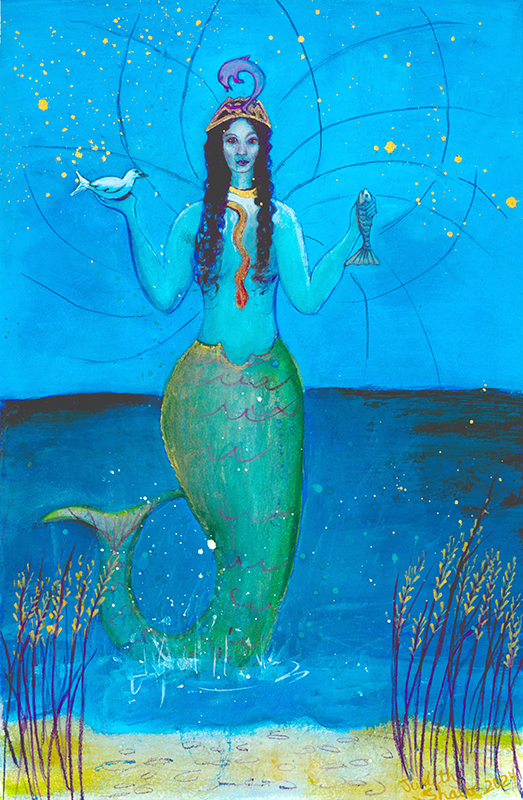
One of the earliest known mermaid goddesses is Mesopotamian Goddess, Atargatis. She was celebrated and petitioned for abundance, health, protection, fertility, safety — pretty much whatever you might need. Her primary sanctuary was in Hierapolis, now modern-day Manbij, Syria. Her worship which began around the 3rd century BCE, embodied the cross-cultural nature of that region’s spiritual traditions.
She was associated with doves, symbol of love, and fish, symbol of life and fertility. Her sanctuaries, scattered throughout the ancient world, were filled with trees populated by doves and ponds filled with her sacred fish. These fish, hand-fed by her priestesses and decorated with golden ornaments hanging from their pierced lips and gills, were Atargatis’ oracle.
Other animals sacred to Atargatis are snakes, whales, dolphins and other sea creatures. She was sometimes depicted wearing a dolphin crown.
Her influence extended far beyond her immediate geographical realm, most likely carried by Greek merchants and mercenaries to various parts of the Greek world, where she was viewed as a form of Aphrodite. In Greece, she was known by another name, Derceto, a name some scholars associate with her mermaid form.
Transformation
There are differing accounts as to how Atargatis became a mermaid.
From birth
One myth recounts that the sacred fish of the Euphrates found an unusual egg floating on the waters. The fish pushed it ashore with their noses. On land the egg hatched and Atargatis was born with a fish body and a woman’s head.
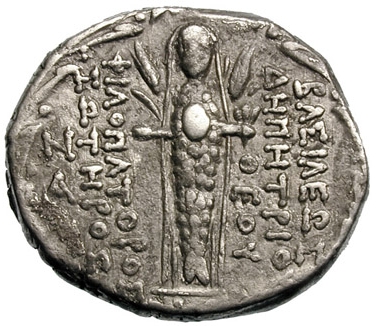
Silver coin of King Demetrius III of Syria with picture of the Derketo of Askalon
Unlike the little mermaids of our modern world who long to be human, Atargatis was proud of her mermaid form. When her daughter was born fully human, she became so distraught that she killed her lover, the baby’s father. Unable to accept her human child, she left the baby in the care of doves. In despair, Atargatis threw herself into a lake, transforming into the Great Fish Mother. Since then, she has communicated with humans through her sacred fish.
Divine/Human Coupling
Another legend tells of how Atargatis had an affair with a mortal youth. Unaware of the strength of her own power and beauty, she accidentally killed her lover. Their union resulted in the birth of a fully human daughter. Once again, she left her daughter in the care of doves. Despairing over the outcome of her affair, she threw herself into a lake, seeking death. It was at this point in the legend that she transformed into the mermaid goddess.
Divine Couple
Known as the baalat (“mistress”) of her city, Atargatis ruled together with her consort, Hadad — a powerful god who controlled the forces of nature, storms, rain, and thunder. They reined together as protective deities for the community.

Atargatis and Hadad – Yale University Art Gallery
This aspect of her nature reveals that she was more than just a fertility goddess, a label often assigned to many goddesses by the patriarchal lens of archaeology. As the baalat of her city and people, responsible for their protection and prosperity, she was often depicted wearing a mural crown and holding a sheaf of grain, symbols of her protective role in an agricultural society. Two lions supported her throne, illustrating her strength and dominion over the forces of nature.
The deep love between this powerful couple lent strength and balance to their people. But when Hadad met an untimely death, Atargatis fell into a far-reaching despair. To ease the depths of her grief, she sought comfort in the waters, diving into the lake near Ascalon.
Here her transformation occurred. She emerged from the depths of the lake as a mermaid, with the upper body of a woman and the lower body of a fish, illustrating the transformative power of love and grief.
Atargatis’s Wisdom
As a mermaid Atargatis symbolizes our ancient and ongoing connection to the sea, the waters of life. She reminds us of the immense power of the sea, with its life-giving elements and its destructive power in the form of storms and tsunamis. This awareness brings us into alignment with the need for respect and humility in the face of nature’s power.
Love, loss, death, and transformation are central to every version of her story. Atargatis, the Mermaid Goddess, bestows the blessings of growth, fertility, and the ever-recurring cycle of life—birth, death, and rebirth. She is a powerful symbol of transformation, opening our hearts to the unknown and unseen in both our external and internal worlds. She reminds us of love’s power to transform. Call on Atargatis when the need to let go of the old ways becomes pressing, and she will guide you safely down the path to new beginnings.
Judith’s art — originals, prints, her Celtic Goddess Oracle, Animal Wisdom Oracle and fairytale are available on her website: judithshawart.com
Here’s a direct link to prints and merchandise of Atargatis, Mesopotamian Mermaid Goddess.
Discover more from Feminism and Religion
Subscribe to get the latest posts sent to your email.

 Feminism and Religion
Wow Judith – this is some essay! Fantastic. As for Atargatis -I did not know the first two myths – so thank you for this scholarship. I remember making a string doll in my late thirties that scared me. She was half human and half fish with penetrating silver “grandmother Eyes” – buttons that belonged to my actual grandmother – I kept her but was really uncomfortable looking at her – it was years before I understood what what the child in me had made was an image of who I was and would become – a woman who lived half her life above the surface of the water and half below… The sad little mermaid story that I learned – the one where the little mermaid longed to become human depressed me and later seemed like such a fake story – and now it’s a travesty created out of powerful mythical reality…. what impresses me now about this story is that something in me knew… Thanks so much!
LikeLike
Sara,
That’s great that now you know what you only intuited when younger. I love this that you said ” a woman who lived half her life above the surface of the water and half below…” I think that is the case for many creative types.
LikeLiked by 1 person
YES…. those of us who are creative must have access to the unconscious realms – it’s just how it is.
LikeLike
Thank you for this post, I was so pleased to see this mention of Atargatis. I featured her in my historical novel “Magdalene A.D.” A temple dedicated to Atargatis was Magdalene’s first introduction to the Feminine Divine on her spiritual/physical journey as she departed Jerusalem twenty-five years after the crucifixion.
In ancient Rome, the temples of Venus (Roman Aphrodite) contained dovecotes to house her sacred birds. One of my earlier books, “Be a Teller of Tales,” contained this poem about the Goddess’s doves:
VENUS COLUMBA
The Blue Men called them dufedoppa,
birds that dip and dive.
But homesick legionnaires
recognized them as columba,
remembering plush Roman days
of galas and garlands when grain,
lavishly flung by heavy–handed acolytes
lay thick about the dark dovecotes,
of Venus Columba.
Venus came by her white birds honestly
inheriting from Aphrodite who
had them from Astarte.
Aphrodite called her brood ionah
and sent them winging periodically
to Zeus, ambrosia in their rosy bills
to feed His immortality.
Aphrodite was a slut,
selling sacred sex to stay alive;
in sleep she dreamed of Byblos
where snowy doves adorned
ten thousand stelae raised
to praise, Astarte Astroarch,
Mother of Stars.
Astarte came to Byblos out of India,
three–faced daughter of great Kali Ma
who gave her own white–winged parvata
to fly Astarte west. Astarte wept
as snow–topped Annapurna fell from sight.
Wiping tears against their downy necks,
she cooed love–words to her carriers:
‘fair–feathered,’ ‘beloved,’ ‘heart’s ease.’
“Mother,” she whispered, “Mother.”
Great Kali,
The One behind the Three
Creatrix/Destroyer – womb and tomb,
She who wears a bloody necklace
of first words. Whose “OM” created
universe from the chaos of Herself,
whose chaos waits us at the end of time.
Out of her Maiden came the dove;
born from that little pulse which flutters
in girlhood but later beats a drum
that can move mountains.
LikeLike
Christine,
I only learned about Atargatis because of my own longing for the sea. That longing took me on a journey into sea goddesses, mermaid goddesses and mermaids where I discovered Atargatis. Your book sounds wonderful! Research for it must have been daunting.
I love your poem and in particular this line resonates with me – “She who wears a bloody necklace
of first words. Whose “OM” created
universe from the chaos of Herself,
whose chaos waits us at the end of time.”
LikeLike
Just tried to comment on this beautiful goddess and her stories that connect sea, sky, and earth. Will try again. Thank you, Judith for your beautiful images and storytelling.
LikeLike
Third try! Just tried to comment on this beautiful goddess and her stories that connect sea, sky, and earth. Will try again. Thank you, Judith for your beautiful images and storytelling.
LikeLike
fourth try. Just tried to comment on this beautiful goddess and her stories that connect sea, sky, and earth. Will try again. Thank you, Judith for your beautiful images and storytelling.
LikeLike
Elizabeth,
That’s funny because 3 of your 4 notes about trying unsuccessfully to comment did come through. Glad you enjoyed my telling of Atargatis!
LikeLike
All Praises be to the Goddesses!
LikeLiked by 1 person
A beautiful painting, lovely photos, and an informative, meaningful essay! I always learn so much from your posts! I have always been moved by large bodies of water — seas, oceans, lakes — and am so glad to read about their power in the story of Atargatis!
LikeLike
Carolyn,
Glad you enjoyed. It was my own longing for the sea from my home in the high desert that led me to discovering Atargatis.
LikeLike