

Part 1 was posted yesterday
Praying people out of purgatory
Beguines excelled at this. By the Middle Ages, the belief in many Christian circles was that one did not go directly to heaven but to a sort of “holding place” after death to be cleansed of their sins before being allowed into heaven. Eventually “the medieval church also taught that people could pray for the souls in purgatory and that their prayers would effectively aid those souls in their transition from purgatory to heaven”(108).
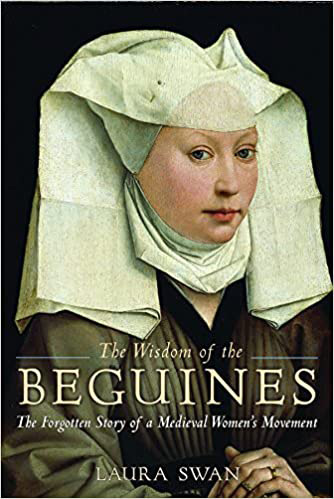
It’s important to note that these women were esteemed by the communities they lived in as spiritually gifted, able to intercede with God on their own without permission from the church, clergy or men. This is radical for the time.
“Beguines, as we have seen, were understood to have extraordinary spiritual powers. People believed that having a beguine intercede before God on their behalf was an assurance that their petition was heard by God—and perhaps in no instance more than for “those poor souls in purgatory.” And beguines believed that they did indeed exercise the authority to release countless souls from purgatory. Many of the stories included in the vitae of beguines grapple with the fate of the deceased in purgatory (or hell)”(109).
They were considered extra good at this because of the power of their prayers. Swan describes Marie d’Oignies having a vision of multiple hands and discovering they were the hands of the people in purgatory asking to be released. She began a practice of praying for them and urged others to as well.
“Beguines so passionately “interacted” with purgatory that it was reported that some of them could cross from this world into the next, intercede before God on behalf of a tormented soul, and win their release into paradise”(114).
Many beguines preached against the popularity of what became known as “Indulgences” (buying or earning one’s way into heaven) warning that “God’s love could not be bought with money or earned with good deeds”(116).
Intriguing is the description of family members coming to a beguine to have them check in on a loved one who had died and how the beguine would go into an ecstatic vision to communicate with the dead one, then “‘pour out’ prayers”(117) for them to be released into heaven.
Beguines as women writers
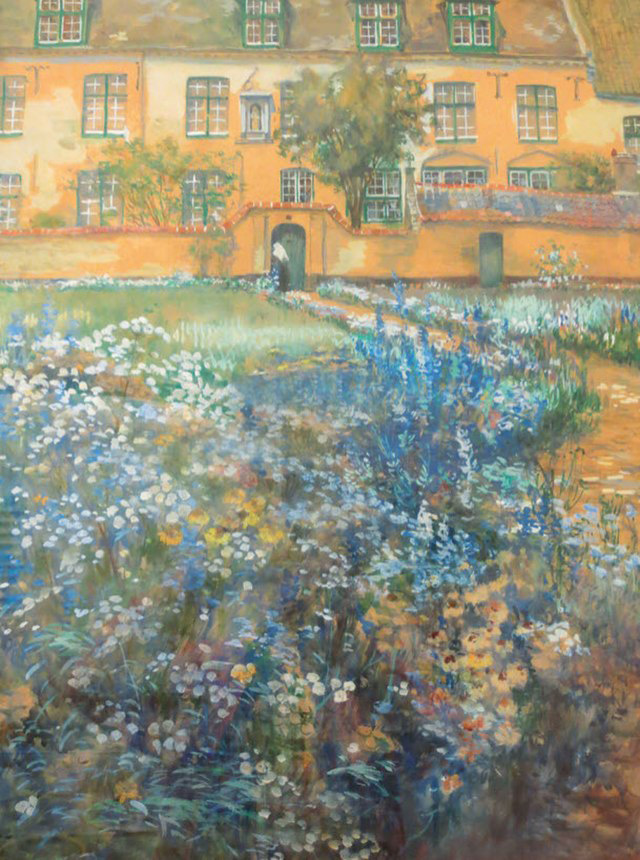
Swan, who is herself a Benedictine Sister, first heard of the beguines while on a trip to Brugge, Belgium where the tour guide, upon showing them a walled village called Beguine Community of the Vineyard, founded in 1242, dismissed the beguines as “pious old ladies”(1). This annoyed her, so she began to look into them. I am so glad that she did.
“In my first round of graduate school I began encountering the writings of medieval women—Angela of Foligno, Catherine of Siena, Catherine of Genoa, and others. These women were mystics and reformers, poets and preachers, servants of the poor, founders of movements, and leaders in their own right . . . women who gave voice to their own experience of the Divine, women with whom I could relate. In recent years, I have come to discover that many of these medieval women were in fact known as beguines”(8).
Beguines were also writers, scribes and publishers. Well known mystical texts of the beguines are written by Mechthild of Magdeburg: The Flowing Light of the Godhead; Beatrijs of Nazareth: The Seven Manners of Loving; and Marguerite Porete: The Mirror of Simple Souls.
Many beguines struggled with the idea of a punishing God promoted by clergy. They believed God is love and preached this. Marguerite Porete who adhered to this belief, was burned at the stake in 1310 for her famous work, The Mirror of Simple Souls, which was determined to be heretical.
“She was condemned both for suggesting that the church and its sacraments may not be necessary for salvation and for defying church authorities. …Theologians preparing their cases for the condemnation of all beguines, along with certain emerging spiritual movements … took a keen interest in Marguerite’s case—as justification for why their orthodox position should prevail”(156).
Marguerite’s text and beliefs sound almost modern:
“In The Mirror of Simple Souls, Marguerite Porete attempts to express her understanding of the soul’s relationship with the Divine, especially the nature of the soul’s freedom and its potential perfectibility. She understands a person’s soul as having the capacity to draw so close to God—even here on earth and in this life—that literally nothing stands between the soul and God: not reason, virtue, good works, or even the sacraments. Marguerite is not condemning any of the above things, but is saying that we can sufficiently mature in our relationship to God so that we can leave behind the need for these things”(157).
In spite of these threats and actual persecutions, beguines lived on into the 18th century. Then the French Revolution happened and, according to Swan, secularization is what did the beguines in eventually. Perhaps after the revolution women that would have been beguines were able to establish lives of their own outside of devotion and prayer. Maybe that moment of creativity and context in finding agency and independence within the context of religion and religious beliefs of the populace was no longer relevant. Women went on to find others ways to express themselves and find independence, which brought a whole new round of battles.
It is reported that the last beguine died in 2013. Swan reports that there may be many women in Europe calling themselves beguines until this day.
“Even if the very last “traditional” beguine died in 2013, these women, over many centuries, have left us a great legacy: the court beguines that are still standing as well as superb mystical literature, artwork, illuminated books, and significant contributions to theology. The beguines also left us a more hidden legacy of healing ministry and passionate preaching. But possibly the most important legacy of the beguines is their bold vision for the possibilities of community: intentional communities committed to working for and with the marginalized and carried by a love for beauty and creation”(179).
Laura Swan and the beguines are Nasty Women Activists and Writers.
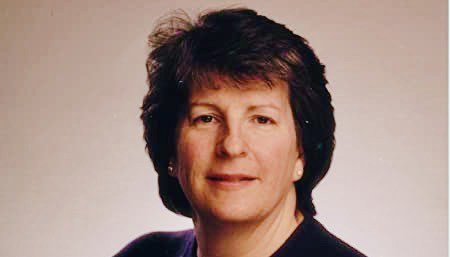
Laura Swan is also the author of The Forgotten Desert Mothers and Engaging Benedict. She is associate editor of Magistra: A Journal of Women’s Spirituality and History and teaches religious studies at Saint Martin’s University in Washington State.
Discover more from Feminism and Religion
Subscribe to get the latest posts sent to your email.

 Feminism and Religion
“But possibly the most important legacy of the beguines is their bold vision for the possibilities of community: intentional communities committed to working for and with the marginalized and carried by a love for beauty and creation”
On November 6th I lit my young cedar tree for the first time to remind myself that this was ‘a tree for life’ that was being lit in the darkness… as I was putting on the lights carefully tending to each branch and talking to this tree she started wafting her sweet scent towards me – that we were communicating was obvious to me and very comforting – beauty and creation live on… Intentional women’s communities might be a solution to the present darkness that so many of us are experiencing but so much individuality would have to be surrendered that I think this would be a real challenge for American women – The beguines didn’t live like we do….we are so focused on individual goals – we have forgotten how to be part of a greater whole – nature can teach us how – but first we must surrender…
LikeLiked by 1 person
I don’t know why a women’s community would require losing individuality. I suppose somewhat if one chose this particular path, but in my studies of the Pagan religins I find individuality welcomed and allowed to be “Part of the whole”
I’ve enjoyed reading this and am going to try and find some of these books in a format I can read.
LikeLike
Hi Patty. I hope you can. Laura Swan’s work is such a gift to us all.
LikeLike
I don’t think it’s about losing individuality but subsuming self into a greater whole
LikeLike
Hi Sara,
Thanks for this beautiful response. I love your description of your intimate connection to the cedar tree on November 6th. I have heard from so many women that the trees reached out to them before the election with reassurance and care. I had an experience with a tree as well, before the elections, that offered me some context and helped calm me. I think there are so many ways to be in community. This is one right here. So they may not look the same as the Beguines but we can stay open for what may be trying to emerge. I am interested in watching and listening for how we move forward.
LikeLiked by 1 person
Oh I couldn’t agree more -and at this point we all need to go inward, work on creating genuine community under the radar and turn to nature to help us even as we acknowledge that by her standards this is just a blip in Earth time… there is something about trees and women – I feel like I’ve always known it long before I ever knew about women and trees in mythology – mythology carries truth and women and trees are One on some level that is beyond biology or comprehension – when we suffer them, they are there for us – just think as we write thousands of trees are being slaughtered…. and by the end of this next 4 fours how many will be left?
LikeLike
Inspiring!
LikeLike
Thanks Elizabeth. Yes, we can pull so much resource from our ancestresses when we feel their strength.
LikeLike