


This post was originally published on Oct. 8, 2012
While the “war against Marija Gimbutas,” rooted in what my friend Mara Keller calls “theaphobia,” is being waged in the academy, her theories continue to unlock the meaning of hundreds of thousands of artifacts from the culture she named “Old Europe.”
According to Gimbutas, the Neolithic and Chalcolithic cultures of Old Europe c. 6500-3500 BCE were peaceful, sedentary, agricultural, matrifocal and probably matrilineal, egalitarian, and worshipped the Goddess as the power of birth, death, and regeneration in human and all forms of life. The cultures of the Old Europe contrasted with the Bronze Age cultures of the Indo-Europeans who brought the Indo-European languages and value systems to Europe and India and to all of the European colonies. The Indo-European cultures were patriarchal, patrilineal, nomadic, horse-riding, and warlike, and worshipped the shining Gods of the sky.
“The language of the Goddess” includes a series of signs and symbols that the people of Old Europe could “read” as surely as you and I know that a cross on top of a building marks it as Christian or that a woman wearing a star of David pendant is Jewish. Gimbutas identified the meaning of these symbols through a painstaking process that involved comparison of artifacts, attention to where they were found, and clues from the recurrence of similar symbols in later cultures. In twenty years of leading Goddess Pilgrimages to Crete, I have found Gimbutas’ theories an indispensible “hermeneutical principle” which unlocks the meanings of the artifacts we encounter.
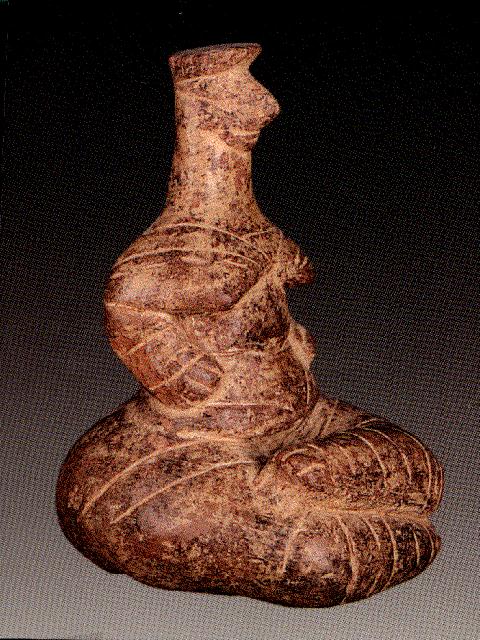
This strange figure greets the visitor on arrival at the annex where the most important finds of the Heraklion Achaeological Museum are on temporary display. She is dated to the Neolithic period c. 6500-5500 BCE and is usually identified as a Goddess or Mother Goddess figurine
The first thing that strikes us about her is that she is human and other than human. Her overall form and seated posture mark her as human. But if she was meant to be a human figure, either her creator was not very skilled—or she had other things in mind.
Gimbutas says that references to birds and snakes are common in the Old European symbolic imaginary. It seems to me that one of the reasons for is this is birds can fly and we often wish we could, while the movements of snakes inspire many of our human dances. In addition, migrating birds and snakes emerging from hibernation are harbingers of spring and the renewal of life. Both lay eggs, symbols of the regeneration. Birds are very good parents, while snakes are good housekeepers, cleaning the house and farmyard of mice and rats.
Looking more closely at the figure pictured above, we can “read” her “beaked” face as a reference to the power of birds. Her thick arms and legs can be seen as “snakelike.” She is both a bird and snake Goddess. The Indo-European Greeks who drew a sharp line between humans and animals, would have found such an image “repulsive.” Our old European ancestors must have lived in another world: one which admired the powers of animals and viewed them as “our relatives.”
What about the lines that mark her body? Referring to hundreds of pouring vessels marked with similar lines, Gimbutas concluded that these are “water lines,” reminiscent of the flowing of rivers and the pouring of water from vessels.
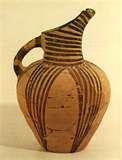
Our Goddess then is also identified with water, the Source of Life, and with the women who collected water for daily use.
This little Goddess is wearing a flat hat or cap. This type of hat is still associated with the Greek Orthodox priesthood and may also have inspired the “cap” that goes with the academic “gown.” Similar hats are widely worn by female figures for thousands of years in widely dispersed areas all over Old Europe. It is likely that such hats were originally ritual garb for women.
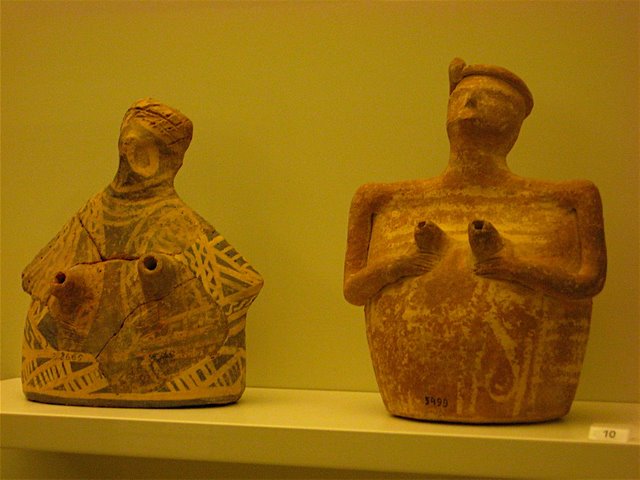
What about the seated yoga-like position of our Goddess and her broad hips and backside? The seated position affirms her grounding and connection to the earth. Her sacred parts touch the earth and her generous proportions refer to the abundance of life-giving Earth.
Is she a mother? She is not obviously pregnant or holding a child, facts which, given our propensity to speak of Mother Goddesses, we might not even notice.
Reviewing the symbolism we have “read” on this simple female figure, we can see that she is associated with birds and snakes and thus with the coming of spring, the powers of flight, the dance of the snake, with eggs and fertility, with the parenting skills of birds and the housekeeping skills of snakes. She is also associated with water sources, the Source of Life, and the collection and pouring of water. Her hat marks her as sacred, and her sacred female parts are touching the Earth.
I think we can read her as a Mother Goddess, but only if we understand that the Earth itself, the Source of All Life, is the Mother to whom the figure refers.
Discover more from Feminism and Religion
Subscribe to get the latest posts sent to your email.

 Feminism and Religion
These words of Carol’s make a critical point.I think we can read her as a Mother Goddess, but only if we understand that the Earth itself, the Source of All Life, is the Mother to whom the figure refers. MOTHER does not have to refer to literal human mothering but is a way of being in the world, a way that western culture desperately needs to embrace. A WAY OF BEING THAT ACKNOWLEDGES AND SUPPORTS THE EARTH AS THE SOURCE OF LIFE…..I’ve said this before – the very first clay sculpture I ever made emerged out of river clay I found bubbling up on a beach that once belonged to RACHEL CARSON – “Mother of the Environmental movement” a brilliant biologist who wrote SILENT SPRING ( 1972) a book that denounced the chemical industry – called hysterical and crazy – no one listened – today we are still using a billion of the same chemicals throughout the world – next time you consider using DEET keep that min mind – we continue to poison ourselves without restrictions – Carson got DDT banned in the US but it was immediately used by Mexico – and so it goes
BYW that sculpture that emerged out of my hands on that beach scared me – it was both a bird and snake – a sculpture I later saw in one of Gumbutus’s books.
LikeLike
That’s the problem with Gimbutas. There is a lot of fantasy and overconfidence about things that do not have clear evidence and writing. There are many ways to interpret figures and signs, as archaeology talked about then and is talking about now. It is no longer correct to describe each female figurine. Since many of the “Venus” figurines that were described as female, in fact, could be asexual or even male. To describe every female figure as a Goddess is akin to madness. For it has long been known that it is foolish to describe the cultures of very ancient peoples who do not even have a written language based on our understanding of religion. They might not have any gods at all. That’s right, thoughts.
LikeLike