

In the origin stories of the Greek deities the overarching importance of water, which surrounds their domain, is undeniable. Water held the power of life, death and renewal.
In each successive pantheon of Greek goddesses and gods — the Primordials, the Titans, and the Olympians — a goddess and a god ruled the seas together. During the time of the Primordial deities, it was Thalassa and Pontus, followed by the Titans, Thetys and Oceanus, and Doris and Nereu, and finally by the Olympians, Amphitrite and Poseidon.
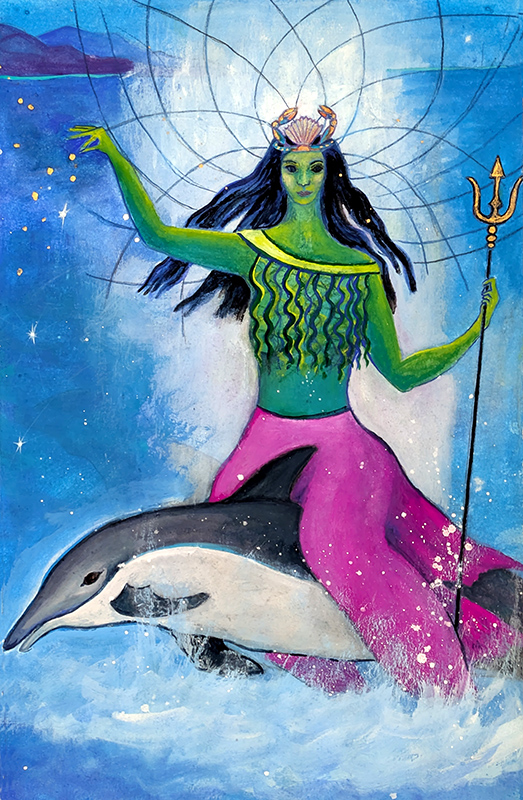
Most scholars place Amphitrite as one of the Nerieds, the daughters of Doris and Nereus. Though some believe she is an Oceanid, the daughter of Oceanus and Tethys. Either way, in the mythology of the Olympians, Amphitrite was the eldest of either fifty Nereids or 3,000 Oceanids, not a goddess. In this view, Amphitrite was raised to the status of goddess only upon her marriage to the Olympian Sea God Poseidon.
Symbolic Meaning:
Fertility, Abundance, Good Luck, Protection, Healing, Wisdom
Marriage to Poseidon
Her most well known myth involves her marriage to Poseidon. One day, as Amphitrite danced with her sisters on the beaches of Naxos in the Aegean Sea, Poseidon saw her and instantly desired to make her his wife. Unfortunately for Poseidon, whose tempestuous nature was well-known, Amphitrite had no interest in giving up her life of freedom to become his wife. She ran away and hid in the Atlas Mountains of North Africa.
But Poseidon, whether out of love or perhaps lust, could not let her go. He sent gifts of pearls, coral, and other treasures from the deep; yet Amphitrite still refused his advances. In his desperation, Poseidon turned to Delphinus the dolphin for help. Delphinus spoke to her on Poseidon’s behalf, urging her to marry him so that she could temper his fiery nature and protect the sea and all its creatures. Eventually, Amphitrite relented and agreed to marry Poseidon. In gratitude, Poseidon granted Delphinus eternal life in the heavens, where he became the Delphinus constellation.
Connections with the Primordial Sea Goddess, Thalassa
It’s possible that Amphitrite is much more than just a sea nymph elevated to the status of Goddess by her marriage. Some scholars suggest that she is a renewed embodiment of the Primordial Sea Goddess, Thalassa, who exerted influence over the natural world long before Poseidon.
Homer wrote of her as the sea in The Odyssey:
“No one can say for certain where he died,
whether he went down on land at enemy hands
or out on the open sea in Amphitrite’s breakers.”
In the 4th century AD, the Athenian orator Callistratus reported on an ancient piece of art that depicted Amphitrite as ‘a creature of savage and terrifying aspect.’ This portrayal inspired both awe and fear. Some scholars interpret Callistratus’s description as evidence of a connection between Amphitrite and Thalassa, who represented both the beautiful and the frightening aspects of the sea.
Though this painting is not the norm, further clues to her more ancient origins might lie in her name, which means “the third one who encircles.” In Greek creation myths first came Gaea (Earth), then Uranus (the starry sky) and finally the third element – the sea. Amphitrite’s name is thus a reference to the three seas encircling the ancient Greek world: the Aegean, Ionian, and Adriatic. Amphitrite, the third element, was both a Sea Goddess and the Aegean Sea itself.
Another hint about her ancient origins is found in the story of her flight to the Atlas Mountains of Libya to escape Poseidon’s attempts at wooing her. Amphitrite is often referred to as ‘ox-eyed.’ The now-extinct aurochs roamed across northern Africa (ancient Libya) in those long-ago days. Could she have originated in Libya, making it a safe place to seek refuge from Poseidon?
Healing Sanctuary
Though there is a tendency among scholars to discount Amphitrite’s importance, there is one ancient sanctuary which highlights her equality with Poseidon. This Sanctuary to Poseidon and Amphitrite was founded on the island of Tinos in the 4th century B.C.E., enduring until it was abandoned in the middle of the 3rd century C.E..
Amphitrite healed women in this coastal sanctuary, where she was revered as a protector and healer, particularly for women seeking to conceive. For millennia, both Amphitrite and Poseidon were honored for their healing abilities, much like the now more familiar Asclepius
Amphitrite was often depicted wearing a headdress adorned with crab claws and making a pinching hand gesture reminiscent of a crab’s pinchers. Similarly, Thalassa was shown with crab claws sprouting from her long black hair. The crab symbolizes protection, fertility, abundance, and wisdom.
Both Amphitrite and Thalassa were associated with the sea’s surface, while their male counterparts were linked to the depths. Although they are more often associated with calm waters, they could also play a role in the creation of storms. If fishermen abused their relationship with the sea, Amphitrite was known to punish them with dark skies and crashing waves. Thalassa often reminded victims of shipwrecks not to blame her for their misfortunes, asserting that it was the winds, not the tranquil sea itself, that gave rise to the waves of destruction.
Mother of All Sea Life
Though perhaps coming from an older Sea Goddess, Amphitrite’s marriage to Poseidon cemented her position in that time, as Goddess of the Sea. They lived together under the sea in a magnificent golden palace.
She was the mother of all marine life, responsible for maintaining the health and balance of marine ecosystems and protecting sea animals. Again, we find a similarity to Thalassa, who was depicted as the mother of all life in the sea in the primordial legends.
Amphitrite and Theseus
Amphitrite and Poseidon’s palace was filled with marine creatures and decorated with the jewel-like treasures of the deep. Her significance in this realm is highlighted in one of the few myths where she plays a role. She appears briefly in the story of Theseus, the son of her husband Poseidon and a mortal woman.
After his victory over the Minotaur which he accomplished with the help of King Mino’s daughter, Ariadne, Theseus prepared to depart with her. With love in their hearts, they wanted to leave Crete together. But King Minos objected, refusing to believe that Theseus was the son of Poseidon. In anger Minos threw his gold ring into the sea, daring Theseus to retrieve it. Without pause, Theseus took up the quest, throwing himself into the sea.
A pod of dolphins surrounded him and guided him to Poseidon’s underwater palace. His amazement at the glorious palace and its beautiful sea-nymph inhabitants grew when Amphitrite appeared. The ox-eyed Amphitrite welcomed him without jealousy or rancor. Such was her sovereignty that she remained untroubled by the arrival of her husband’s son by another.
She gave him King Minos’s ring, wrapped a purple cloak around his shoulders, and placed a crown—one she had received from Aphrodite upon her marriage to Poseidon—on his head. With these gifts, Theseus returned to the shores of Crete victorious and sailed away with Ariadne. Unfortunately, her story did not end well, but that’s a tale for another time.
Sea Goddess Amphitrite ruled a vast domain, offering love and protection to all sea creatures and those who depend on the sea. Her realm teems with life—dolphins, seals, and shimmering schools of fish—while her trusted sea nymphs safeguard the thriving ecosystem beneath the waves.
Sailors and fishermen paid homage to her at altars along the seashore, leaving offerings of oil, honey, and milk along with their requests for a profitable voyage and a safe return home. She either bestowed calm seas or, if that wasn’t possible, guided those in her care through the storm.
In Greek art, Amphitrite is depicted riding on a dolphin and holding either a trident or a garland of flowers. The dolphin, which symbolizes the playful and joyful aspects of the sea that she embodies, is sacred to Amphitrite.
Artists have also depicted her adorned with seaweed, coral, seashells, and other marine life. This highlights Amphitrite’s ability to bring balance and harmony to her realm and mitigate the unpredictability of the seas. She serves as a counterbalance to Poseidon’s powers, which embody the turbulent and sometimes violent nature of the ocean.
Our world today is severely out of balance, as evidenced by the increasing ferocity of storms, high winds, hurricanes, fires, and floods. Just as Amphitrite nurtured the marine ecosystem, we must recognize our responsibility to restore balance to our environment. It is imperative that we embrace Amphitrite’s wisdom—her ability to care for and protect, to bring balance and harmony, and her deep love for all life in and connected to the marine world, which makes all life on Earth possible.
View Judith’s art on her website, Judith Shaw Art
View print and merch choices of “Amphitrite” – click here – original available also
Find Judith’s Celtic Goddess Oracle and Animal Wisdom Oracle here
Discover more from Feminism and Religion
Subscribe to get the latest posts sent to your email.

 Feminism and Religion