

Part 1 was posted last week. You can read it here.
The second sand painting used on the sixth night of the Mountain Way Chant is supposed to be a representation of the bears’ home in the Carrizo Mountains. In the center of this painting is a bowl of water covered with black powder. The edge of the bowl is adorned with sunbeams, and external to it are the four sunbeam rafts, on which the Nature Spirits, the Yei stand. There is a close relationship between the Yei and the bears. In the Mountain Way Chant, Talking God, Water Sprinkler (often pictured as a rainbow) Growling God (bear), and Black God are always present.
Bears and Light are related. In the first painting there is light that surrounds the bear and light is present in the form of sundogs that are positioned in each of the four directions. In the second, sunbeams are present in the center and also in each of the four directions providing places for the Yei to stand. It’s very difficult not to draw the conclusion that the light that we are speaking of is also an inner light, and this is consistent with the qualities of healing, insight, and introspection that the Navajos associate with the bear.
After each sand painting has been created and used for a healing it is then destroyed. With the first bear painting pictures erasure begins by erasing the tracks of the bear and moves around the circle obliterating the four directions beginning in the west.
Many aromatic plants are also used during these ceremonies to help restore harmony reflecting the importance of the ‘plant people’ to the Dine’ and to the bears.
The last dance of the Mountain Way Chant occurs at night inside a huge Circle of Spruce boughs that are brought in to a circle and then burned at the very end of the ceremony. Although this next point does not directly refer to bears I want to mention it briefly. Although grizzlies did not, Black bears co – evolved on this continent with trees during the last ice age and even today cannot be found in areas where they are absent. Black bears must have trees to climb in order to protect themselves and their young from predators. My point: Black bears and trees co –exist as a unit. They inhabit the same field. Thus the importance of spruce boughs representing the sacred trees in these ceremonies cannot be stressed enough.
What follows are translations of three songs “that the women who have become bears sing.” These women have become holy people.
(1)The maiden that becomes a bear
walks far around
on the black mountain.
She walks far around.
Far spreads the land.
(this song is repeated once substituting blue for black –
black represents a male bear, blue a female bear)
(2)The young woman who becomes a bear
sets fire in the mountain
in many places; As she
journeys on
there is a line of burning mountains.
(3) In ancient times during a year of great drought
the holy ones set fire to the mountains and the waters.
The smoke arose in great clouds from which rain descended onto the land.
The woman who sought the gods found them.
Throughout the Mountain Way Chant both male and female bears are present at different times as bears and as holy people.
As a Black bear researcher, I am struck by the correspondence between the details of the first painting and the way bears actually hibernate. Black bears prefer to den with openings to the south side, and because they walk in their own tracks they can enter and leave a den invisibly leaving no tracks at all. Note that in this painting the tracks only go one way.
I am also struck by another healing aspect of the bear that doesn’t seem to appear in the extensive research I did for this essay, and that is the bear’s apparent ability to treat itself when it is ill by ingesting certain plants. It may be that these plants are part of the ceremony but are not mentioned by name (or names that I would recognize). Certainly the Navajo knew about these plants and tubers because they were the first naturalists, people who learned directly from animals, plants, trees, through keen observation.
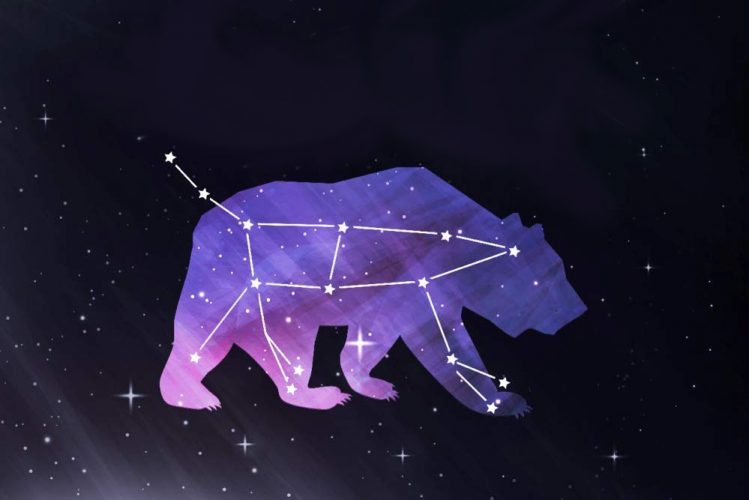
That the bear would be so important to Native peoples in the Northern Hemisphere is also not surprising if one considers that Ursa Major, the Great Bear, is among the oldest recognized patterns in the sky. This prominent cluster of bright stars is circumpolar for mid-northern to polar latitudes in the Northern Hemisphere. Interestingly, throughout the Americas Indigenous people of all tribes called this constellation the Great Bear.
Although today this star cluster conjures up other images to other peoples – stories about this particular constellation may date back to the Ice Age when ancient people could cross over the Bering Strait to North America. At that time, cultures in both Siberia and Alaska shared a common heritage. It is even possible that the constellation Ursa Major actually got its name 50,000 years ago because of a Paleolithic bear cult that existed in Europe.
Maybe the next time you look up into a velvet night sky towards the North you will see the Great Bear and think of him as being one of the most important animal healers of all time.
Postscript: It is important to note that although the Navajo have lived in the Southwest for about 1,000 years, they are related to the woodland Indians of Canada and Alaska. They speak Athabaskan, the language native to the western sub arctic and once lived in the boreal forest and made their living much the way Athabaskan peoples do today. When they migrated south along the Rockies they ended up in Arizona and other Southwestern states, and took on attributes of the Pueblo peoples. However, the foundation of their culture lies in the North Country. It is theorized that they may have reached this continent by way of Siberia. However, some sources suggest that Native peoples have been here all along. Navajo people did not hunt bears unless they were starving because they considered all bears their relatives and complex rituals surrounded any necessary kill.
Discover more from Feminism and Religion
Subscribe to get the latest posts sent to your email.

 Feminism and Religion
Sara, Thank you for this gift to all of us. … for me this especially makes me sit up and consider your words, as I’ve experienced my spirit animal as a black bear for many years now. I’ll have to reread this a few more times to understand it better.
LikeLiked by 1 person
Ah, my relationship with bears brought me to these mountains 40 years ago – not having any clue why…I ended up doing an academic study of bears (PhD) that visited me here on my land… to be called into relationship with the bear, for me at least, has been an ongoing process – I ams till learning… we kill bears here in Maine with a vengeance for 4 plus months of the year – so anguish has been visceral – last June a young bear arrived that I named Chloe – she stayed around until bait season – she was young – and had just breed for the first time -after her disappearance I kept a picture of her up in my bedroom – the room I write from – dead or not this little bear lives on for me – as I said I am still learning – I have a Canadian film – culture unplugged – Charlie Russell ‘The Edge of Eden : living with Grizzlies’ – old film – but you will learn so much about bears – just google and film will come up. Bears are considered to be ‘Root Healers’ and protectors….
LikeLiked by 2 people
Thank you for sharing your knowledge of Bear on earth and in the night sky and the people who honor them.
LikeLike
Thank you for this post. I live in the Yukon and was recently visiting the Beringia Interpretive Centre in Whitehorse with my grandson. During this last ice age there were many animals that are now extinct, including the Giant Short-Faced Bear. From the look of it, this was not a grizzly, as it had no hump. Said to be 1.5 times the size of the largest grizzly, the Kodiak.
Also interesting is that people came across the ice bridge from Siberia 12 – 20 thousand years ago and, as you said, traveled far south. Maybe even to South America?
Maria Gimbutas talks about the Paleolithic Bear Cult and its importance to women. Black Bear is my own totem as a shaman/witch.
LikeLike
The short faed bear evolved with the black bear on this continent – it was the predator – black bear the prey – to this day you will not find black bears any place there are no trees because this was how they dealt with that predator – and yes Gumbutus believed as others do that the bear (grizzly) was the oldest cave painting in the northern hemisphere – glad you liked the article…
LikeLiked by 1 person