

Two years ago I was in Pembrokeshire in South Wales. The retreat I’d taken myself to consisted of a collection of stone and flint buildings half way up a mountain and set around a farmhouse and chapel. I had come to find a way through my writer’s’ block and also to deal with a couple of really painful family issues.
My room was only a half corridor away from the chapel itself. It was four o’clock in the morning and because I was quite close to the kitchen on the other side I had my earplugs in. Despite all this, on the second night, I quite clearly heard a woman’s voice calling “Madeleine,” loudly enough to wake me and send me looking down a deserted corridor. It was not imagined or metaphorical, but distinct and unmistakably real. The experience startled, not because I was afraid but because I recognised the truth of it. This familiar, maternal and sacred truth led directly to the writing of Maiden Mother Crone, my second poetry collection just a few months later as well as a resolution of the two other issues that had weighed so heavily on my mind.
That moment returned to me recently, during another retreat at the same centre, where I found myself in conversation with a fellow attendee, a fundamentalist pastor. He was resolute in his view: “God the Father is precisely that,” he said, warning that to conceive of God in any other way was to risk spiritual confusion, or worse. When I shared my experience of hearing the Divine in a woman’s voice, his response was swift and sharp. He likened it to false revelations and spoke of ‘”the enemy’s” deception.
Later that day, as I was lighting the candles in the darkening chapel, when he walked through the door. After a few moments he broke through the silence to request I allow him to pray for my “deliverance.” What unfolded in that sacred space which contained just the two of us, was difficult but ultimately revealing. I was not cowed or angered. Instead, being grounded in scripture as well as widely read around Celtic Christianity and its associations with ecofeminism and pilgrimage, I was able to make my argument well.
I believe my positive, evidence-based approach when coupled with my question as to why I, who’ve been hurt and silenced by lived experience, should entrust myself to his worldview, one that seemed to erase my own spiritual reality, allowed me to reach him. Despite misguided intentions, I do believe he was earnestly trying to help. So, when I went on to present him with the indisputable fact that many women seek the Divine in alternative ways – new age practices for example providing a higher power experience, without the accompanying spiritual rigour or indeed protection a world faith affords – I could see him really listening.
By the end of the conversation, something had shifted. We prayed, not as adversaries, but as people trying to understand God from opposite shores. Still, I was left wondering: what happens when a woman less confident, less scripturally rooted, has such an encounter; especially in what is ostensibly a ‘safe space’. What if she walks away believing there is no place for her in ‘the Father’s house’? What if her story, like so many others, is dismissed?
This question lies at the heart of my latest poetry collection, Maiden Mother Crone, described by Buzz Magazine Wales as: “A compelling, highly affecting memoir in verse that delves into the intricate tapestry of womanhood….an exploration of personal transformation through the lens of myth, the divine feminine, and Christian spirituality.” The poems are part myth, part prayer, part battle cry. They speak to the journey so many women take to reclaim spiritual space in a tradition that has often rendered them invisible or voiceless.
In Maiden Mother Crone, the divine feminine is not simply an idea, it is embodied. It speaks in many voices: as myth, as memory, as landscape. The collection continues the work begun in The Horse and The Girl, where the act of dialogue, between woman and horse, between writer and world, become a metaphor for self-discovery.
But while Maiden Mother Crone is personal, it’s also political and theological, challenging the narrowness of spiritual narratives that exclude or diminish the feminine. It stands as a ‘cri de coeur’ for those women who have been side-lined, abused or exiled from faith communities, urging them to find, or found, their own seats at the table.
Too often, the metaphor of fire in Scripture is framed in terms of judgment or purification. But for women fire can be something else entirely: a source of energy, of clarity, of uncontainable voice. In an earlier article on “fire and the feminine voice,” for the prestigious Writers’ and Artists’ organisation in the UK, I wrote about this shift, not just as metaphor, but as lived experience. I focussed on Midlife as a furnace in which old roles and scripts can burn away. What remains is raw, real, and holy and the workshops I led to accompany the feature around my collection, inviting others to write also, seemed to prove this point.
It is worth remembering, though, that this reclamation is not always welcomed. In spaces meant for sanctuary and growth, women’s spiritual authority is still often questioned, especially when it diverges from patriarchal norms. The woman who claims to hear God as Mother, or who seeks wisdom in the rhythms of the earth, is too often labelled as suspect. But I believe these experiences are not only valid, they are vital. They call the Church to a broader vision of the divine, one that reflects the full image of humanity in God: “Male and female, He created them.”
The danger of dismissing such experiences isn’t just theological error, it’s pastoral harm. When women are told, directly or indirectly, that their spiritual instincts are untrustworthy, the cost is real. Feeling unheard at best and abused at worst, many walk away not just from the Church, but from any hope of belonging to a spiritual community. The house of God, we’re told, has many mansions, but we must ask: are there rooms prepared for women who hear Her voice?
I believe there are. And I believe poetry, storytelling, and shared experience can help us find the keys.
In a world where too many women have been told to doubt their discernment, their gifts, and even their relationship with God, let us create space for the sacred feminine to speak. Whether in a chapel or a poem, a fire-lit prayer or a whispered name, She still calls. May we have the courage to answer, not in fear, but in faith.
Spellsong (from Maiden, Mother, Crone)
I draw breath and know what’s coming next.
This song is already half-written,
coming unbidden to me last night.
Drip dripping words filling me,
till they’re ready to free themselves
from where they’re held.
I‘m just a temporary resting place,
their power depends on my faith and
it’s not a given this equals religion.
In this wildwood world of ours
Christ rides on the wind and howls
his delight at the lost souls found.
He’s in this place, but so is She,
there’s femininity in the Trinity.
She brings the road up to meet us,
allowing the sun’s kiss to greet us
and the rain to fall softly on our face.
So I walk on the moonlight
intertwined with the sunlight
till all becomes one light.
Cats’ eyes in the night.
The sum of expression between Creator and Son,
the Spirit casts words into the world,
but a poet is needed to set them free
and, at least for today, that’s me.
Part of creation’s breath, Spellsong poetry
defeats mortality by shaping reality.
As peace, joy and wonder persist
in “Come And Become” we find rest.
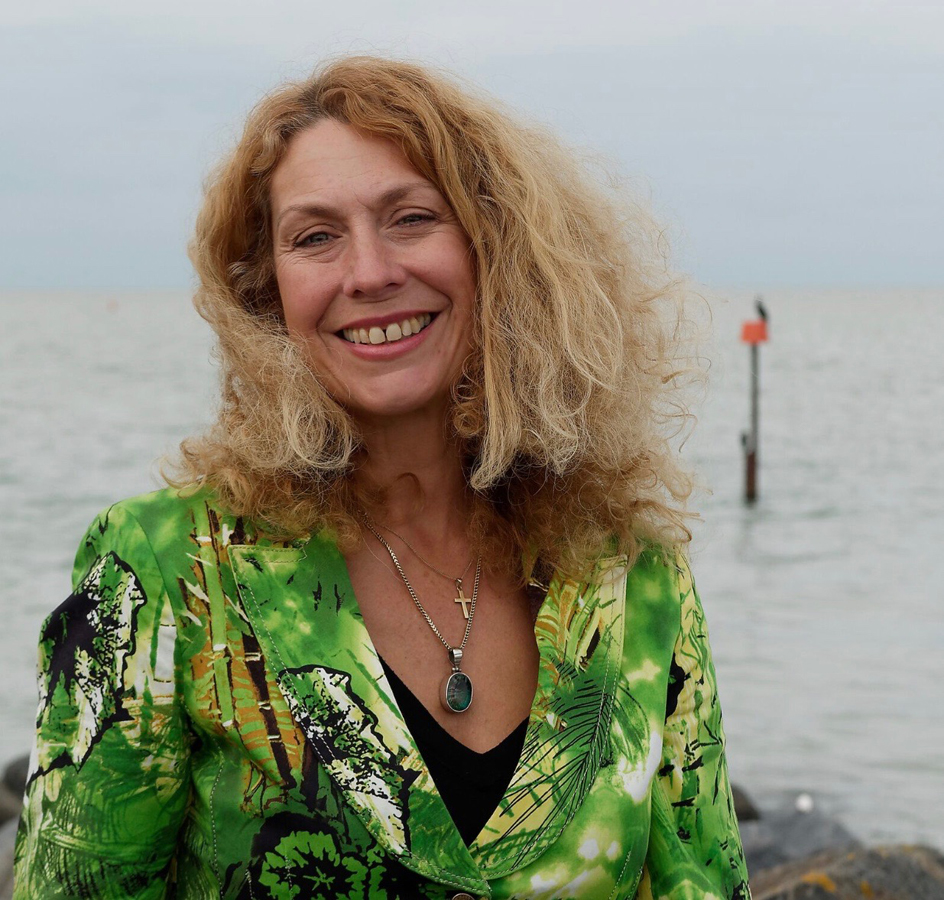
BIO: Madeleine F White is a poet, novelist and magazine editor. Living in Broadstairs in Kent, her debut novel Mother Of Floods was published by Crowsnest Books in 2020 and she is currently putting the finishing touches to a new one, ably supported by her horse Lucie who is immortalised in The Horse And The Girl poetry collection. Part of the Crossing Places series, Maiden Mother Crone is published by the award-winning woman owned Sea Crow Press and is her second published collection.
For more information on the series, and the up and the next years’ anthology which is currently open for submissions, check out the Sea Crow Press website.
Maiden Mother Crone, and The Horse And The Girl are available where all good books are sold.
Discover more from Feminism and Religion
Subscribe to get the latest posts sent to your email.
 Feminism and Religion
“women’s spiritual authority is still often questioned, especially when it diverges from patriarchal norms. The woman who claims to hear God as Mother, or who seeks wisdom in the rhythms of the earth, is too often labelled as suspect”. I know from 40 plus years of personal experience as a celebrant of earth based spirituality that this is true…we are held suspect…. – forever -I think it’s important that you shared what happened to you and how you were able to dialogue with someone who comes out of Christianity – we need more of this …opposition gets us nowhere. But I have learned that many Christians – maybe even most – are not interested. Not sure where to go with this
LikeLike
Hi Sarah
Thank you for commenting. For me the big differentiator is between the meaning of faith and religion.
Many people work their religion like a mallet, often with the specific purpose of destroying to dominate and control. The hierarchical religious structures, for example, are very patriarchal ‘ command and control’.
There is a huge difference between this and being a seeker of a faith that succours, supports, connects and heals, even in the darkest of times.
I have only realised over the last couple of years how closely my own faith is linked to Celtic Christianity, the way Christ was worshipped as part of the culture and social and natural ecosystems. This didn’t change until the synod of Whitby in 7th century, where the Roman church gained influence , mainly through huge incentives consisting of gold and ‘kingdom unifying’ arms.
Other than physically visiting places such as Iona, St David’s, Lindisfarne and Durham, which gives true perspective on how the egalitarian approach of the Desert Fathers and Mothers was brought to these Isles I gave also found Margaret Silf’s ‘Sacred Spaces’ very helpful, Sue Monk Kidd’s ‘Dance of the Dissident Daughter’ also gives powerful perspective of how the spiritual feminine has been warped and distanced from faith.
There will always be those who don’t want to hear no matter what, but sometimes a mixture of knowledge and honesty and a willingness to listen also,can get through. Those precious moments of connection are worth fighting for.
LikeLiked by 1 person