

A thoughtful gesture from a coworker—complimentary tickets to the Isabella Stewart Gardner Museum—stirred a quiet excitement within me. It’s curious, isn’t it, to reside in Boston, a city so steeped in history and intellectual vigor, yet find oneself so often distanced from its beautiful, intricate past? Time, energy, and finances often conspire to keep such access at arm’s length, even for a history buff like myself. It was a welcome reminder of the stories waiting to be discovered, right here in my own backyard.
I arrived at the museum expecting to immerse myself in the European art showcased on its website. Yet, to my profound surprise, the featured exhibit immediately drew me into a powerful narrative: one that centered the Black struggle for freedom, dignity, and the reclaiming of ancestral roots, in this case Haitian Vodou. These roots, I believe, have always grounded, protected, inspired, and empowered the African diaspora across the globe.
Anyone familiar with my perspective knows this resonates deeply with my Interfaith Womanist spiritual framework and worldview. It wasn’t just a display; it poured life into my soul. Even still, it feels almost surreal to live in a time when Black people’s stories, struggles, joy, “swag,” and spirituality are increasingly represented in mainstream spaces. This shift is not only transforming our collective consciousness and perceptions of Black people, but it’s also actively fortifying a much-needed pro-Black renaissance and cultivating a strong self concept for Black individuals. It’s a powerful and long-overdue evolution.
What an incredible discovery! The exhibit, “Waters of the Abyss: An Intersection of Spirit and Freedom” by Fabiola Jean-Louis, absolutely captivated me. Her art, I learned, chronicles her deeply personal journey toward self-acceptance as a Black woman, a profound process of reclaiming, healing, and preserving her ancestral history, all while decolonizing her mind.
And then, to read her words ,made my heart beat with such pride, power, and affirmation:
“When Black people pay attention to where we actually come from and the things that spiritually inspire and guide us, we are a stronger people. We can overcome and we will overcome.”
It’s truly exhilarating to see such a potent message brought to life through art, echoing sentiments that resonate so profoundly with my own spirit. What a gift to experience!
This profound artistic expression underscores the very power of healing and truth. It powerfully echoes my own convictions, laid down in 2019 in a paper titled, A Black Liberation Theology of Wholeness: Post-Colonial Thought from the Intersections of Womanist Theology & Thought and Yogic Philosophy, where I asserted:
“Justice is wholeness, in the sense of well-being; wholeness, in the sense of well-being for the Black community requires social transformation.”
It is a stark reminder that being whole and resting in bliss is our birthright, a state rendered impossible when we remain disconnected from our origins.
This exhibit vividly brought to mind bell hooks’ powerful insights in Sisters of the Yam: Black Women and Self-Recovery. She so bravely explores Black women’s inherent right to autonomy and to live authentically in their truth. I was particularly struck by her use of Scott M. Peck to highlight the damage we inflict upon ourselves when we divorce from our truth. It’s such a crucial point:
“Scott Peck’s popular discussion of a new healing psychology emphasizes the link between dedication to truth and our capacity to be well. He stresses that one of the roots of mental illness is invariably an interlocking system of lies we have been told and lies we have told ourselves. Commitment to truth is the first step in self- recovery.”
Absolutely, yes! For Black folk to genuinely achieve wholeness, we simply must commit to decolonizing our minds and lifestyles. It’s the only way to truly empower ourselves to live out our truth, unapologetically and completely! What an inspiring call to action, brilliantly reflected in both hooks’ words and Jean-Louis’s art!
This deeply resonates with Audre Lorde’s powerful insight:
“In order to perpetuate itself, every oppression must corrupt or distort those various sources of power (& truth) within the culture of the oppressed that can provide energy for change.”
These sentiments collectively reinforce the absolute necessity of studying and reconnecting with our ancestral traditions. These are the traditions that have miraculously morphed and adapted, enduring through the brutal forces of enslavement, colonialism, white supremacy, and patriarchy. Nevertheless, they survive! It’s a critical truth we must accept: even with this resilience, some of these traditions carry patriarchal infusions as a direct result of colonialism, making decolonization an ever-ending process. This journey of reclaiming our authentic power is continuous, and profoundly vital.
The healing powers of art, vulnerability, and self-respect through representation and creativity truly have the capacity to profoundly impact both the Black psyche and the global perception of Blackness—fostering a more diverse, complex, and respectful understanding. In so many ways, Fabiola Jean-Louis’s art embodies a spirit strikingly similar to my own book, Black Gold: The Road to Black Infinity. Both projects stand as brave acts of vulnerability, aiming to inspire our communities to reclaim and recover ourselves. We must, with urgency, reconcile the split consciousness that W.E.B. Du Bois so acutely identified—that disorienting experience African descendants develop simply to survive and function in spaces not meant for our thriving, places indeed designed for us to be sick, unwell, and ultimately, to perish. This reconciliation is paramount.
W.E.B. Du Bois’s concept of “double consciousness” in The Souls of Black Folk, describes the psychological challenge faced by Black people in an un-liberated society. It’s not only about having two separate souls, but rather the tragic, unreconciled conflict between being both “an American” and “a Negro”—always seeing oneself through the demeaning eyes of a world that holds them in “amused contempt and pity.” It is living as a hybrid – living with a mask that cannot be removed. This perpetual internal battle prevents Black individuals from being whole.
True revolution, a radical re-imagining of our societal frameworks for life, governance, race, gender, sexuality, spirituality, church, and theology, will erupt only when Black people reclaim and prioritize their inherent wholeness.
Consider the undeniable power embedded in our spiritual heritage.
“A Vodou ceremony, a profound communion with ancestral spirits, was the catalyst for the Haitian Revolution—a seismic overthrow of French colonial rule and the brutal abolition of slavery. The abhorrent violence of the sugar plantations, which claimed hundreds of thousands of enslaved African lives, began to crumble one August night in 1791. Hundreds of enslaved people gathered, calling upon their spirits to advise and ignite a movement for liberation. For them, as for Fabiola Jean-Louis, the freedom of the physical world is inextricably linked to communication with the spiritual.”
Jean-Louis’s artistic framework channels time-traveling, shape-shifting spirits to serve the global pursuit of Black freedom. As reflected in her gallery, her art is a testament to the power of creativity to heal, inspire, and enact profound, meaningful change. This is not merely art; it is a spiritual imperative. Interfaith Womanism is the future and this art captures its spirit.
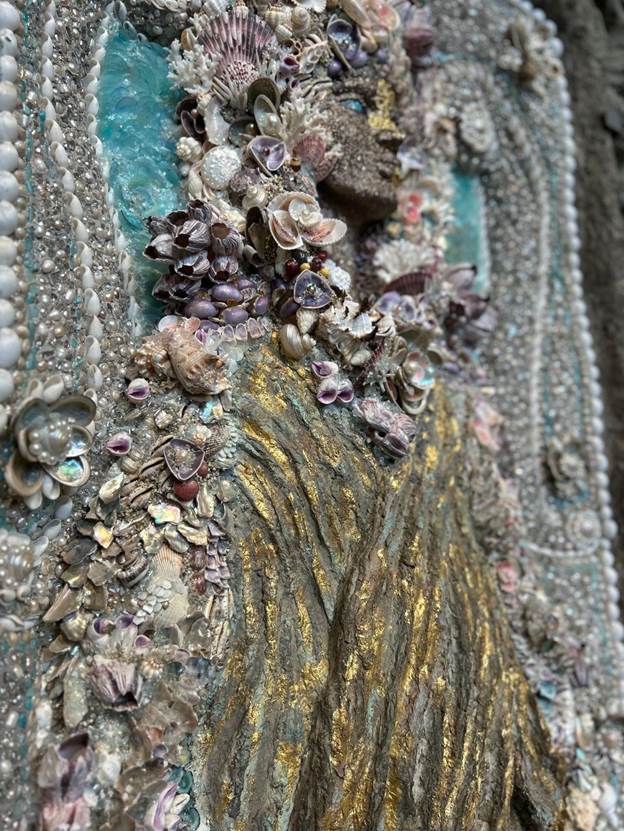
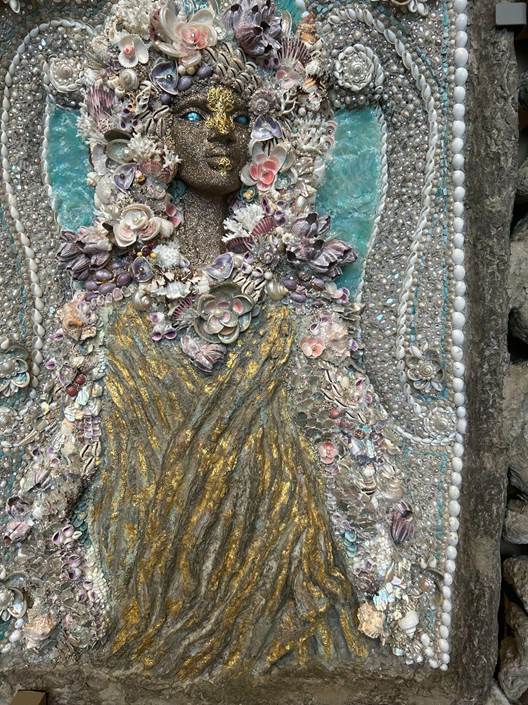
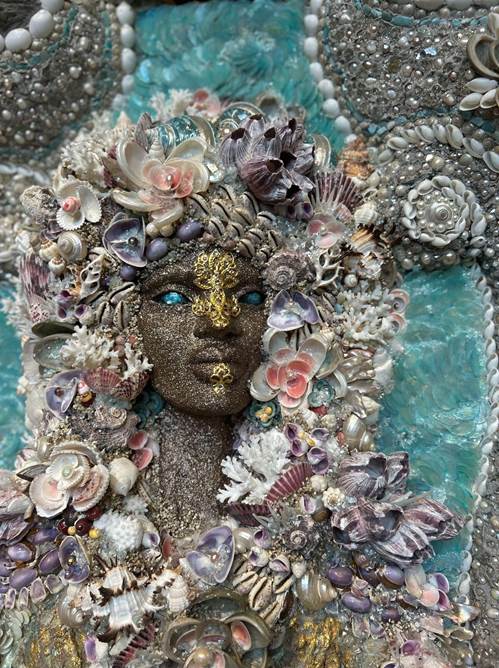
Words to describe how this speaks to me:
Divine feminine energy, eclectic, gentle, soft, fierce, ancestral spirit brought to life in color, endless depth, primordial element of water, witch craft, goddess, living art, focus, dedication, passion, ancestral connection, depth, defiance through existence, contentment, peace.
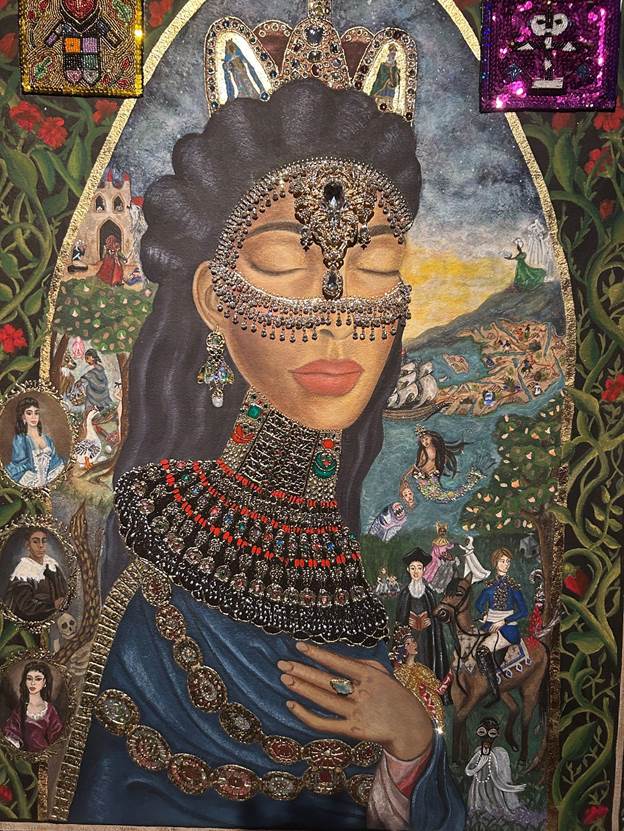
Paying attention to the details in the background. Grace, dignity, liberation, history, time travel, interdimensional, recovering past life and ancestral memories, Black ass Vodou ceremonies, motherhood, decapitating colonialism, retribution, rage, vengeance, transcendence, colonization, sacrifice, royalty, divinity, and beautiful vodou symbology.
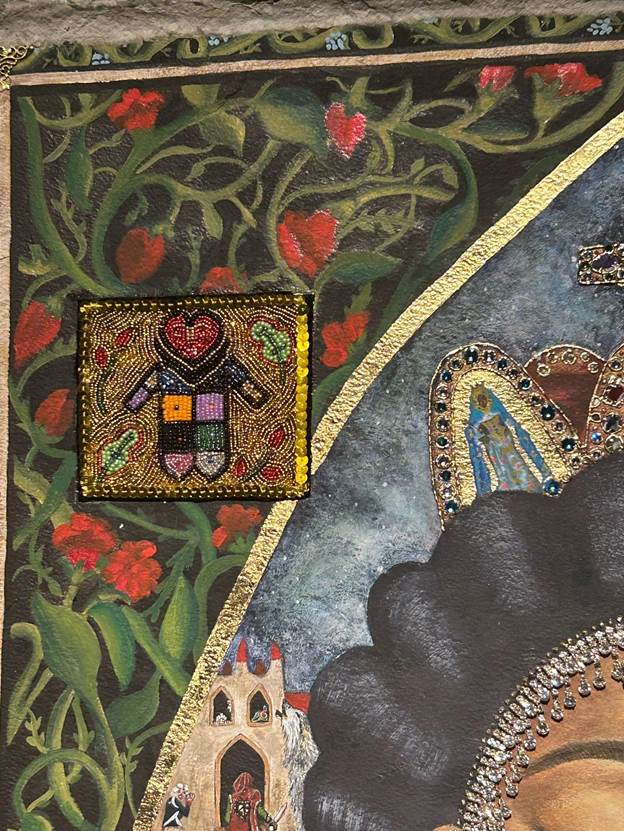
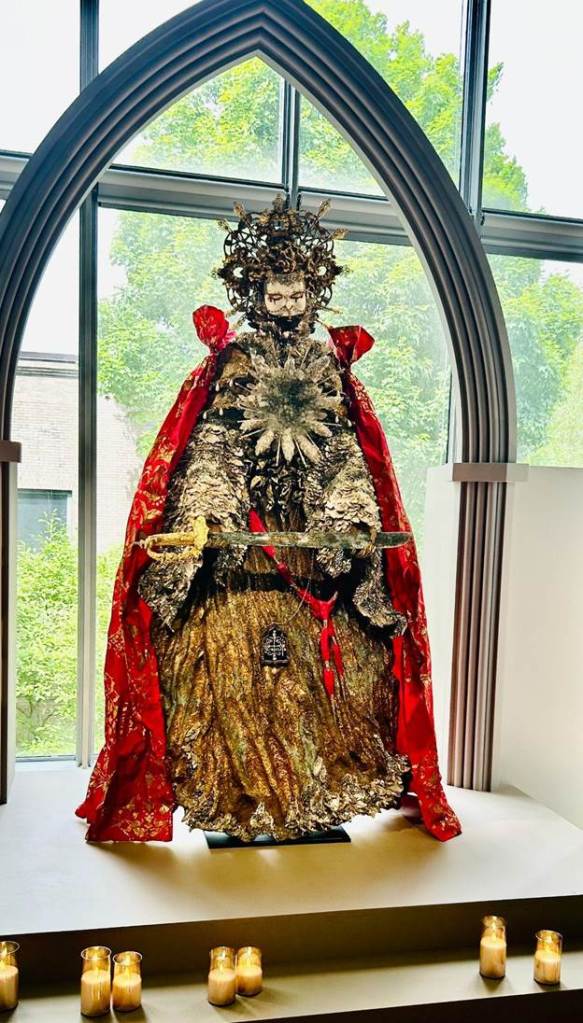
When I took in this piece, I immediately felt the urge to kneel down and pray. I didn’t.
I feel reverence, grace, beauty, command, primal survival cloaked in grace and wisdom, leadership, protection, grounded in Vodou symbols
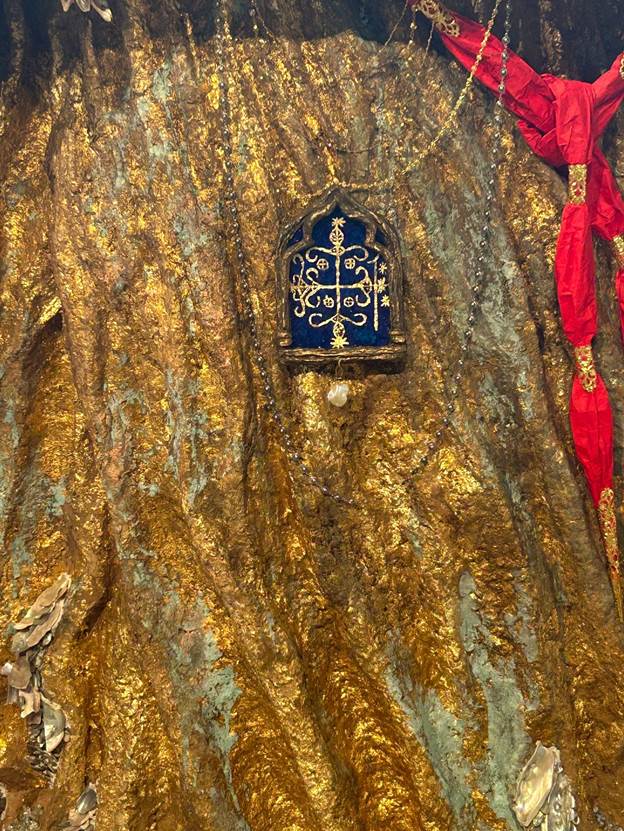
“Legba is the keeper of the crossroads, the guardian of the liminal space between the earthly and supernatural realms where magic occurs.”
Justice Ifafunmilayo Isaacs, “The Hoodoo You Knew” : An Afrocentric (Re)location of Conjure and Hoodoo Cosmology via James Davidson, “A Cluster of Sacred Symbols”: Interpreting an Act of Animal Sacrifice at Kingsley Plantation, Fort George Island, Florida
Discover more from Feminism and Religion
Subscribe to get the latest posts sent to your email.

 Feminism and Religion
I love that museum! I love Boston!
LikeLike
This art speaks to me also.
Thanks for sharing!
LikeLike
Beautiful, powerful post! Thank you!
LikeLike
Thank you for this inspiring art and your powerful insights. Near where I live, in Charleston and Beaufort, SC, there is a large group of creative Black women artists, prominently featuring textile arts. Some of their most recent shows have been “Black Gold,” “Black Mermaids,” and most moving, “Black Madonnas.” Deep and soul-stirring work.
LikeLike
Thank you for writing this. I was fortunate to visit the Whitney Museum of American Art in NYC when, Edges of Ailey, was exhibited. Art and music combined. It included prominent Black women in Alvin Ailey’s life. I also felt what you wrote, that it is “fostering a more diverse, complex, and respectful understanding. “
LikeLike