

Part 1 was posted yesterday
Combining ancient wisdom and western science

At age sixteen Beresford-Kroeger was graduated from her mentorship of the Lisheens and went on to become a scientist, learning medical biochemistry and botany. Eventually she saw that many of the things she learned from the Lisheens elders could be scientifically proven. This offered her delight and reassurance.
One of the first of these was the plant Chrondrus crispus or seaweed named Irish moss. Her Great-Aunt Nellie taught her that it cured tuberculosis and how to prepare and use the gel-like mucilage it released upon being boiled.
In the lab Beresford-Kroeger later discovered that this mucilage has antibiotic properties.
“The feeling this confirmation of Nellie’s teaching gave me is hard to describe. I loved my teachers in Lisheens, but I hadn’t completely ruled out the idea that the things I’d been taught there were just old superstitions. I needed to confirm them for myself. There was always the chance that there would turn out to be nothing of import in the plants they’d emphasized to me, and nothing more to the ancient knowledge than beautiful clouds of vapor”(96).
She began to understand that what she had been taught was an oral tradition and that it existed in no other format and that she was meant to be a bridge between “the ancient and the scientific”(97).
“My teachers in the valley might have indicated that a particular plant was good for poor circulation, which I’d taken to mean heart trouble. I would then know to keep a particular eye out for the presence of any chemical known to benefit the heart. “Well, Diana,” they might have begun, while cradling a small, five-pointed yellow flower in the crook of two fingers. “St. John’s Wort, as you see here, has a strong medicine for nervousness and mental problems.” I would later find out that St. John’s Wort contains phytochemicals such as hyperforin, which increase the effectiveness of dopamine and serotonin in the brain. The plant is as effective as many prescription anti-depressants, and may in some cases be more effective”(98).
Beresford-Kroeger ended up doing her Ph.D. at Carleton University in Ottawa, Canada in l969 where she explored the tryptophan-tryptamine pathways in trees, proving that:
“such pathways existed in plants—in some more than others, and in trees most of all.
Plants contain the sucrose version of serotonin as a working molecule. It is a water-soluble compound in, say, a tree. Serotonin is a neuron-generator. By proving that the tryptophan-tryptamine pathways existed in trees, I proved that trees possess all the same chemicals we have in our brains. Trees have the neural ability to listen and think; they have all the component parts necessary to have a mind or consciousness. That’s what I proved: that forests can think and perhaps even dream. This knowledge was new to science. Such connections were not recognized or known at the time”(120).
At the same time she had acquired 165 acres of land in the Ontario region and began cultivating it, focusing on planting trees that were on the brink of disappearing or even believed extinct, traveling all over the world to find a species thought gone, and planting it on her farm. She has dedicated her life learning what certain plants and trees need to grow and prosper and how different areas of the world will be able to maintain certain species as the climate continues to change. She has created a survival plan for all of us for the coming times.
“Bioplanning” was a term I coined to describe it. Like many things in nature, it is a simple concept that opens up into endless complexities. As I wrote, the bioplan is “the blueprint for all connectivity of life in nature.” It is the web, both seen and unseen, that ties the willow to the sapsucker to the butterfly to the ichneumon wasp—and ties all of them to us. It is the evolutionary framework, the balance, the give-and-take-and-give, that allows life to exist and thrive on our planet. Bioplanning is the act of aiding and encouraging the bioplan. In a garden or on a farm, that means realigning the garden to encourage its use as a natural habitat”(149).
She went on to develop a plan to offset climate change called the Global Bioplan which involves every person planting one tree per year for the next six years. That is all it would take to offset climate change.
The Celtic Alphabet of Trees
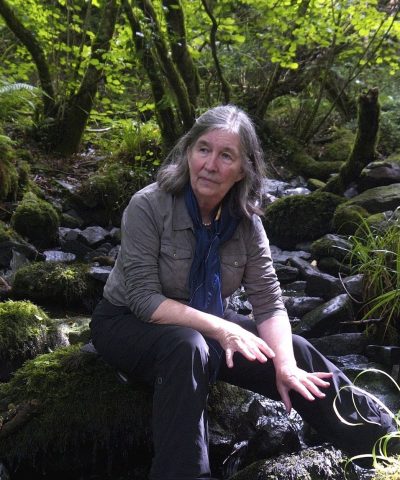
Beresford-Kroeger dedicates the second part of this book to the Celtic Alphabet of the Trees: the Ogham. This was another teaching gifted to her growing up in the Lisheens, The Celtic Alphabet of Trees is called the song of the universe and was dictated to a young man named Ogam. Each of the letters is named for a tree or associated woodland plant.
In a fascinating series of chapters, Beresford-Kroeger lists each one and their associated tree or plant and then gifts the reader with more sacred and scientific information about each. There is age old wisdom seeping through these pages. I find myself going back to them again and again and also learning things I had been searching for. It is a beautiful and generous offering and I recommend anyone interested in a Celtic lineage to read it themselves. It is reference and a prayer.
It must not be easy to send these sacred teachings out into the anonymous world of readers she will never know but Beresford-Kroeger also knows that time, both hers and ours, is short and she needs to spread the word, literally, as well as the seeds she plants, quickly.
The sacred Oak, Dair, is D.
H is for Hawthorne, Huath. This tree was believed to be:
“an entrance to the world of the síoga, the fairies, the people of good deeds or na daoine maithe. . . .
“The Druids schooled both genders equally. Theirbelief system was governed by the concept of the soul, anam, and the spiritual guidance, anamchara, that arose from everywhere. They believed that the living world was filled with soul, from the water to the mountains, to the grass, to the wild animals and insects. All of life was connected by this soul and, because of that, life in all of its forms needed to be protected.
Anam spread into the afterlife, like a great sheet of consciousness. The fairy people lived in this parallel world and could come and go at will”(207).
She also explores the medicinal use of Hawthorne for heart ailments and the chemical constituents of the plant that make that true.
And then we arrive at the letter U. Úr — Heather. In this beautiful passage Beresford-Kroeger educates us about the properties of the Heather that are curative to the lungs, the chemical stamp of arbutin. A walk through the Heather would release just the right amount of this to heal the lungs.
She explains how the Druids could read the weather in the Heather and educates us in stunning prose about the Heath, where the heather grows:
“Heath land is one last memory held in the soil of the ancient forest system of the planet. The plant called heather, fraoch, with its carillon of tiny open bells, grows on the heath in the luxury of sweeping air and well-drained soil. The soil, another clue to times past, is a mixture of sharp sand and peat. The sand came from the ice-age scouring of the rocks and the peaty humus came from the mercy of trees.
The Celts understood this landscape, filled with birds on the wing and game birds nearer the soil. Butterflies and insects abounded in their ocean of flowers that stretched into and confused the horizon. Long ago, the Druids pointed to the heath and gave it a name, úr, which means anything that is fresh, green and renewing. This word also came to mean free, liberal and generous. The heath, úr, is a place of giving for everyone, from animal to human”(245).
The poetry that Diana Beresford-Kroeger creates with her integrated wisdom traditions is a treasure to behold and the world is made better by it.
Diana Beresford-Kroeger is a Nasty Woman of STEM.
©Theresa C. Dintino 2023
Works Cited
Beresford-Kroeger, Diana. To Speak for the Trees; My Life’s Journey from Ancient Celtic Wisdom to a Healing Vision of the Forest. Oregon, Timber Press, 2019.
Discover more from Feminism and Religion
Subscribe to get the latest posts sent to your email.


“She began to understand that what she had been taught was an oral tradition and that it existed in no other format and that she was meant to be a bridge between the ancient and the scientific”…. Diana tapped into the Indigenous way of learning – we would do well to pay attention
LikeLike
What a wonderful review of a brilliant author. What valuable wisdom passed along to all of us. Thank you so much.
LikeLike