

This was originally posted on December 2, 2013
 Olives are being harvested in the fields outside my town these days. We have been having the first rains of the season. The roads are wet and muddy, and the trees are partially shrouded in mist. The fields are spread with black plastic nets, and people are hard at work, the men hitting the trees to make the olives fall, and the women picking up the olives from the nets. The harvest will continue throughout the winter.
The olive press is busy. Cars and trucks come and go, unloading heavy bags filled with olives. These days the bags are white, made of sturdy woven plastic. In Crete this fall several of us bought canvas olive bags, hand-woven by women. These, along with baskets hand-woven by men, were still in use only a few decades ago.

A friend who died a few years ago told me that “in the old days” there were no nets. The women and the children had to pick the olives up from the ground, often cutting their hands on thorns and stones. The nets are a Goddess-send. Between harvests, the nets are simply folded up and placed in the crotch of the tree. Here no one steals them.
In the fields where I walk some of the trees have enormous trunks. Some of them have two trunks, growing like sisters. Many of them are 300, some perhaps 500, years old. A man emerges from a field that has some particularly old trees. I ask him how old they are. “Older than I am,” he replies. “They were here before I was born. They will be here after I die.”

Here the olive harvest is not mechanized, so even with tractors, cars, and nets, old rhythms continue.
The trees bear. The olives are harvested in winter. Oil is produced, stored, and sold. Some olives are blanched with salt for weeks. In the late winter, the trees are pruned. The trees are kept low enough to manage. The sun must reach the olives, so the trees are thinned so that the light shimmers through them. This is why they look so beautiful in the wind. In the spring the trees flower. All summer long the fruit ripens and the olives grow larger. Just as the olives begin to fall from the trees, the harvest begins again.
Olives have been cultivated for at least 6000 years, from at least the middle of the Neolithic period. Evidence of the most ancient olive cultivation is found in Syria, Palestine, and Crete. It is likely that women were the first to pick and discover how to preserve wild olives. Why? Because women were the gatherers, and they were ones who prepared the food they gathered. Thus it is likely that women first cultivated the olive, and that they chose the varieties that were cultivated.

The olive is known as the immortal tree. This is because shoots are always springing up from its roots. Even when it is cut down, it will grow again. No wonder the olive cycle was once considered sacred and the olive tree a holy tree.
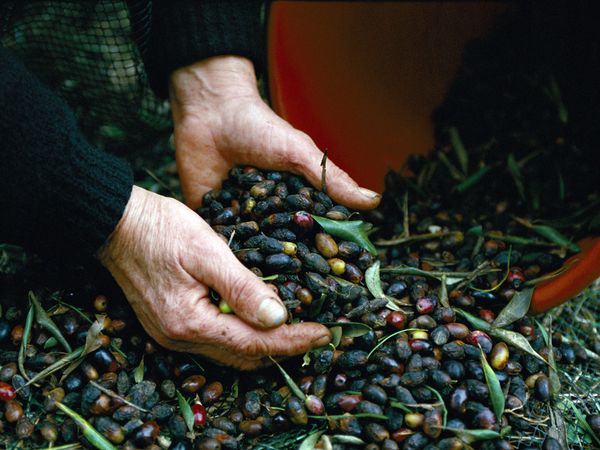
As I walk through the fields I like to think of people harvesting fruit from trees passed down from generation to generation. I try to imagine what it would feel like to pick olives from the same trees that my grandmother’s grandmother harvested. I imagine feeling firmly rooted in the tradition of the olive harvest, knowing that my grandmothers were here before me, and my children and grandchildren will come after me. My knowledge and appreciation of it is one of the ways I have become Greek.
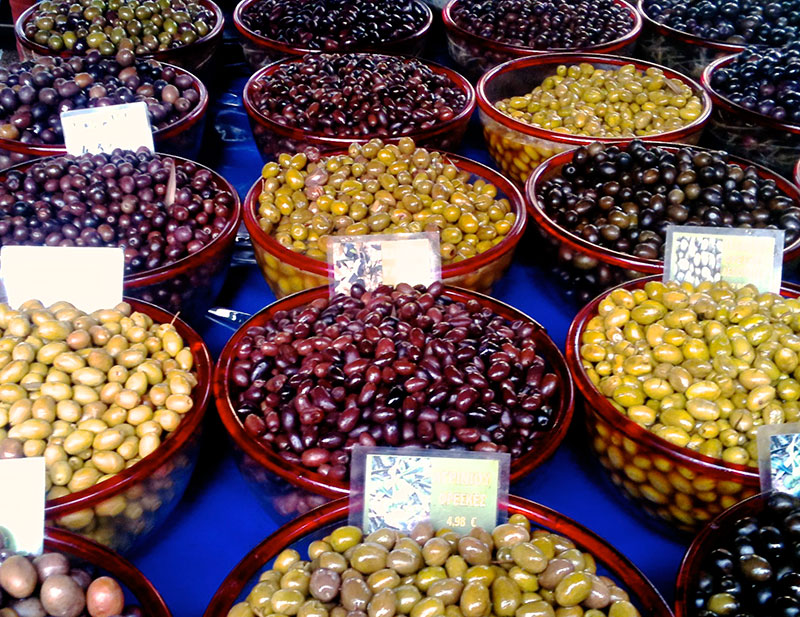
In Greece there are many different kinds of olive trees, many different kinds of olives, and many different colors and flavors of oil. In Kalamata they say that the best olive oil is thick and green. Here in Lesbos, our olive oil is light and golden, with a slight flavor of nuts. In Crete they preserve tiny olives, the size of two peas. In Lesbos, our local olives are larger, black, and when preserved wrinkled. In each area of Greece the olive trees have been nurtured and selected. They are resistant to disease, and they don’t need to be watered. The locals say they bear a heavy crop every other year.
In Crete, the European Union has encouraged people to uproot their olive groves to replant them with higher yield trees. The new trees need to be watered. Already this process has lowered the water table. In the European Union they say there is a glut of olive oil on the international market.
Olive oil is the healthy oil. It not only does not create “bad cholesterol,” it creates “good cholesterol.” What if olive oil were used as the common oil around the world the way it is here in Greece? Food would taste better, people would be healthier, and the olive harvest would be profitable.
In America olive oil is a luxury. Americans pay top dollar for small bottles of Italian olive oil. They don’t even know that much of the Italian oil they buy was harvested in Greece. Here in Lesbos our farmers sell their oil for 3 euros a liter. Some don’t even bother to harvest their trees because there is so little profit. There is something wrong with this picture.
Carol P. Christ has recently returned from the fall Goddess Pilgrimage to Crete which she led through Ariadne Institute. It is not too early to sign up for the spring or fall pilgrimages for 2014. Carol can be heard on a WATER Teleconference. Carol’s books include She Who Changes and Rebirth of the Goddess and the widely-used anthologies Womanspirit Rising and Weaving the Visions.
Discover more from Feminism and Religion
Subscribe to get the latest posts sent to your email.

 Feminism and Religion