

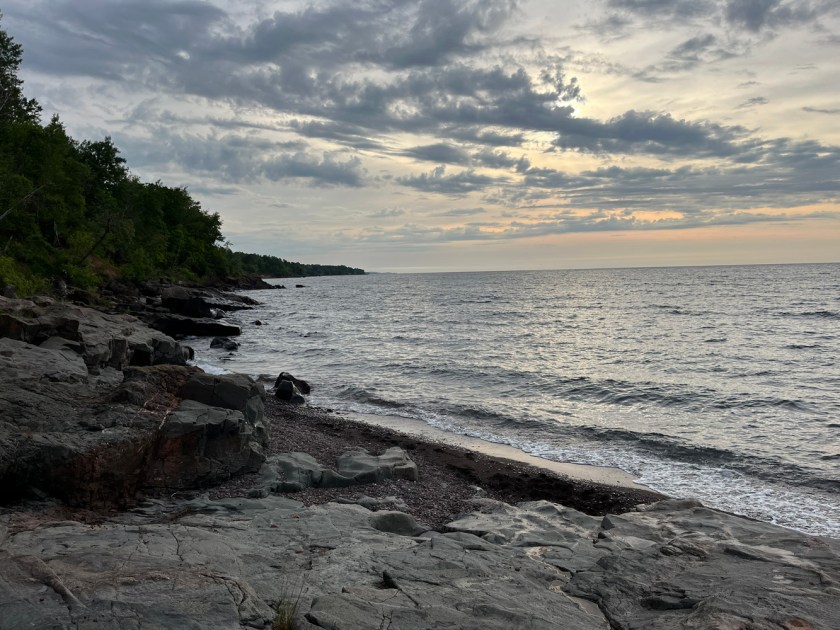
I went to the lake this morning, seeking the peace, sustenance, and perspective it so often provides. I had been particularly distressed and distraught the day before after watching the documentary on Christian Nationalism, “Bad Faith.” It was chilling to say the least. Among other things, the film demonstrates the longevity of Christian Nationalism in this country, dating back at least to the Ku Klux Klan, founded in 1865. However, the central theme of the documentary is the staggering influence of conservative political operative Paul Weyrich, who orchestrated the merger of conservative Evangelical Christians with the Republican Party in the 1980s. He founded the Moral Majority with Jerry Falwell, the Heritage Foundation which authored Project 2025, the American Legislative Exchange Council, and the Council for National Policy – all of which seek to undermine democracy in order to bring about what these organizations and their followers call a “Christian nation,” by force if necessary. But as former Republican strategist Steve Schmidt states in the film, there is nothing “Christian” about this movement. It is pure nationalism, a striving for power requiring the dismantling of the institutions of democratic government as we know them. These extremist Republican strategists found a powerful base of voters by tapping into Evangelical Christians and manipulating the messages they received to fill them with fear, and found just the puppet they needed in the charismatic and amoral figure of Donald Trump. As we’ve seen in recent years, they have been quite successful in the destruction of government. After filling the Supreme Court with their chosen nominees during Trump’s first term, getting Christian Nationalist Mike Johnson installed as Speaker of the House, and getting Trump elected a second time despite the January 6th insurrection, or perhaps because of it, they are now successfully dismantling or otherwise destroying the Departments of Education, Health and Human Services, Energy, Defense, Agriculture, Justice and more along with the Environmental Protection Agency, the Food and Drug Administration, the Social Security Administration, the Federal Regulatory Agency. . . the list goes on. It’s all part of the plan to fulfill the “Seven Mountain Mandate” of dominionism[i], which seeks to impose its beliefs in seven spheres of influence: religion, family, education, government, media, arts and entertainment, and business. As one of the Christian Nationalists interviewed in the film proudly said, “It’s the Christian Taliban.”
. . .
The words of Mary Oliver’s poem, “Dogfish,” have haunted me of late, but with a few words changed, paraphrased —
I wanted/ it all to go away, I wanted/ to leave it, this country; I wanted/ this life to close, and open/like a hinge, like a wing, like the part of the song/where it falls/down over the rocks . . .[ii]
. . .
Perhaps that is what I was seeking when I went to the lake this morning. It was cool and gray, the lake and sky reflecting the clouds of dismay that filled my being, but it was just the mood and temper of the lake that I needed, granting me the quiet and solitude so curative for the turbulence in my soul. Gichigami, as it is called by the Anishinaabe, holds a wisdom in its vastness; the ancient rocks that line its shore carry the solidity and perspective of eons of time. Sitting on those rocks, with the quiet companionship of my dog, Ben, I let the healing spirit of the waves wash over me. As I felt my spirit be restored, I began to notice signs of resilience all around me – the wild parsnip, yarrow, and blue harebells growing through the slightest cracks in the rocks. Even here on rocks two billion years old, new life; amidst the dark gray, flowers bursting with color – yellow, white, purple, blue, green; evidence that even the most solid of boulders have their cracks where life can take root and flourish.
. . .
an explosion, a discovery/I wanted/to hurry/into the work of my life; I wanted to know/whoever I was/I was/alive
. . .

Walking farther along the shore, the many rocks surrounding me formed from lava pouring from the volcanic activity that once erupted here were lessons in and of themselves of how periods of volatility can evolve over time into places of peace and serenity. Later, a white feather I found in the rocks brought Emily Dickinson’s poem, “hope is the thing with feathers,” to mind — a talisman of sorts to restore the light of hope into the day.
. . .
Yet Oliver’s words seem to mock me.
. . . nobody gets out of it, having to/swim through the fires to stay in/this world.
We are swimming through those fires now.
. . .
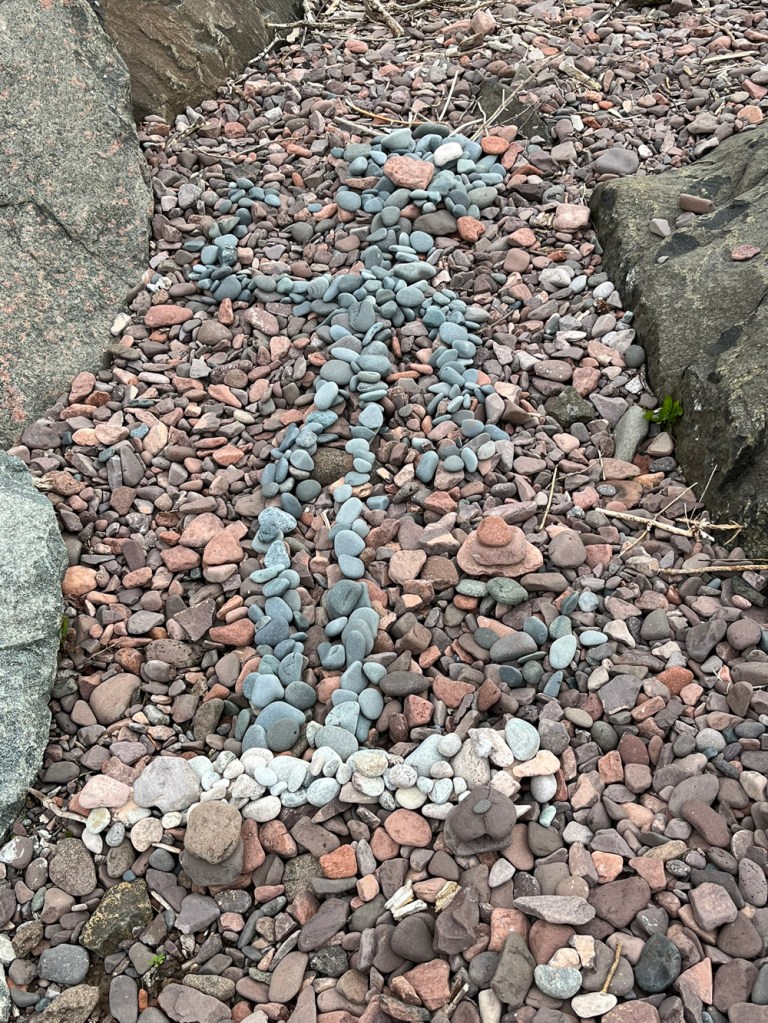
But as we left, a rock image of someone raising their hand in greeting, in what I imagined to be an Australian- fashion, “gday,” gave welcome.
I returned home by way of waterfalls – the Seven Bridges Road that crisscrosses the beautifully named stream – the Amity – and that is what I wish for the world – amity – friendly relationship, goodwill.
. . .
. . . I wanted to be able to love . . . Mostly I want to be kind.
. . .
Yet the dogfish approaches, stealthily, ominously, as the smaller fish huddle together. Oliver’s message ultimately is both foreboding and hopeful; both prescient, penned as it was forty years ago, and wise:
And look! look! look! I think those little fish/better wake up and dash themselves away/from the hopeless future that is/bulging toward them.
And probably, /if they don’t waste time/looking for an easier world,
they can do it.
. . . . .

I have no illusions that amity, friendship, goodwill are an easier world. They take work. But I do believe they are the basis of a better world, a kinder one. With the dogfish fast upon us, we cannot afford to waste time. But like Oliver, I still have to believe we can do it. Perhaps it is just the spirit of the lake talking, but I would wish that all had such a great lake to feed their souls, and if not that, some piece of wildness to return them to their true wild and amicable selves. Perhaps in that would lie, as Thoreau said, the preservation of this world.[iii]
Sources
Oliver, Mary. “Dogfish.” Dream Work. NY: The Atlantic Monthly Press, 1986.
Ujlaki, Stephen; Chris Jones (co-directors). Bad Faith: Christian Nationalism’s Unholy War on Democracy (motion picture). United States. 2024.
[i] Dominionism is the conservative Christian movement that seeks to take control of government and establish it under what they perceive to be biblical law.
[ii] Oliver’s original words – I wanted/the pastto go away, I wanted/to leave it, like another country (changed words in bold.)
[iii] The centerpiece of the coffee table in our living room when I was a child was a book of Thoreau’s quotes accompanied by photography. The title came from one of those quotes, “In wildness is the preservation of the world.” That one line has remained with me all of my life.
Discover more from Feminism and Religion
Subscribe to get the latest posts sent to your email.

 Feminism and Religion
Beautiful post Beth, I love how you intersperse Oliver’s poetry and others between the lines of the difficult world we are facing along with the lines that allow us some breathing room so we can find our own inspirations. I love how you found signs of resilience around you.
LikeLiked by 1 person
Thank you, Janet. The inspiration of the flowers blooming through the cracks in the rocks was such an important reminder of resilience.
LikeLike
What a great piece Beth, what a time we are in. You have Trump, in Canada we have Carney, who is the deeps states boy to bring us into digital currency, social credit score system is where he is going. What I am witnessing in Canada is an out and out rape of nature, A.I. raising forward, patriarchy is in full swing. Carney has talked the indigenous people into joining him, and they did, for ten billion dollars more. Now Carney is saying, see our keepers of the earth are all in and unfortunately, they are. One elder was quoted, we can be rich like Saudi Arabia, you can not make this up. The good news is that we are all keepers of the earth, not just a handful, all of us and so we can join hands and do that. I see this as a time of choosing, I have turned my back on this satanic agendas, I am not going along full stop, prayer is what we have and our NO.
LikeLiked by 1 person
How awful that you are dealing with this in Canada as well, and to hear that some of the elders have bought into it, though our biggest threat to the forests and waters here in the north of the US is the Canadian company Enbridge and its pipelines. So I am grateful for you and others like you who are saying NO!
LikeLike
Wonderful peace – whoops piece Beth! Finding solace in nature eases distress by placing us in the present moment and you do this beautifully! But oh don’t use an animal that has to hunt for food to survive to illustrate human rapacity – we are becoming a terrifying species… Maybe if we had to hunt and fish for food it would bring us closer to the great round of living dying living again without all this insanity.
LikeLike