

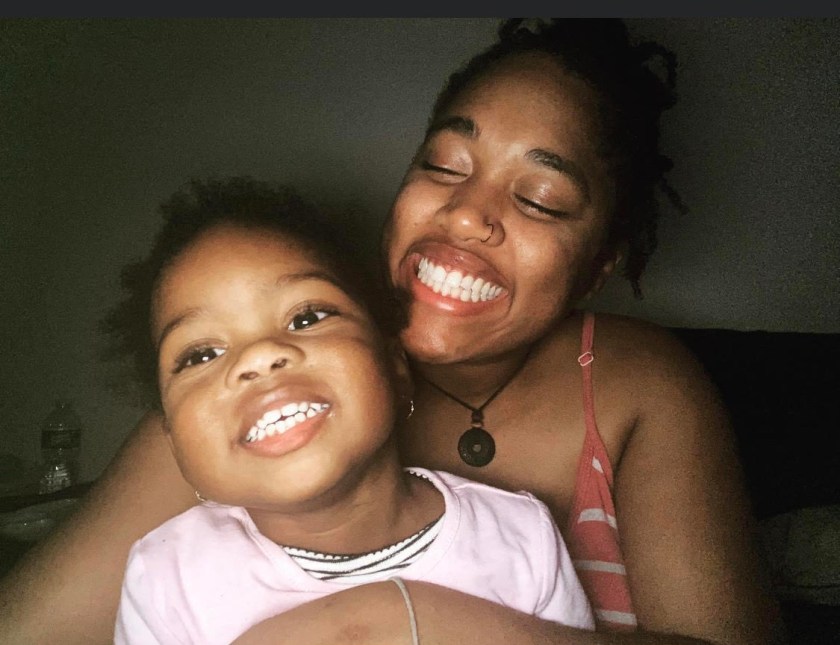
Even before her life unfurled beneath my heart, a quiet vow took root: to parent with purposeful grace. My unwavering compass points to this: to nurture an emotionally vibrant, confident, kind, compassionate, gentle, yet fiercely bold chocolate warrior queen, a child wholly devoted to her own radiant self. For in her spirit, I long to mend the broken echoes of my past, to see her soar where I once faltered, especially in the intricate landscape of the soul. She will possess a richness I only dreamed of; she will transcend.
Seven years, a fertile ground before her birth, from youth’s edge at twenty-two to twenty-nine, I dreamt of motherhood, shaping it idealistically. My spirit yearned to reweave the tapestry of mothering, to cast aside the heavy cloak of predetermined expectation: no longer would Black motherhood be synonymous with weariness, with anger’s sharp embrace, with bitterness, or a spirit held distorted and captive. I craved for her a vision unobstructed, a path where she could shatter the assigned roles that shadowed a Black girl’s journey into Black womanhood in this land. Above all, I wanted her to be FREE.
My daughter’s dawn, her whispered future, ignited in me a fervent need for change. To cultivate in her a garden of self-love, of confidence, of fierce, gentle grace, of empathy’s wide embrace— I first had to grow these blossoms within myself. For a cup cannot pour what it does not hold, a spirit cannot give what it has not earned. And still, the thought fills me with awe: that her bright wellness, her sacred wholeness, mirrors and depends upon my own.
From the pages of my book, Black Gold: The Road to Black Infinity, I penned: “Justice is wholeness, in the sense of wellbeing; wholeness in the sense of well-being for the Black community requires social transformation.” Yet, I would argue further still: this vital social shift, this blossoming of Black wholeness, remains elusive without a deeper alchemy— an inner transformation, forged in brutal honesty, a fierce commitment to change, spiritual healing, discipline’s steady hand, unwavering consistency, and the audacious reclaiming of the “powers of the deep.” These are the very currents our ancestors drew from to survive and endure chattel enslavement, to mend their shattered spirits. Perhaps, this profound wellspring is what we touch when we speak of ‘Black Girl Magic’ and ‘Black Excellence.’
Here are a few poetic edits that capture the profound commitment you’ve made to your daughter’s well-being, rooted in your own healing journey:
“If you don’t face your demons, they will raise your children.” – R.A. Dickey, Wherever I Wind Up: My Quest for Truth.
This truth, a sharp echo in my soul, propelled me. In Mother Blues, Part One, I chronicled my journey back to the heart of who I am, to mend her—body, spirit, and soul’s raw energy. There, in that crucible, I confronted my deepest fears, the long shadows, and the parts of myself I’d hated for decades, for what felt like centuries. All this, to forge a foundation: to be as stable, as healthy, as profoundly supportive for her unfolding path. I must grapple with my own emotional abandonment, to ensure, with every fiber of my being, that whatever storms she faces, my daughter will never know the desolate hell of existential loneliness, not if my love has anything to say about it.
Unearthing, confronting, and mending the hidden fragments of self, as told in Mother Blues, Part One, unlocked my presence for her— my daughter, whose struggles echo my own. For much of her brief life, she has known the tight knot of extreme constipation, a symptom born shortly after I left her father, fleeing to a temporary solace for four long months, caught in a housing crisis, shadowed by a pandemic. Then, three years bled into a demanding, emotionally cruel labor, my strength spent rebuilding, striving for a stable haven, alone. Though my heart yearns to believe she was too young to absorb the constant hum of survival, to feel the tremors of my pain, my silent battles with recurrent mental breakdowns in which the suicidal ideation I thought I left in my past resurfaced— I poured every ounce into showing up, meeting her needs: body, mind, learning, connection, heart. This nearly broke me. I did my best, however, I am a therapist; I know the truth. I’ve seen the lasting marks on children of divorce, the unseen legacy of unaddressed pain. Within her small frame, the echoes of her early years remain, a subtle imprint, now surfacing as tummy troubles, a mirror of my own.
Continued tomorrow
Discover more from Feminism and Religion
Subscribe to get the latest posts sent to your email.

 Feminism and Religion
Patriarchy created the fragmented self, I see it as men over women, of every color and men over nature. An against life system, which we are witnessing right before our eyes.
LikeLike