

This post was originally published on Jan 20th, 2014.
Last week I reflected on Angela Yarber’s insightful essay and painting on Jephthah’s daughter. For those who did not read the earlier posts, the story of Jephthah’s daughter is found in the Hebrew Bible. Jephthah’s daughter was sacrificed by her father after he swore in the heat of battle that if his side won, he would sacrifice the first person he would see on returning home. Angela called us to reflect on who Jephthah’s daughter is in our time.
In my earli er midrash on the story, I invoked Daniel Cohen’s powerful retelling of the story of Iphigenia. Cohen concludes that Artemis told Agamemnon that his ships would sail only if he sacrificed his daughter not because she wanted him to do it—but because she hoped this challenge would induce him to realize that the costs of war outweigh any possible gain.
I suggested that these words be spoken whenever the story of Jephthah’s daughter is told:
We read this story not to celebrate Jeptheh’s terrible act, but to remind ourselves that every father or mother who goes to war or condones war is signifying his or her willingness to sacrifice not one but many beloved daughters, not one, but many beloved sons.
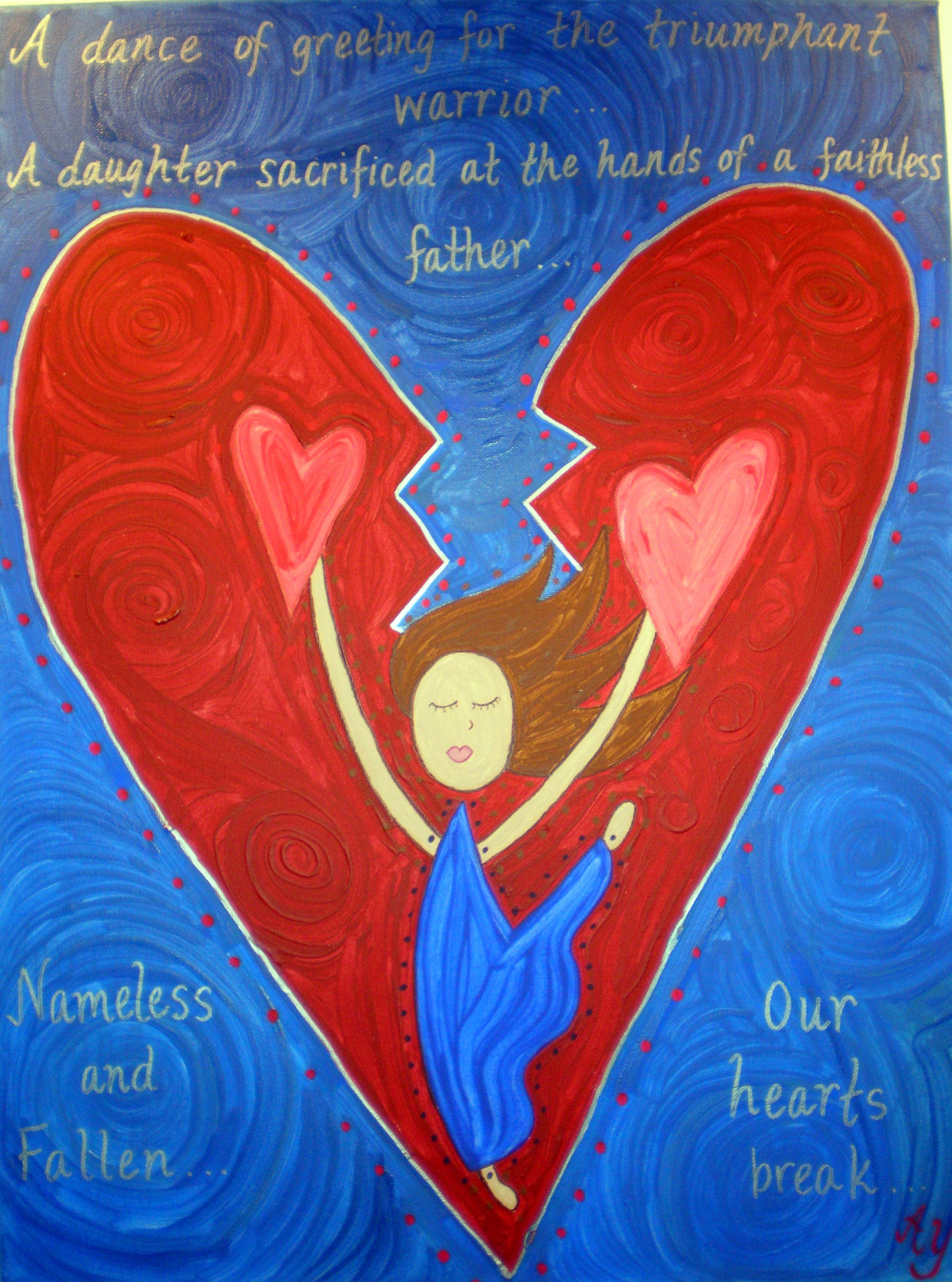 As soon as I completed my midrash on the text, I realized that it was incomplete. My midrash glossed over the fact that Jephthah and his counterpart Agamemnon each sacrificed a daughter. When speaking of the story of Jephthah’s daughter as a “text of terror,” feminist commentators generally focus on the fact that in patriarchal societies daughters are considered as less valuable than sons, as property, and as expendable. My midrash had not focused on the gender dynamics of the story.
This train of thought brought me back to my series of essays “Patriarchy as a System of Male Dominance Created at the Intersection of the Control of Women, Private Property, and War.” There I presented my theory that patriarchy is an integral system in which the control of women, private property, and war are integrally connected. This suggested another coda or postscript to be spoken whenever the story is read.
We read this story not to condone Jephthah’s terrible act, but to remind ourselves that in patriarchal societies women and girls are considered expendable and are sacrificed every day on the altar of male power as domination.
The story of Jephthah’s daughter provokes us to question the world in which the story of Jephthah’s sacrifice of his daughter can become a sacred text. In matriarchal societies, mothers were honored as the givers of life and no mother’s daughter and no mother’s son would ever have been sacrificed. The values associated with mothers—love, care, generosity—were the highest values. Jephthah would have learned to honor his mother, his sisters, and his nieces. He would have been taught to be gentle, he would not have been told he had to become a hero, and he would never have been conscripted into an army. He would never have sacrificed his daughter on the altar war.
 When we tell the story of Jephthah’s daughter, let us remember that in another time and place Jephthah’s daughter might have danced in honor of the Source of Life, her mothers and uncles might have smiled proudly, and her father might have clapped his hands to urge her on and on in celebration of the joy of life.
Let us bless the Source of Life.
Discover more from Feminism and Religion
Subscribe to get the latest posts sent to your email.


Ugh – Carol is so right “in patriarchal societies women and girls are considered expendable and are sacrificed every day on the altar of male power as domination”. We are going backwards.
LikeLike