

in memory of Esther Shumiatcher-Hirschbein
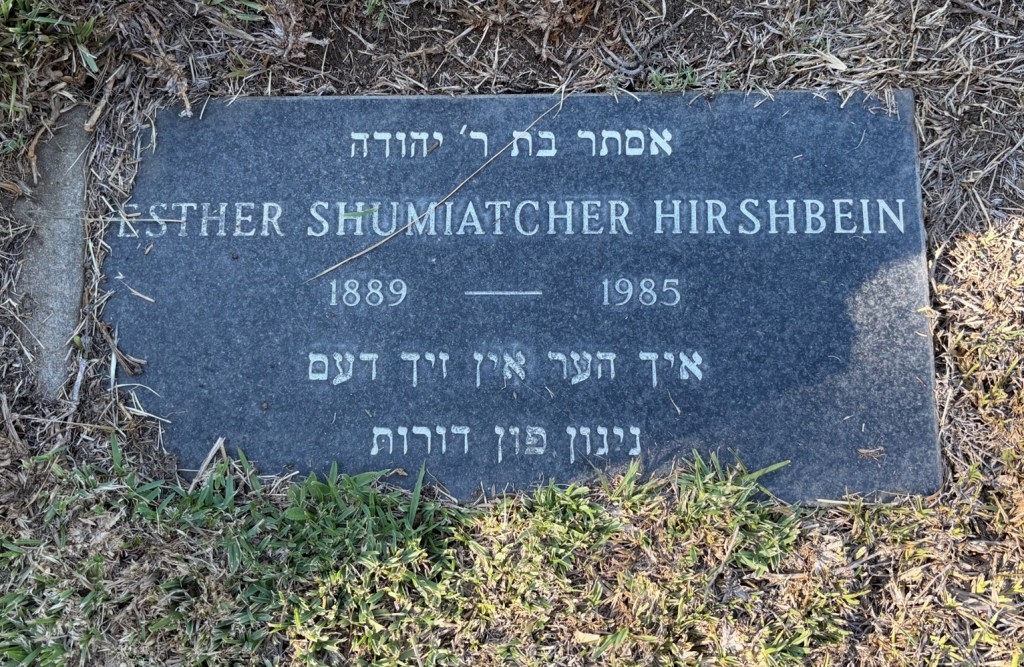
1.
On a sunny Elul afternoon
I kneel at your grave
a sprig of rue in my pocket.
I recite a tkhine for visiting the graveyard
and imagine that you know this ritual–
stretching string to calculate
the space your body inhabits.
The unspooling wick rests gentle
on rough-cut grass, touching
the edges of mortality,
its twists separating and connecting worlds:
the dead and the living
the past and the now
mine and yours,
a woman I never met,
a writer dead these 40 years.
2.
I am walking the paths
of Warsaw’s old Jewish Cemetery.
The first and most insistent pull
in this new-to-me ancestral land
is an end-of-the line bus ride to
this silent city of the long-dead.
Jet-lagged, my bootsoles
crunching on snowcrust,
I am the trace of life
that goes on outside the walls;
I almost glimpse the angel of death
rubbing its satisfied hands
among dark, bowed trees.
Branches slow-drop snow
onto faded-chiseled monuments;
soft plops land on gravestones
leaning on one another
in mutual support.
The ice-wind of history sweeps
this place where huddled generations
lie beneath monuments to what was,
a refuge for those fortunate to die
before they could be murdered.
3.
The mysteries of lives– whole worlds–
are held so neatly in
each
neat row of graves;
the soaring obelisk at the end of this one
sparks sunlight.
What did you carry, Esther,
as you crossed oceans, cultures, languages, centuries?
What albatross did you ride
into avant-garde fame a hundred years ago?
Was it the memory of Belarus
or the leaving of it?
The old world or the new?
Your life in a baker’s dozen immigrant family,
shapeshifting to “Esther Smith”?
How did you emerge
from the quilt of seven sisters
to marry the great man of Yiddish letters,
twenty years your senior?
Did you choose?
Or were you chosen?
Did you find that you were forever bound
by the power of the mamaloschen?
4.
Poet and playwright, inspired
by pogrom-orphans, you created your place
in his literary world, a cosmopolitan Jew:
Warsaw, New York, Los Angeles to New York again.
Your destiny a star-filled Hollywood cemetery
to lie forever in the plains of Abraham–or maybe Moses.
Your space eternally Beit Olam-adjacent
next to your husband’s monument,
words verbatim from his book
incised on a stone scroll.
Your flat stone’s inscription is written on my heart:
“I hear in myself the melody of generations.”
Oh, Esther, I hear that melody
singing in me, too,
the rhythms of my mother’s mothers,
the lives and work of women, flowing
so swiftly and so soon forgotten.
In their memory and in yours,
I place a smooth-shiny pebble exactly
on the dash between your birth and death dates.
I cut and braid the wick,
roll it up in beeswax,
my hands warming in the making
of your neshome likht.
I ask you to intercede for me
in the coming year
as I light your candle
and claim you as my ancestor.
Note:
Esther Shumiatcher-Hirschbein (1899-1985)
Esther Shumiatcher-Hirschbein was born in Belarus in 1899, one of seven sisters in a family of eleven children. Her family emigrated to Calgary, Canada, in 1911. As a teenaged immigrant, she briefly called herself “Esther Smith.” In 1918, she married Peretz Hirschbein, a leading playwright in New York’s Yiddish theater. They traveled the world together, celebrities in the Yiddish literary world; the Berlin avant-garde literary journal Albatros (1922-23) took its name from her poem “Albatros.” Her three books of poetry include poems on topics considered ground-breaking at the time: pregnancy, childbirth, grief, marriage, sexuality, and widowhood. She is buried at Hollywood Forever Cemetery in Los Angeles, CA, either in the section called The Plains of Abraham or the section called The Plains of Moses, both of which are adjacent to the section called Beit Olam.
Glossary:
Keyvermestn (Yiddish): “Grave Measuring”
Practiced by Eastern European (Ashkenazi) Jewish women, this ritual of measuring graves of loved ones with thread, string or candle wick is an intercessory prayer practice that connects individual to both the Divine and the souls of their ancestors. Historically, carried out by pious and learned female elders of Jewish communities, Feldmestn is the ritual of prayerfully measuring the entire cemetery with thread, string or candle wick while Keyvermestn is the ritual of prayerfully measuring individual graves with thread, string or candle wick. When the measuring is complete, the string, thread or candle wick is used to make wicks for candles in the mindful-prayerful practice of (kneytlekhleygn, “wick laying”) as the wick is dipped and/or rolled into candle wax. Historically, some these candles were used to light the synagogue during the 25 hours of Yom Kippur services while others were lit at home in remembrance of the dead. While this practice is most usual during Elul, in preparation for the High Holy Days, Keyvermentn can also be employed to make candles when someone is in need of Divine protection, such as in cases of serious illness or childbirth.
Elul (Hebrew):
Elul, which occurs in August-September of the Gregorian calendar, is the final month of the Jewish year. It is a time of introspection, repentance and preparation that precedes the High Holy Days of Rosh HaShanah (The Head of the Year), which is followed 10 days later by Yom Kippur (the Day of Atonement). Practices during Elul include sounding the shofar (ram’s horn) as a spiritual wake-up call and praying Psalm 27 daily.
Rue:
(English); Ruda (Hebrew); Ruta graveolens (Latin)
Rue, the “queen of herbs,” has long been widely used in the Jewish world as a protective and cleansing herb.
Thkine (Yiddish): “Supplication”
Intended for Jewish women and primarily composed by Jewish women, thkines are personal prayers in Yiddish. Thkines are private, intimate prayers, invoking Divine connection both for holy days and occasions and for those in need of protection–children, those suffering from illness, women during pregnancy and childbirth. Traditionally, thkines were also prayed when visiting graves of loved ones, asking the souls of beloved dead to watch over those in the world of the living. Thkines are a spontaneous prayer practice, although they also have been written and published as prayer collections specifically for women’s use.
Mamaloschen (Yiddish): “Mother’s Tongue”
This term refers specifically to Yiddish, the ancestral language of Eastern European/Ashkenazi Jewish communities.
Pogrom (Russian) “to wreak havoc, to demolish violently”
This term describes violent attacks by local non-Jewish populations on Jews, originally in the Russian Empire but also in other countries.
Beit Olam (Hebrew): “House/Home of Eternity”
This term can be used for the concept of eternity, as the name of a cemetery or as a synonym for grave. Beth Olam Jewish Cemetery, founded in the 1920s on the grounds of Hollywood Forever Cemetery, is one of the oldest and most historic Jewish cemeteries in California.
Neshome likht (Yiddish):
Soul Candle, also known as Memorial Candle and Yahrzeit (anniversary) Candle.
Judaism considers that that candles represent the human soul as lights of the Divine, as expressed in Proverbs 20:27. Lighting soul candles/memorial candles on the anniversaries of deaths is a common sacred Jewish practice.
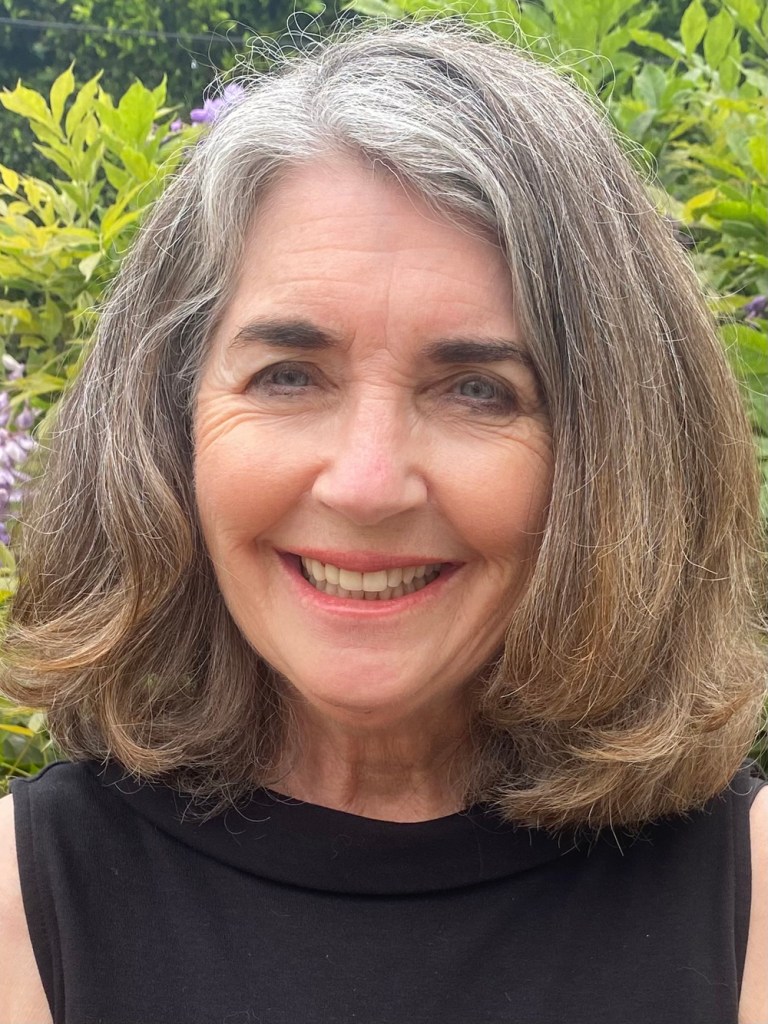
BIO: A writer and ritual leader, Janet Madden is a rabbi and Spiritual Director who earned her PhD from the National University of Ireland.
A Greenfaith Fellow and ordained animal chaplain, she is a dedicated hand quilter and gardener and an herbalist who is deeply invested in relationship with the more-than-human-world, Janet lives with her spouse, dog, cat and flock of backyard chickens.
Discover more from Feminism and Religion
Subscribe to get the latest posts sent to your email.
 Feminism and Religion
Thank you for sharing this. It is beautiful.
LikeLike
This is quite a tribute and I learned so much from reading this essay – thank you – I am struck by the use of rue – this herb is used by so many peoples including Indigenous folk from South America – I am also struck by the candle lit for the dead – another universal practice and the th use of thread… if we get beyond individual religions we see that we are more alike than different and these spiritual practices are perhaps more important now than ever before?
LikeLike
whoops I meant poem and essay!
LikeLike
So beautiful! So important to remember and honor and remember the words and stories of women who have shaped our own lives.
LikeLiked by 1 person
What a beautifully written, powerful poem. I’m so moved by your journey with Esther at her grave. “I hear in myself the melody of generations.” Thank you for warming my heart and connecting me with the ancestors.
LikeLike
Really lovely poem, Janet. It was so good to read something of yours!
LikeLike
Thank you so much for this. While I knew about this practice, I am now inspired to actually perform it.
LikeLike