

I dedicate this article, an excerpt from my dissertation to Rita Rosalind Kolb Grenn, Hanna Eule, Verena La Mar Grenn & their mothers,
Franziska Silberstein, Kaye Schuman and Regina Possony,
and to the Kolb, Berlstein, Bernstein, Mathivha, Sabath, Gruenbaum,
Silberstein, Lawler and Scott female ancestors.
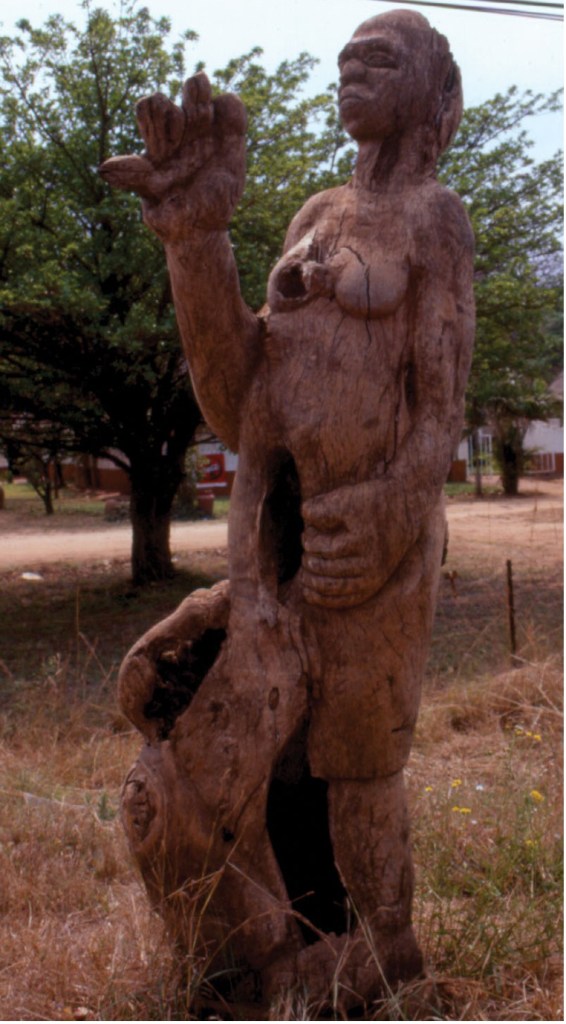
“She is Creator of the Universe, and of Mankind…She is Creator Woman”
– Meshack Raphalalani, Venda artist describing his sculpture, 2001
“The Shekhinah1 is considered an alternative way of thinking about God in the orthodox community… not the major way of thinking about God…
but not heresy at all. It’s right there in the tradition.“
– Blu Greenberg, co-founder, Jewish Orthodox Feminist Alliance, interview, 2001
“He created me in his image so he’s inside, within me.“
– Hanna Motenda, Lemba translator at Hamangilasi village, 2001
These and other voices are heard in my dissertation, “For She Is A Tree of Life: Shared Roots Connecting Women To Deity,” an organic2 theological inquiry intocultural and religious identities, beliefs and practices among South African Lemba and European American Jewish women. Despite my best efforts to remain impartial—a mindset I know to be flawed, since “objectivity” cannot exist in social science research—I look for woman in the Divine and divinity in Woman wherever I go. In both my academic research and my daily life, I constantly scan the horizon, consciously or otherwise, for maps, icons, symbols and other tangible images providing clues to the identity or presence of the ever-mysterious, intangible Sacred Feminine.
For many years I could only conceive of God as male and transcendent. During the course of my early studies this began to change; later, as I did my doctoral research, I came to see the Sacred Feminine as immanent, and deity as both female and male. How else could I image God if we are all made “in God’s image”? As I found Her in the lives and beings of other women and in myself, I was able to view even mundane activities as sacred. I saw that She was everywhere – in the ritual cleaning of pots, in the cooking and sharing of meals, in women’s secular, daily conversations and laughter even in the face of adversity.
When I learned of the female face of God within Judaism, the Shekhinah, I wondered why I had never heard about Her, why She was not part of the Jewish liturgy or ritual I experienced growing up. I did not hear anything but passing references to her as an adult and was well into adulthood by the time I found Rabbi Lynn Gottlieb’s work, She Who Dwells Within. People would sometimes say to me, at times defensively, that Shekhinah is part of Kabbalistic or mystical Judaism, but they neglected to mention that She was first written about in the Talmud, the body of Jewish oral and written laws and commentary dating back to 200-500 C.E. Others would note that Jewish women are respected for their knowledge, for holding their families together and for their communal contributions, but there was never a mention of a female Godhead or deity. And so I remained keenly aware of the patriarchy that still lived and lives within Judaism, who the decision makers are in its formal institutions, and of the absence of Shekhinah’s voice and that of the Sacred Feminine in other forms such as Asherah from most of our liturgy, chants and conversation.
However, at the time I first wrote this, I found that Her voice and more gender-neutral language was resoundingly clear in the work of Rabbi Gottlieb, in Marcia Falk’s Book of Blessings and other writers, poets and thea/theologians in the 1990s. And since first writing this, I discovered that She was and is very much alive in the music, liturgy and writings of Jewish Renewal leaders and musicians including Rabbi Shefa Gold, Rabbi Nadya Gross, Rabbi Irwin Keller, Rabbi Geela Rayzel Raphael, Batya Levine, Rabbi Jill Hammer, Rav Kohenet Shoshana Jedwab, Yael Kanarek, Kohanot (Hebrew priestesses) D’vorah K’lilah, Ketzirah Lesser, Annie Matan, Shoshana Bricklin and Batya Diamond, and so many others. And of course I write and speak about Her all the time.
In both my studies and my own spiritual practice, I found the Sacred Feminine—in the red earth, the drums, the rituals, traditions and art I witnessed—throughout the Northern Province of South Africa. I found Her in the new rituals other Jewish women and I have been creating in the U.S., and then in some modernized Orthodox Jewish containers as well, as in the formation of the Jewish Orthodox Feminist Alliance. Many of the people I spoke with both in South Africa and the United States during my study were taken aback and sometimes offended at the idea of deity as female, but I spoke with some who, like me, feel Her presence, in many areas of our lives.
Artist Meshack Raphalalani, for example, in describing the role of snake as a symbol of fertility and creation in the python dance that is part of the Venda domba puberty rite told me, “Everything is done by the womb.” The Venda are close neighbors with whom the Lemba have lived, both in Zimbabwe and South Africa for more than 200 years. When I mentioned to Meshack that those believing in a feminist spirituality sometimes speak of the earth as the body of the Goddess, his response was an enthusiastic “Oh, yes, yes!!!” This reaction was in drastic contrast to the lack of response I had gotten to the concept of a female deity from the women I interviewed in South Africa.3
I believe this may be a cosmology running throughout much of Africa, the active female principle that many cultures regard as deity comes alive through Meshack’s art and that of Venda artists Noria Mabasa, Albert Munyai and others. Eight thousand miles away in northern California, when I asked about the possibility of God as female, educator Patti Moskovitz said to me: “If we believe God is in and over everything…if you think of God in a womanly way…we’re in the womb of God. We are part of God.4 We’re in a protected place, even though the world feels frightening to us at times.”
1 Defined variously as the female in-dwelling presence of God, the feminine face of God and the Hebrew Goddess.
2 Organic inquiry is a methodology in which research is treated as sacred (see Clements et al, 1999).
3 Reaction to my suggestion of God as possessing female attributes brought reactions ranging from amusement to disbelief to extreme discomfort. One Sotho woman to whom I suggested this hastened to assure me that God is male in the bible. She had just given me a list of all the different types of African “churches” (religions); when I suggested that God may be portrayed as male simply because men likely wrote most of the bible, she quickly told me about another church—one she identified as satanic!
4 Patti Moskovitz, interview, 2001.
Part 2 to be posted tomorrow
BIO: D’vorah J. Grenn, Ph.D is a Yoreshet/lineage holder of a female Kabbalist tradition, priestess and ordained Mashpi’ah/spiritual guide. She founded The Lilith Institute (1997), co-directed the Women’s Spirituality MA Program at ITP/Sofia University and has taught at Napa Valley College and throughout the San Francisco Bay Area on women’s rituals, feminist thealogy and philosophies, sacred arts and literature, and Jewish mysticism. She co-teaches on the Kabbalistic Tree of Life with Reb Nadya Gross; they recently co-produced the symposium “Wisdom of the Mothers: Celebrating Matriarchal & Matrilineal Spiritual Traditions” and will co-produce a “Wisdom of the Mothers: Ancestral Roots and Connections” Symposium on April 22-23, 2026.
Publications include: Lilith’s Fire: Reclaiming our Sacred Lifeforce; Talking to Goddess, an anthology of writings from 72 women in 25 traditions; “Lilith’s Fire: Examining Original Sources of Power”, Feminist Theology Journal; Jewish priestess and Lilith entries in Encyclopedia of Women in World Religions; “For She Is A Tree of Life: Shared Roots Connecting Women to Deity”, her dissertation on beliefs and rituals among U.S. and South African Lemba women of Jewish ancestry, and “Spiritual Brokenness and Healing Presence of the Sacred Feminine”, FEMSPEC feminist journal. She has been a guest on a number of podcasts including the Revelation Podcast Project and Breaking Down Patriarchy, was a speaker in the recent “Crones, Hags and Elder Wise Women” Summit, and co-hosted 50 episodes of the “Tending Lilith’s Fire” broadcast with Kohenet Annie Matan.
Moderator’s Note: Yerusha and the Lilith Institute are sponsoring the symposium in April. There will be a call for papers coming up as well an invitations to attend the Symposium. For further information to and to stay up to date, visit their websites at Yerusha and Lilith Institute.
Discover more from Feminism and Religion
Subscribe to get the latest posts sent to your email.
 Feminism and Religion
Thank you for this perspective D’vorah. I love the quote from Artist Meshack Raphalalani “Everything is done by the womb.” From where I sit that should be a “duh, of course” moment but as you so poignantly point out, this has become hidden and even reviled in some places.
This is a concept that needs to be brought into the light of consciousness for our world to survive. Thank you for contributing to that.
LikeLiked by 1 person
‘ Reaction to my suggestion of God as possessing female attributes brought reactions ranging from amusement to disbelief to extreme discomfort’ Yes indeed – probably why earth based ritual is so misconstrued – Earth is embodied spirituality – an idea most cannot tolerate – but this is more about patriarchy’s lens than reality -I dislike the word god used in any context just for that reason. I am not interested in debating the female aspects of god. All I have to do is to be with the rest of nature to feel Her Presence…
LikeLiked by 1 person
Your stunning piece of writing HERe, D’vorah, is balm, beauty, buoyancy. Just yesterday I wrote a poem and as I have read and re-read your words and its Wisdom, I thought to share my poem HERe. I have added a final line in response to your inspired and inspiring words. Sent with gratitude. In abundance.
~~~
My soul is housed in hope.
I abide wHERe dreams, too, abide.
From stars and dust I came.
And in by beginning is my end.
My very end is my beginning.
Always. Always. Always: I am home.
Always. Always. Always: Home lives in me.
© Margot Van Sluytman
~~~
Sawbonna,
Margot/Raven Speaks.
LikeLiked by 1 person