

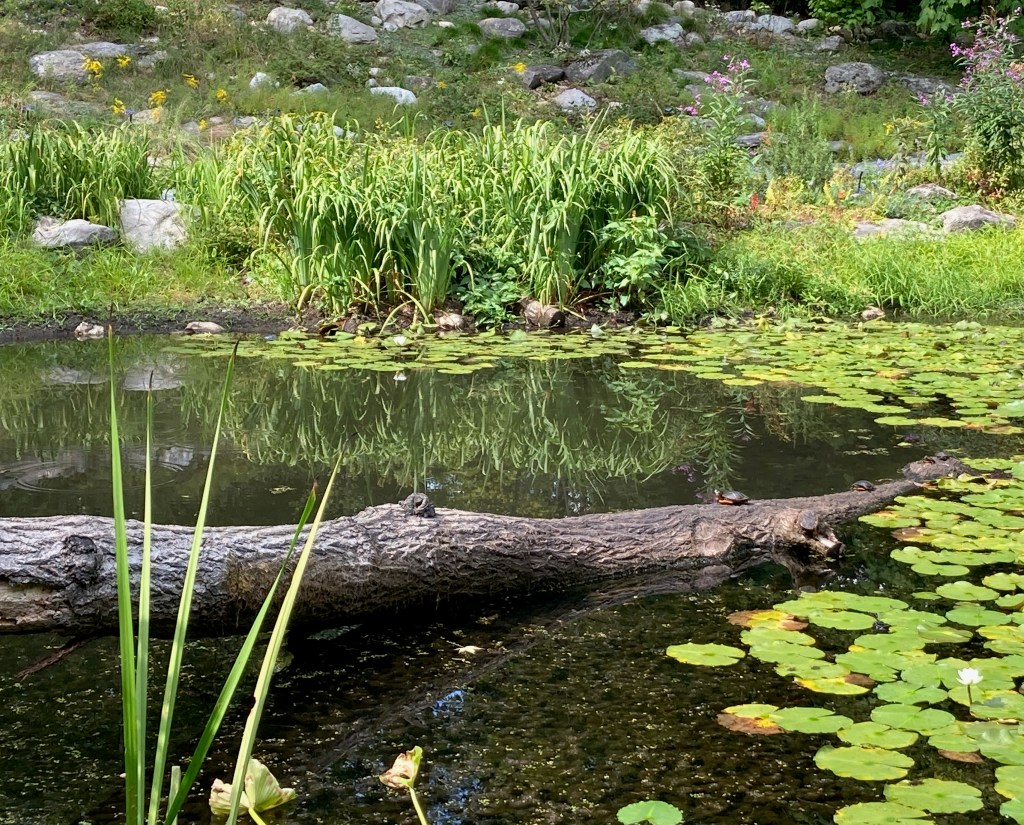
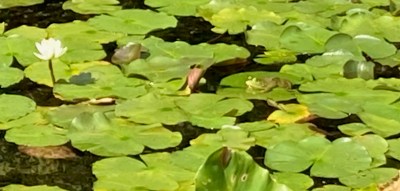
On a recent tranquil Sunday afternoon I was wandering around a lily pond in a nearby botanical garden, fully immersed in that liminal time between summer’s outbursts of nature’s abundance and the peaceful contentment of fall. The late goldenrod and delicate white wood asters danced a hued duet in the wind among the turtleheads and cardinal flowers, while hydrangeas shifted from white to the vibrancy of their last red passion. The lilies in the pond poked their heads above the water while frogs lay in repose on the pads. They were joined on nearby logs by a family of turtles, parents on one side and two babies on the other, close enough for security but far enough to enjoy some independence. A long dark brown watersnake was curled up unmoving on a boulder. All seemed to be basking in the sun, napping now and then. Around the pond were wanderers like me and human caretakers, silently tending to wildflowers and trees and occasionally stopping to watch if one of the beyond-human inhabitants plopped into the water for a little late afternoon swim.
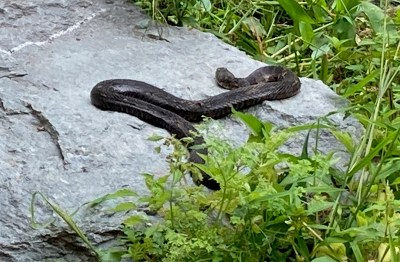
Of course, I also knew that the peacefulness of this snapshot moment would not last forever because what do watersnakes eat? Frogs, fish and other beings that live around ponds. And what do frogs and fish eat? Insects, snails, and other beings, and so on up and down the food chain. But even this is part of the wholeness of the pond, as each being fulfills its place in the cycle of birth, life, death, and rebirth so that all of us can, in our own time, enjoy these short times of contentment living on the face of our magnificent planet.
An intuitive awareness of the rightness, the integrity, the awe-inspiring grace of the scene did not leave me for several days. It was as if I were experiencing something that had always been a part of human daily life until recently, when now it was so rare as to be almost a mystical moment. It was only when I realized that the pond was not just a place for human recreation, but a living community, that I understood why. Here, for this one afternoon, I witnessed a web of life where all beings belonged, all made meaningful contributions to the ecosystem, all had everything they needed to live in that moment, and all seemed to experience, as if it was their right, enjoyment of the splendor of their home in nature.
I could not help but think of human communities throughout time and over many continents of the Earth that have strived to incorporate these characteristics of a healthy ecosystem. These those of past and contemporary Indigenous societies, those of peaceful cultures from all over Old Europe, and enclaves of intentional communities that all try to put into place, in their own way, values of a gift-giving economy to which all contribute and all receive enough to meet basic needs, an egalitarian social structure in which all are valued for their contributions to the well being of all, and an appreciation of beauty, especially as it expresses nature, among others. Was, I wondered, the feeling of wholeness I experienced after witnessing the pond the gift of being able to, for just a moment, understand what it must be like to live in one of these communities?
I could not help but also wonder if perhaps these ancient and contemporary communities, did not, tens of millennia ago, model themselves on their observations of the thriving ecosystems in which they lived. While we cannot know the thoughts of our most ancient ancestors whose cultures have not survived intact, we do have testimony from contemporary Indigenous societies who have continued their traditions over millennia. For example, Gregory Cajete states in his book Native Science: Natural Laws of Independence, “Mimicking the processes observed in nature, community involved learning how to be responsible in relationships. Everyone had their work, a place, and a purpose in the community. Everyone had something to share as well as something to learn. so young and old came to understand this mutual, reciprocal principle of Native science” (101).
This led me to ponder further whether one reason we have such trouble creating and maintaining healthy communities in our mainstream society is that we no longer have many healthy ecosystems to model ourselves after. In fact, we spend our lives surrounded by examples of the imbalances of nature and their consequences until we come to experience them as normal. And what are the consequences to us as individuals of living in an unbalanced world, not only physically, but emotionally and cognitively? How can we build sustainable, nurturing communities when we have rarely or never lived in one?
It seems to me that ecological imbalance is not simply just one among many challenges our human communities face, but rather represents the loss of our foundation of knowing intuitively how a successful community works so that we can recreate them. So the question becomes, how do we regain this intuitive knowledge of how a successful community grows?
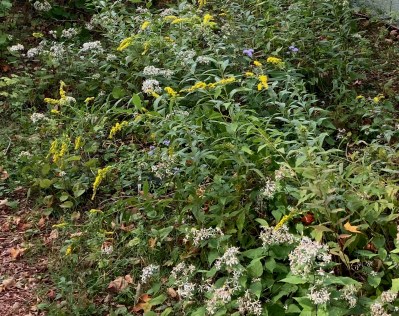
I think of the initiatives all over the world to build small “way stations” for pollinators. In one neighborhood I recently visited, residents had made small “monarch way stations” on lawn extensions that were filled with monarchs and other butterflies, dragonflies, bees, and other insects. You could feel a vibrancy in that small space that was absent on sidewalks just a few feet away that felt barren and empty. Are these small way stations a panacea for our desperate planet-wide problems? Of course not, but for those who walk by them they do create a model of how to build better human communities. Perhaps their popularity reflects our human longing to come back to a world in which Nature and humanity live together in one inter-related healthy, multifaceted landscape. When we can spend a few moments in the world we want to live in, we have a vision to work and that is important.
Immediate planetwide initiatives are essential for addressing the direness of climate change, but pursuing a multitude of solutions, including those that individuals can do now and that address how we think about our communities in a way that lifts up both our spirits and our local ecosystem, is also important. When we think about what the world would be like if every community on the planet was based on Nature’s model, we realize that this is both a bigger and perhaps a more effective task than it may seem at first. What can you do where you live?
Source:
Cajete, Gregory. Native Science: Natural Laws of Independence. 2000.Santa Fe, New Mexico: Clear Light Books, 2000.
For more on communities with characteristics of a healthy ecosystem, past and present:
Gimbutas, Marija. The Civilization of the Goddess: The World of Old Europe. New York: HarperCollins Publishers, 1991.
Goettner-Abendroth, Heide, ed. Societies of Peace: Matriarchies Past Present and Future. Toronto, Canada: Inanna Publications and Education, Inc., 2009.
Goettner-Abendroth, Heide, ed. Matriarchal Societies: Studies on Indigenous Cultures Across the Globe. New York, NY: Peter Lang, 2012, 2013.
All photos (C) Carolyn Lee Boyd 2025.
Discover more from Feminism and Religion
Subscribe to get the latest posts sent to your email.

 Feminism and Religion
This post really struck a chord with me Carolyn. A couple of years ago I read a book called The Healing Wisdom of Africa by Malidoma Patrice Some which describes finding life purpose through nature, ritual and community and shows how each person in that village was an important piece in the jigsaw of village community. Elders mentor young people and if one person or something in the eco system is out of balance then that becomes the responsibility of the entire village to help restore it. If the feminine was restored then we might begin to see ourselves not just as individuals but part of the global community and fulfil our responsibility joyfully. I am restricted at the moment because my husband is in nursing care, but then he is a big part of my community, needing me to be there as his condition deteriorates and he moves towards his transition. In addition, I can communicate with and be there for the young people in my family – a niece,3 nephews, 3 great nephews and 2 great nieces. My brother and I have become great friends, discussing and cooperating. They too are keen to drive distance to see my husband when they can because they care about us. Then there’s my friends and their families, as well as neighbours in my apartment block who form small community. My circle is small but like tossing a pebble into a lake, the ripples begin to spread out. Working small, if that’s all we can do, holding the frequency of love, cooperation and healing must not be underestimated in these crazy times.
LikeLiked by 2 people
The Healing Wisdom of Africa is one of my favorite books – thank you for connecting it to my post, I hadn’t thought of how the two relate, but they certainly do! I love your sentence “My circle is small but like tossing a pebble into a lake, the ripples begin to spread out. Working small, if that’s all we can do, holding the frequency of love, cooperation and healing must not be underestimated in these crazy times.” This is so true! Never underestimate the impact that what you do might have that you will never know. Lots of positive thoughts for you and your family and all in your circles and how wonderful that you are there for each other!
LikeLike
Thanks for your good wishes Carolyn. I have visited your inspirational site and will be dipping into it.
LikeLiked by 1 person
Thank you, this post made me feel young again. It gave me happy memories. 🙏
LikeLiked by 2 people
What a lovely thought! I hadn’t thought about how the feeling I got from the pond is like that which I had as a child being in nature but you are right, they are very much the same. I had no idea of the extent of the damage that would be done to our Earth in 2025 when I was a child in the 60s, so every time I went into nature it all seemed perfect. Your comment brought back happy memories to me!
LikeLiked by 1 person
Thank you! I was having a conversation about this very thing on YouTube the other day. We talked about how people don’t stop to watch the skies or feel the air anymore. I have been doing that a lot lately.
LikeLiked by 1 person
Watching the skies and feeling the air… what great ways to quickly and easier reconnect ourselves to the world around us! We have been having the aurora borealis visible in our night sky recently. It has been too cloudy to see, but I’m hoping for tonight!
LikeLiked by 1 person
That sounds like an amazing sight!
LikeLiked by 1 person
“How can we build sustainable, nurturing communities when we have rarely or never lived in one”? Great question Carolyn….My relationship with nature is the model I use to live my life – I wouldn’t have said this 40 years ago because I didn’t have the self awareness to make such a statement – I just knew then that The POWERS OF PLACE directed my life. I was criticized for being that way. Like it or not I move with seasons – they direct my life so it’s no surprise that I literally fell into eco – feminism – finding home in a community which unfortunately is on line. I miss people who can see that we are so out of touch with nature as a whole that we have to control/overpower/change/USE Her – without ever giving thanks…. you are showing us how to pay attention – those moments are mystical and mundane – both and. we fall out of time and then back in again…. I’ll say it again if we turned to Nature as teacher as Indigenous folk do we would be living in a different world. Thank you for this post.
LikeLiked by 2 people
Your statement about living by the seasons makes me realize how many different ways there are to find our model and inspiration in nature. We humans seem to be finding so many new ways, especially with technology, to separate ourselves from nature. I’ve read a couple of times in the past few weeks about how the light bulb, for example, completely changed our relationship to time and nature by making it possible for us to no longer live according to Nature’s cycle of night and day and how that has wreaked havoc with our circadian rhythms, health, and so much more, most especially our connection to the sun and moon. I always enjoy your posts for all the ways you show us how to live more in alignment with nature just by being who you are and living the way you do.
LikeLike
Brilliant and beautiful, Carolyn. I love the way you showed how indigenous communities based their community practices on what they learned from the ecosystems around them. It follows from the Anishnaabe and other indigenous creation stories that all of the flora and fauna were created before humans, so humans need to learn from all of the plants and animals and waters and soils. And then to turn again to the reflection that perhaps one reason we no longer live in such sustainable cultures because we no longer have healthy systems from which to learn. What an important insight. I was reading earlier this morning about the importance of leaving the autumn leaves on the ground to help nourish the insect and other animal life that rely on them for warmth and nourishment in the winter. One small thing so simple that we can do — don’t rake up the leaves.
LikeLiked by 1 person
Yes, “leaving the leaves,” as we say in our small town, is such a simple thing, but so important for a healthy local ecosystem. Another thing that can be really helpful is not cutting down all the stalks of perennials which is where so many little beings overwinter or cleaning up fallen trees that become ecosystems all in themselves, supporting many kinds of wildlife. I’ve heard that we should leave “spring clean-up,” if we do it at all, till after the temperatures are consistently above 50 degrees F, when all the little creatures in the leaves, stalks, etc will have gone on their way. We can learn so much from both nature and from the way that Indigenous communities ensure the sustainability of the landscape. Thanks for your comment!
LikeLike
We also call it “leave the leaves.” And ‘No Mow May.” Up here in the north we wait until June to clean up the yard and gardens. Thanks again for your wonderful post.
LikeLiked by 1 person
Beautiful, Carolyn. Thank you! I live near a wildlife sanctuary. Your post gives voice to the peace I find there. It is a hopeful sign that we are capable of longing and re-entering the community of life on earth.
LikeLiked by 1 person
Thank you for your kind words, Elizabeth! What a treat to live near a wildlife sanctuary! I can feel the peace you gain from it in your writing!
LikeLike