

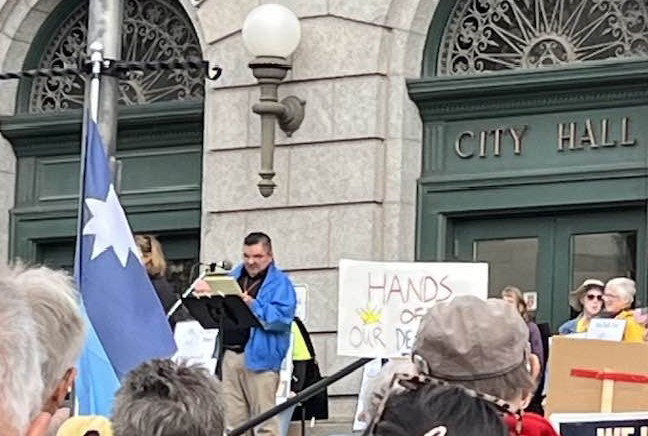
At the No Kings rally on October 18th, Anishinaabe elder Ricky DeFoe affirmed to the gathered crowd that “the natural response to oppression, ignorance, evil, and mystification is wide-awake resistance.” Such resistance, he claimed, calls for an “ethic of risk.” I was immediately struck by his use of the term, paralleling feminist theologian Susan Welch’s A Feminist Ethic of Risk.[i]Returning home, I picked up my copy and found many of the same points DeFoe had articulated.[ii] Both asserted that an ethic of risk recognizes that “to stop resisting, even when success is unimaginable, is to die,” and by this they meant not only the threat of physical death, but also “the death of the imagination, the death of the ability to care.”[iii]
Hearing those bold (and bolded) words spoken by DeFoe, I was deeply moved. Finding them again in Welch’s book enabled an even deeper reflection on all that they entail. What does it mean, I wondered, that to stop resisting, to acquiesce to the overwhelming powers of domination and oppression is to allow death of the imagination? It is both to give up on creating alternative ways of resisting the powers that be and to no longer believe a future of peace and justice is possible. Even in the writing of those last words I feel a despair so overwhelming that I cannot give that thought credence. Welch’s explanation is akin to my own, writing that if we cease resisting “we lose the ability to imagine a world that is any different than that of the present . . . and strategies of resistance and ways of sustaining each other”[iv] — an ability we cannot afford to lose.
And what of the effect of acquiescence on our ability to care? To know that ICE agents are storming apartment buildings in the middle of the night, traumatizing families and young children; life-saving scientific research is being halted; millions of AIDS sufferers have lost their medical care; billionaires throw extravagant parties while thousands go to bed hungry; and total disregard of climate change in the name of greed is causing the wanton destruction of forests, waters, the very earth and not feel a “NO!” rising within oneself, to simply turn a blind eye and go along with it all would require us to completely numb ourselves to pain and suffering – something I choose not to do, for the ability to feel is at the core of our humanity. Resistance arises out of such care, out of love – a theme echoed in the works of so many feminist resistance writers. We find it in bell hooks’ declaration that “embedded in the feminist revolution is the challenge to love”[v] and her acknowledgement that “love was the force that empowered folks to resist domination and create new ways of living and being in the world;”[vi] in Audre Lorde’s assertion that “anytime we do the work of love, we are doing the work of ending domination;”[vii] and in Beverly Wildung Harrison’s recognition of “the power of anger . . . in the work of love. . . ” is what moves us to acts of resistance.[viii] Resistance is care in action.
Resistance to authoritarian power involves risk, even moreso in the current environment of weaponizing military forces against the citizenry, especially for the brown and black peoples being targeted by this administration. However, Welch argues, even though acts of resistance entail risks, these are not acts of self-sacrifice. Though one may risk censure, livelihood, prestige, wealth, or even physical harm, what one gains in being true to one’s sense of integrity to the cause of justice is far greater. “When we begin from a self created by love for nature and for other people,” she writes, “choosing not to resist injustice would be the ultimate loss of self.”[ix] .
An ethic of risk guides us in determining what form that resistance takes. Welch explains that the ethic of risk entails three elements: 1) a redefinition of responsible action, 2) grounding in community, and 3) strategic risk-taking. We need to examine each of these.
Welch describes responsible action as “the creation of a matrix of further resistance.”[x] ‘Matrix’– – from the Latin matrix or womb, and rooted in the Latin matre or mother. It is the medium or source from which something else grows and emerges. So, if responsible action is the creation of the matrix of further resistance it calls both for actions that make life more just in the present while also continuing to nurture the possibilities for the growth of resistance and change in the future.
This is the nature of what Welch calls strategic risk-taking. By this she recognizes that while the aims of individual acts of resistance may be modest, they also, like responsible action, create the conditions for sustained resistance in the future. “The measure of an action’s worth is not,” she argues, “the willingness of someone to risk their life but the contribution such an action will make to the imagination and the courage of the resisting community.”[xi]
Still, I wonder how does one determine what those actions should be? Welch’s second condition is that such actions be grounded in community. When I asked Ricky how he determines what acts of resistance to engage in, he, too, responded that this is never something that one determines by oneself, but rather in continual conversation in community.
We may be fortunate to be born into community, or join existing communities, but community is also something we create by the work of nurturing relationship. We weave the web of community by strands of showing up, listening, talking together, and as Welch argues, literally working together – growing and preparing food, building houses, sewing – all necessary to develop truly emancipatory conversations, especially as those strands weave across difference.[xii]
As we enter this season of Thanksgiving, I wonder about those early interactions of creating community across difference. Much mythology surrounds the story of the first Thanksgiving, but the historical records do suggest that in 1621 the fifty-three remaining pilgrims at Plymouth and ninety members of the nearby Wampanoag tribe shared a harvest feast. One can only wonder who we would be as a society if, in the growing and preparation of food together, the sharing of meals and conversation, this had been the beginning of true community rather than an isolated moment before what would become the genocide of the indigenous population of this land. As DeFoe said so forcefully in his speech, “Western colonialism may speak of an American history. Native people speak of an American holocaust.” But, as he continued, “Native America still stands.”
A settler on these lands, I am fortunate to live in a place where Native America still stands vital and vibrant. Because of the strong presence of the Anishinaabe and other indigenous peoples here I have had many opportunities to forge relationships, friendships I treasure. I am grateful beyond measure for the generosity and welcome I have been given, the wisdom shared and the relationships formed by which I am moved to acts of solidarity and reparation.
Toward the end of his speech, DeFoe called on us all to “join hands in the strong bond of kinship.” For those of us who, like myself, are settlers on this land, if you want to move from being settler to kin, writes Anishinaabeikwe Patty Krawec, it starts with what you do – showing up — to protests, actions, powwows, and events; supporting Land Back movements and helping to restore what was stolen; and most important of all, entering into relationship with humility and respect. If we do so, Krawec writes, “we can walk together on a good path that is green and beautiful and together we can light the eighth and final fire: an eternal fire of peace, love, and kinship.” [xiii]
References
Bartlett, Elizabeth Ann. Rebellious Feminism: Camus’s Ethic of Rebellion and Feminist Thought. New York: Palgrave MacMillan, 2004.
DeFoe, Ricky. No Kings speech. Duluth, MN. October 18, 2025.
Harrison, Beverly Wildung. 1989. “The Power of Anger in the Work of Love.” In Judith Plaskow and Carol Christ, Eds. Weaving the Visions: New Patterns in Feminist Spirituality. San Francisco: HarperSanFrancisco, 214-225.
hooks, bell. Talking Back: Thinking Feminist, Thinking Black. Boston: South End Press, 1989
hooks, bell. Writing Beyond Race: Living Theory and Practice. New York: Routledge, 2013.
Lorde, Audre. Sister Outsider: Essays and Speeches by Audre Lorde. Trumansburg, NY: Crossing Press, 1984.
Kraweck, Patty. Becoming Kin: An Indigenous Call to Unforgetting the Past and Reimagining Our Future. Minneapolis: Broadleaf Books, 2022.
Welch, Sharon D. A Feminist Ethic of Risk. Rev. Ed. Minneapolis: Fortress Press, 2000.
[i] The term “feminist ethic of risk” originated in Sharon Welch’s book by the same name. In her revised edition she says that the term is both accurate and misleading, accurate in that the process of reflection in which she engaged was feminist, but misleading in that she has found elements of this ethic expressed elsewhere among African American ethicist and novelists. She would now name it simply an “ethic of risk.” I have retained the word “feminist” because so much of what is deeply true of the feminism I know and love, such as this ethic, has been lost and forgotten, so that only a shallow version of feminism remains in the popular consciousness. I wish to resurrect it here.
[ii] In re-reading Welch’s text, I found many of the same phrases and concepts that DeFoe had spoken. I was so struck by the parallel I asked Ricky about his acquaintance with Welch’s work. He said that these were concepts he had learned in engaging in anti-racist work. Apparently Welch’s ethic of risk has become endemic in the work of anti-racism. The concept has come full circle. Welch claimed that her conceptualization of the ethic of risk came out of her work in feminist movement, but that it was deeply grounded in the work of womanist writers – Katie G. Cannon, Emilie Townes, Toni Cade Bambara, Paule Marshall, Toni Morrison and their struggles against racist oppression.
[iii] Welch, 46.
[iv] Ibid.
[v] hooks, Talking Back, 26.
[vi] hooks, Writing, 194-195.
[vii] Lorde, 248.
[viii] Harrison, 220, 217.
[ix] Welch, 165.
[x][x] Welch, 74-75.
[xi] Welch, 47.
[xii] Welch, 135-136. See also my longer discussion of this in my Rebellious Feminism, 95-97.
[xiii] Krawec, 186. The reference is to the Anishinaabe prophecy of the seven fires in which this is the time of the Seventh Fire. During this time, the light-skinned race will need to choose between two paths. The one path is green and lush; the other black and charred. If we choose the right path, the Seventh Fire will light the Eighth and final fire of peace, love, and harmony.
Discover more from Feminism and Religion
Subscribe to get the latest posts sent to your email.

 Feminism and Religion
Native people speak of an American holocaust.” But,…Native America still stands.”… On this day of Indigenous mourning we see first hand what active resistance can really mean. These peoples do live in community – a community westerners can barely comprehend – but if we are fortunate like you and I have been we can see how resistance manifests intergenerationally by being amongst these peoples and learning from them…. 500 years and still no accountability on the part of the peoples who invaded this country and did everything they could to destroy them… Do these people expect some kind of victory, that all we be well? Are they attached to outcomes? Absolutely not. They maintain their bonds and way of life in a country that would obliterate them if only they could. We could learn a lot about how to live through this global catastrophe from them. I think refusing to give up under these circumstances is an act of amazing courage… I am hoping my wild turkeys will come to visit today to counteract the massacre of so many….
LikeLike
Thank you for this post, Beth, and for your response, Sara.
LikeLiked by 1 person