

I would not say that I was much of a reader growing up. Doctoral studies and years of education had turned me off of reading as something pleasurable. Instead, it had become a task, an item on my to-do list, often, a chore. It was also not that joyful since I have struggled with some form of dyslexia all my life.
But, now, I would say I am embracing reading. I have talked on this blog about my love of dystopian books before, but I also enjoy fantasy books, historical fictions, feminist retellings of myths, the occasional thriller, and so on. In terms of format, I read both paper books and audio books. The joy of audiobooks is the freedom to read when commuting, cooking, doing laundry, walking the dog, relaxing on the couch, etc. They have opened up the possibility of enjoying two activities at once sometimes and other times making a difficult activity more bearable.
Recently, I have begun asking friends for book recommendations. One friend has recommended Braiding Sweetgrass by Robin Wall Kimmerer. I love this book! I miss it actually. Have I ever said that about a book before? No. So many parts of that book have functioned as food for my soul: the Honorable Harvest; the gratitude for nature’s gifts; plants and animals as teachers; the weaving of science and storytelling; the messages of hope; the warnings… Don’t worry, there is so much more discussed. I’m not spoiling it. The book is one of those books that even after listening for 15 minutes would change how I approached my day. It was, as a friend described it, truly meditative, food for my soul in a way I certainly did not expect it to be.
As an ecofeminist, it was this book which has challenged me to rethink human and environmental interactions in a way that none of my academic reading to date has yet to do. In one section of the book, Kimmerer discusses a scientific study done hoping to shed light on Native American knowledge surrounding the plentitude of sweetgrass in a given field. Those Native Americans that use sweetgrass to burn for spiritual practices and to make baskets understand that sweetgrass thrives not when humans leave it alone, but when humans harvest and use it. Generally, I consider most human interactions with the environment to be harmful, science being one of them, but her telling of the experiment and its results was such a different take on uses of science and discussions of what environmental stewardship entails. That being said, I found it difficult to agree with Kimmerer that hunting animals shows animals respect or that animals would volunteer to die so that humans could live. Those parts were hard to read and I often had visceral reactions to them even though I understand the tradition from where they are coming.
Another friend has recommended Girl, Woman, Other by Bernardine Evaristo. Completely different from Kimmerer’s book, this book is fiction, character-driven, and tells the life stories of various, predominantly immigrant and black, women living in England. Girl, Woman, Other is intersectional feminism in novel form, and I loved it for that and the brilliant ways in which the lives of all of these women somehow all interconnected. At times, I found myself laughing out loud and, at other times, lost deep in thought. For example, when Evaristo describes the competing demands of those who establish the Republic of Freedomia, I caught myself giggling out loud on the tram. I won’t spoil it for you. And, when Dominique’s relationship becomes a prison, I was reminded of the ways in which patriarchal violence can be internalized and imposed by women on each other. If you haven’t read Girl, Woman, Other, I highly recommend it. I am thinking of ways to incorporate it into my teaching.
I am currently working my way through The Testaments by Margaret Atwood. I found this one on my own, as I read The Handmaid’s Tale in high school. The book takes place in that same world. I have only listened to about 70 percent of the book so far. What stands out is the brutality of how Gilead rose to power, the ways women find room for compassion and subversion within a system that actively harms them, and the bravery of those who work against such brutal regimes. Given recent world events, this dystopianism feels very close to home. In fact, I put the book down for a while as I just could not find the strength to continue to listen. I picked it up again about a week ago and am determined to finish it as I think Atwood’s stories are prescient warnings of the destructive patriarchal nature of white Christian nationalism.
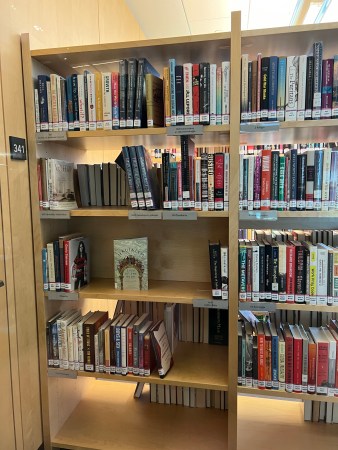
One feature of the book that has taken me aback is the way in which reading in Gilead is gendered. Many men can read and write and thus have access to both knowledge and power. Women, except for the Aunts, cannot read; neither do most men, except the most powerful. Women are taught that reading is not in a woman’s nature, and books are dangerous. In reality, we know that reading would expose them to knowledge about Gilead’s lies.
Atwood’s commentary on reading illustrates how it can bring knowledge which can forever challenge one’s perspective on the society one inhabits. That is the power of reading. In fact, some books have the potential to help us also think about how to survive in the midst of patriarchy, how to subvert it, sometimes how to become cognizant of it, how to cope with it, how to reject it, and warn us what happens when we let our guard down and become complacent with it. Other books offer us possibilities and visions of a post-patriarchal future.
I’m taking your book recommendations in the comments down below. Thank you.
Discover more from Feminism and Religion
Subscribe to get the latest posts sent to your email.

 Feminism and Religion
Love this post, Ivy! I’ve used fiction in my undergrad classes with success. Especially THE RED TENT by Anita Diamant and THINGS FALL APART by Chinua Achebe.
Found this online by Aditi Sharma. Love the line by Camus.
We are, in some sense, liars. We create people who never breathed, places that don’t exist, tragedies that never unfolded and yet, we make readers weep. We write stories of heartbreak and hope, of rebellion and redemption, and though the plot is stitched from imagination, the emotions are very, very real.
What, then, is this strange alchemy?
Fiction is where reality goes to heal. When the real world becomes too harsh, too loud, too divided, fiction becomes a confession no one dares to make aloud. It allows us to say things we cannot say outright to explore identity, injustice, trauma, love, longing all wrapped in a safe disguise.
The orphaned wizard, the rebel district girl, the old man in the boat, the boy who talks to the stars they’re lies on paper, and yet they are the emotional biographies of our times.
Because fiction doesn’t ask for facts; it asks for truth. And truth is not just something that happened. It is something that felt like it happened.
When you read a powerful story, your brain doesn’t know it’s fiction. Your heart definitely doesn’t. That lump in your throat when a character says goodbye, that rush of rage when injustice unfolds in a novel that’s you connecting with a lie that holds something real inside it.
Fiction let us explore forbidden feelings. It let us question power without naming names. It let us love what we have lost or never had.
That is why stories matter in revolutions, in exile, in grief. That is why totalitarian regimes fear novelists as much as journalists. Because fiction tells the emotional truth behind the political silence.
We build lies with intention. Not to deceive, not to mislead, but to reveal, to guide. We might say, “This never happened,” but we really mean, “But it could. And it does in some form, somewhere, to someone.”
We name our characters Arjun or Fatima or Mei, but what we’re really doing is showing you yourself. Your doubt. Your courage. Your guilt. Your second chances. We are not gods of creation we are mirrors tilted just right.
There’s a child somewhere who reads about a lonely misfit and feels a little less alone. There’s a woman who reads about another woman walking out of a loveless marriage and finds a sliver of courage. There’s a man who reads a love story between two men and finally breathes freely.
Those stories are not true but they make us truer versions of ourselves.
That’s the magic.
yes, writers are liars.
But our lies are made of empathy. Of questions too dangerous to ask plainly. Of wounds that need metaphor to heal.
Fiction wears a mask, but behind it is the face of raw, unfiltered truth.
That’s why we write. That’s why we read.
To find truth, wrapped in a lie.
LikeLiked by 1 person
I loved your take Ester, how scary is the truth for some, that we need to turn it into fiction rather than just tell the truth…..are we a bunch of cowards or people pleaser wishing to be liked?
LikeLike
Yes, the truth is/can be very scary. This poem by Emily Dickinson is probably my favorite:
[POEM] Tell all the truth but tell it slant by Emily Dickinson
Tell all the truth but tell it slant—
Success in Circuit lies
Too bright for our infirm Delight
The Truth’s superb surprise
As Lightning to the Children eased
With explanation kind
The Truth must dazzle gradually
Or every man be blind—
LikeLike
Yes it can be Esther, look what we are seeing now, yikes! We got this.
LikeLike
Unlike you I have always LOVED to read… grad school opened me to so many new ways of thinking ( I attended a very progressive institution where independent thinking was lauded…. never wanted to leave. One of the sad parts of aging is that I am no longer able to read many books because the type has become too small – thank goodness for audiobooks – though finding good NEW material is becoming a real challenge – especially since I am a researcher that has nature at the center of her life and my reality is different – for me all living beings are sentient – possess intelligence equal to or more sophisticated than ours – as for love and compassion – well nature has it over humans for sure -most of my experiences are impossible to translate so I rely on the few women scientists who have written about trees and plants like Suzanne Simard and Monica Gagliano as well as Kimmerer for validation… it’s lonely out here – I think if you dive deeper into Kimmerer’s work you will find that the example you use is one example of bridge making between cultures more than a concrete belief – ..Kimmerer is inviting westerners into a matrifocal way of living that is compelling – I return to this book over and over to remind me that the culture we have constructed is just that – a construction. No more.
LikeLike
I really enjoyed reading your post and look forward to picking up these books. What I know is that Margaret Atwood was born into patriarchy, most women have been and we are going back almost a hundred years here. Margaret understands deeply how patriarchy is played out socially/culturally she shares her reflection with us. History repeats itself and at this time Margaret is reminding of the French revolution, we are seeing much resemblance of this being played out now. No more kings. Sure things have changed much in a hundred years and we have feminists to thank for that, though have they changed much, really? All of our systems are patriarchal, Margaret reminds us once again how fast thing can change (agenda 2025), is for real. I am seeing lots of crazy things emerging these days, like sex is gender (forget about biology), when we know gender relates to stereotypical roles (thanks Jane Claire Jones for clarifying any confusion once again). Trad wives (back to the fifties-we have already been there, history repeating itself), sex is work and so forth, really? What we have been witnessing is one hundred years of women’s, very hard won, basic human rights going down the toilette because women need to be nice. Margaret is once again reminding us of all of this, how easy it is for us to lose everything we have struggled for and she is spot on again.
LikeLike