

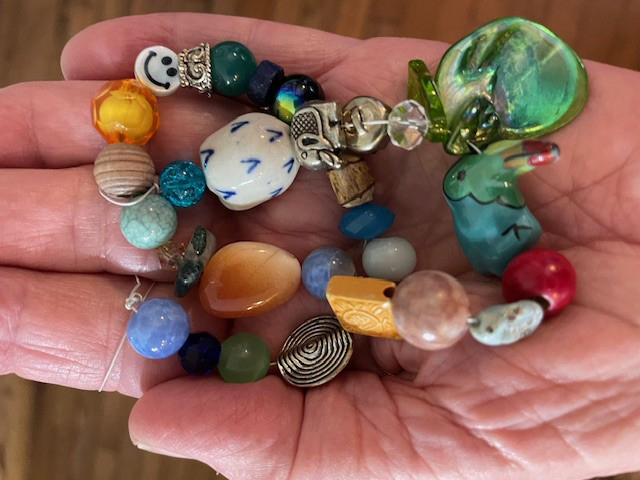
The string of beads lies coiled in my palm as I reflect upon my women’s circle and our annual kything ritual. Sixteen different beads, each representing a different woman in the circle. We are a Goddess honoring group that meets twice a month from September through June, at the local UU church. Some of us have been active in this group for twenty years. Some of us joined last month. We range in age from mid-forties to mid-eighties.
We sit around the outsides of three long tables, arranged in a U-shape so we can see each other. In front of us, we each have a small cup of beads, some paper to make notes on, and a knotted piece of beading wire. We begin our kything ritual.
Lynn, one of the facilitators, holds up a blue bead and describes it. She names her intention for this summer—life energy—and asks us to visualize her walking confidently on the beach at low tide without a limp or cane, full of life energy. Knowing as we do that she is recovering from knee replacement surgery, the intention is not surprising. I find it empowering to energetically support her healing as I visualize her confidently walking on the beach.
The paper before us has columns for us to write each woman’s name, bead, intention and visualization. We bend to this task. Lynn puts her bead on her string of beading wire and passes her cup of matching beads to the person sitting next to her. This woman adds Lynn’s blue bead to her string and passes the cup along. Then she shares the same information for herself, adds her bead to her string, and passes her cup around. As the cups of beads work their way around the circle, we all diligently listen, write and string, until each woman’s desire is represented on the strand in our hands.
The word kythe means to make visible. It is a Scottish word which means to enter into a state of union with others, to consciously communicate with an object or another being. Madeleine L’Engle used the term kything in her 1973 novel, A Wind in the Door. It represents a spiritual technique that offers a way to be present with others without regard to either space or time. Kything can foster deeper connections and be a gateway to mystical experiences.
My group doesn’t meet during the summer months. So our kything practice helps us feel connected during that time, and fosters a deeper relationship among us. When the last bead has been strung, the facilitator invites each of us to reflect on the experience, our string of beads, and how we plan to use them over the summer.
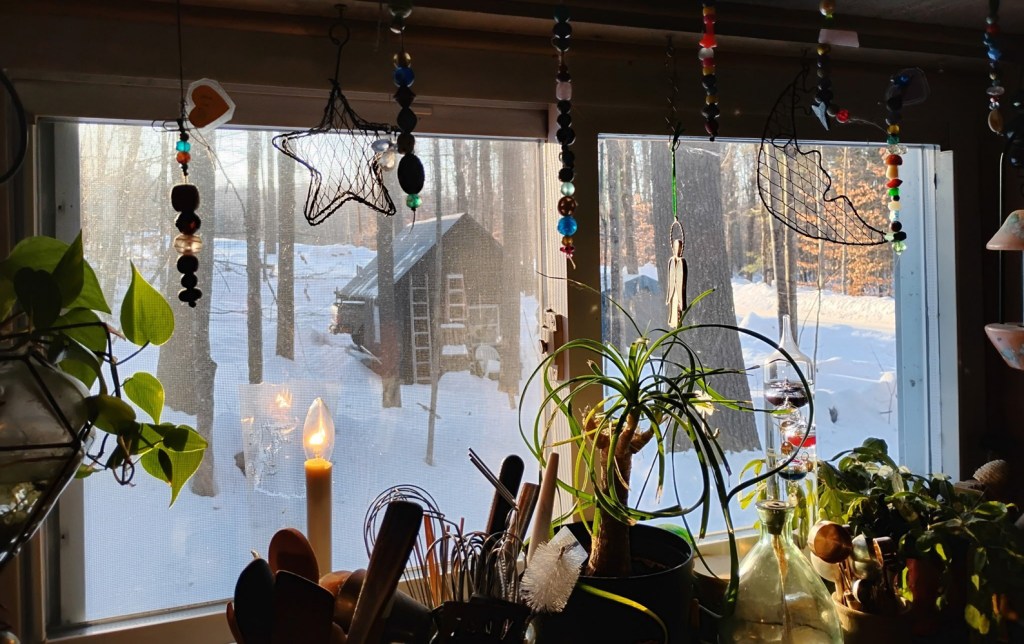
The string of beads is a symbol of our shared bond. When we are not meeting regularly, it acts as a way for each of us to connect to both individuals and the group as a whole. We practice kything throughout the summer by interacting with the string of beads in some way. Joyce, age eighty-three, hangs her strings of beads in the window over her kitchen sink so she can be in the presence of friends while baking.
Others use the beads as a meditation tool—sitting in a quiet space and touching each individual bead. Touching the bead allows us to envision that woman and her intention. We can send our energy to aid in manifesting her vision. When we come back together in September, we discuss our experiences kything as we share tea and cookies to renew our bond.
I have six of these strings of beads. They live in a bowl on a bookshelf by my chair and throughout the year I take them out from time to time to handle and reflect, like a mala or rosary. Sometimes I refer back to my notes about what each bead represented, and sometimes I just think of the friend who contributed that bead. The beads serve as reminders of the challenges and blessings each of my friends has engaged with since I joined this group. The fiery red bead from 2022 is Sally’s bead, containing her desire to bring a little more passion into her life now, that she is finished with cancer treatments. In 2018, Nicole’s blue and white owl shaped bead represented her intention that the writer’s workshop she spent the winter organizing would successfully manifest that summer. The year after my daughter’s traumatic divorce, my bead was rose quartz and I was looking to manifest love and joy.
No one is exactly sure how long the kything practice has been going on. Ten years at least, and the group keeps getting stronger. I believe that our kything practice is part of the reason why.
In quantum physics, string theory is a theoretical framework that hypothesizes that the fundamental constituents of the universe are not in fact tiny microscopic particles. Instead, string theory proposes that these particles are actually one-dimensional vibrating ‘strings’ of energy, which vibrate at different frequencies, each pulling on others to create a coherent fabric of space, time, and experience.
Contemporary metaphysics speaks of the unique vibrational fields human beings unconsciously create, and encourages us to increase our vibrational levels through various physical and contemplative exercises. Much like the vibrating ‘strings’ of string theory, each woman in this circle brings a unique energy frequency with her. We are all different, coming from different backgrounds, growing up in different circumstances, and living adult lives which vary greatly. We come together in this space as a spiritual community of seekers, looking for connections and a safe and supportive space in which we can explore our relationships with the Divine Feminine, our bodies, and other women.
When our individual beads are added to the kything strings, new vibrations are created by the intentions each woman brings to the process. When I sit in the morning, thinking of my friends as I work my way through the kything beads, my vibrations are added to the equation, supporting each woman in the accomplishment of her summer intention, and welcoming in the support I receive from them.
In this way we represent a feminist string theory, based on the belief that our combined vibrations can, over time, strengthen our communal connections, support the manifestation of our individual intentions, and help us create a coherent fabric of space, time, and experience.
My 2025 We’Moon calendar included this quotation from Kaitlin Illya Wolf about the power of women’s circles.
“I want to live in a world where women support each other and lift each other up, in a world where we know there is enough for us all and we can help each other to find what we need. Gathering in women’s circles is one of the most important stepping stones on the path to that world.”
May it be so.
Discover more from Feminism and Religion
Subscribe to get the latest posts sent to your email.

 Feminism and Religion
I do think these rituals matter – although I believe that it’s imperative to include the rest of nature INTENTIONALLY because we are relying on this planet for life.
LikeLiked by 1 person
Bookmarking for later to read
LikeLiked by 1 person
Love this so much! What a treasure of an idea and such a powerful support–energetically, tactically, practically, ritually.
LikeLiked by 1 person
I am going to do this with a group of women on pilgrimage to Scotland! Thank you!
LikeLike