

Moderator’s Note: This piece is in co-operation with The Nasty Women Writers Project, a site dedicated to highlighting and amplifying the voices and visions of powerful women. The site was founded by sisters Theresa and Maria Dintino. To quote Theresa, “by doing this work we are expanding our own writer’s web for nourishment and support.” This was originally posted on their site on May 20th, 2025. You can see more of their posts here.
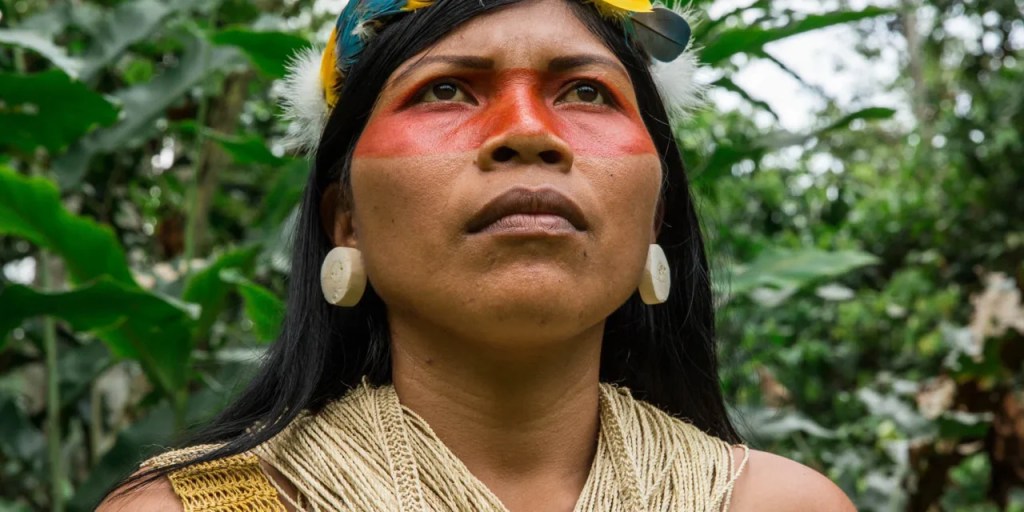
She didn’t know what the United States was. She didn’t know where it was, she called it “the land of Rachel” after the missionary in her village. She didn’t know what God was. She only knew if she went to church, she may get a pretty dress. And she wanted one.
More important than an activist tome, more important than a cry for the Amazon Rainforest and acknowledgement of indigenous peoples’ right to their own land, more important than a scathing exposé on colonialist pillage, and predatory preachers, this book is the story of a woman growing up, a woman coming of age, a woman allowing us into her personal story and her unique worldview in her own voice. This book is a treasure primarily because of that. Because we finally get to hear the story from the point of view of a Waorani woman as she experienced it.
Born in 1985, the narrative begins in the Pastaza region of the Ecuadorian Amazon when she is a girl. Nemonte does not interject her current worldview, one where she speaks and writes Spanish, travels the world as a spokeswoman for her peoples, her land and ancestors, onto it. She allows that girl to tell her story with what she knew and didn’t know then. We have a window into her life with all its beauty and pain, no outside projections, no White gaze, no European worldview pasted over. It is an authentic telling that takes your breath away. From the point of view of a White person and culpability, it is not an easy read.
“For us, stories are living beings. They breathe life into our homes, into our forests. They pulse in our blood, in our dreams. They stalk us like jaguars, clack like peccary, sail like macaws, run like fish. They are powerful beings. Like rainbows, they bring peace. Like lightning, they bring war. And they are always changing. That’s how we know that they are alive. A story dies when no one tells it”(Introduction).
Her people are the Waorani living in the rainforest of what is now Ecuador. They have been referred to as Auca, meaning savages, for many years, when she begins her story. They are called Auca by their local indigenous neighbors because many of the Waorani tribes are still uncontacted and still authentically engaged with the wild forest. The White people who call them Auca are both missionaries attempting to baptize them into their brand of Christianity and the oil companies who want their oil.
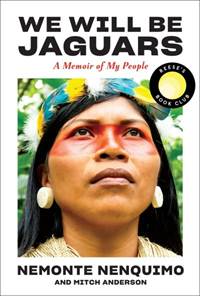
The book opens with a crisis that reveals rifts already present in the village. Nemonte’s brother falls ill. While her mother goes to the forest to gather ancestral remedies from plants and trees, she also goes to church and prays to the missionary’s God. Nemonte’s father does not go to church, but the mother won’t leave a stone unturned to save her son. In this crisis, Nemonte becomes more exposed to the missionaries and their way of life. She finally receives the pretty things that she’s been longing for when her mother sends her to Sunday school.
Before this, she never had a dress like the other girls in the village who went to church and were given them as reward. Now she has one. Thus begins her indoctrination. She learns to hate herself. She begins to believe that White is beautiful and brown, the color of her skin, is not. She begins to resent her own teeth with large gaps in them, not straight like the White girls. She begins to dislike the way her face looks—wide and wild— when she sees its reflection in the water.
At the same time, her life continues as a Waorani in close communication and embeddedness with the wild forests.
“When we die, we become jaguars,” her father tells her.
“We will live in the forest, tracking peccary and wooly monkeys. But we are not like any old jaguar. We are spirit jaguars. The souls of our ancestors roam in these woods. They remember everything. They carry sadness, anger, revenge, songs, healing powers. Only some of us can speak with them. The meneras and the meñemempos. The mother jaguars and the father jaguars”(23).
These are the shamans of her people. Nemonte is identified as one of these people.
She is also told by the missionaries that the devil is small and black. It makes her fear her grandfather who is small and black.
Also living in the area, only further out, were other tribes, the Taromenane and The Tagëiri. These are the uncontacted. They had stayed away from the White people. They are also known for killing with their spears to protect their land. The Waorani are related to these people, and feel a kinship and loyalty to them.
The oil companies want their land.
Part 2, tomorrow
Discover more from Feminism and Religion
Subscribe to get the latest posts sent to your email.

 Feminism and Religion
Having read this account – the split is hard to deal with since we continue along the same line with Indigenous peoples everywhere – the stories must not die – for then the should of the jaguar is dead.
LikeLiked by 1 person
Hi Sara,
Nemonte’s story is one of hope in spite of the devastation. She, together with others, is keeping the stories alive.
LikeLiked by 1 person
Thanks for this. It hit me in a deep place. When I was 15 or so, the wife of a friend of my dad (they had been in the US military together) gave our family a missionary book titled The Savage My Kinsman, using the epithet “Auca” as the people’s name. It was written by a missionary wife whose husband had been killed by the missionized. She stayed and continued the same conversion process described here. The missionaries were so absorbed in their goal of indoctrination that they did not realize (or much care) that they were the advance line of colonization, which led to mining, oil extraction, logging, and genocide (cultural as well as land seizure, and probably foreign diseaes). Even then I was suspicious of their motives (the author was convinced of her own heroism) but the color photos of the people fascinated me. It was my first look at the originarios of South America.
Later, researching this, I saw them identified as Shuar (which is wrong) and found out that the Waorani language is an isolate, unrelated to any surviving language.
LikeLiked by 1 person
Thanks Max. Very interesting about the language.
LikeLike