

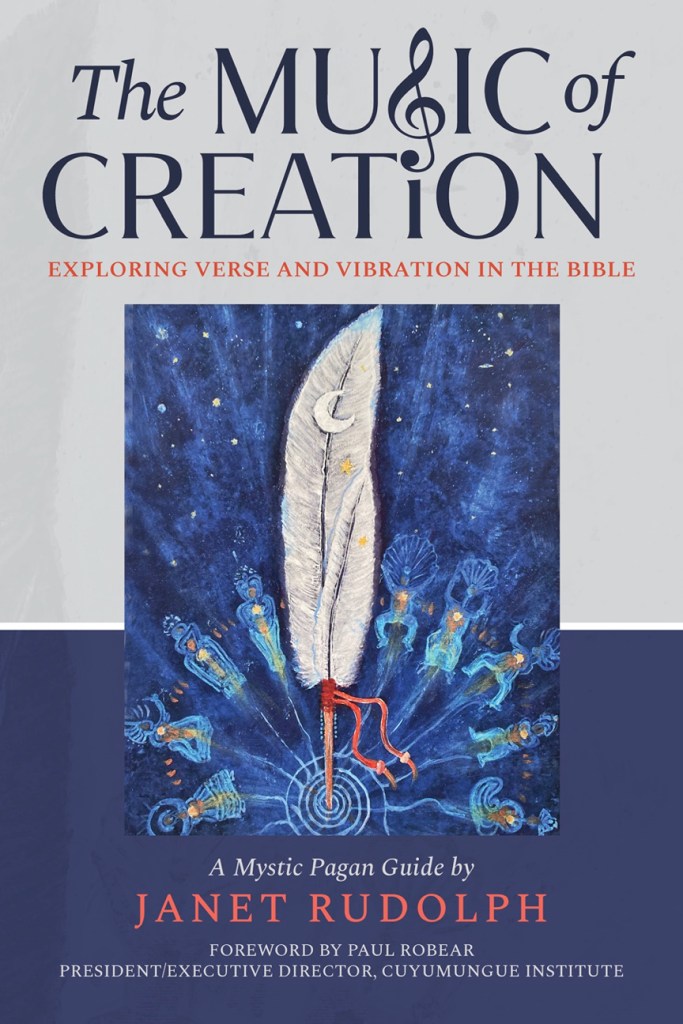
“What if the teachings within the Bible were not dualistic, but taught of oneness, connection, and the flow of energy?” (9) In The Music of Creation: Exploring Verse and Vibration in the Bible, Janet Rudolph (whom FAR readers already know as a FAR co-weaver) explores the definitions and vibrational elements of the sounds of original Hebrew words in the Bible. This is her latest book. In this book, Janet creates retranslations that express the energy, flow, dynamism and movement of the verses. She also discusses ways for readers to experience the power and potential of the verses for themselves. As she notes, Hebrew is a “sacred language” so that “the words themselves carry a vibrational element that we, as human beings, find meaningful and compelling” (3). In doing so, her retranslations revive the energy of “nature and its cyclical wisdom” (4). These are remnants of the original teachings, bringing forth their fresh beauty, inspiration, and world perspective we so need now.
Janet takes passages that in common English translation appear to glorify violence, relegate women to sinful, secondary status, objectify the Earth, and portray a wrathful, sometimes baffling Divinity and reveals original meanings. She does this by accessing the energetic essence of the original Hebrew words, letters, and sounds, to unveil a world that is full of joy, love, equality, mystery, and graceful, harmonious resonance. Often the retranslations reconnect the verses and manifestations of the Divine to female spiritual beings, including Eve, Isis, and Asherah. I am reminded that women and female Divinity were not as absent from the Bible as we may have been brought up to believe. As I read the book, I found myself asking over and over, “What if this was the Bible that most of us had been taught from childhood and that was foundational to the society we live in? How might the world be different?”
Throughout the book, Janet not only retranslates, but offers exciting new perspectives. In the first retranslation, one of my favorites, Janet begins at the beginning, with Genesis, parsing the Hebrew word bedel that is translated in the King James Version (KJV) and elsewhere as “separation.” The first act of the KJV’s creation is to create division between good and bad, “light and dark, heaven and earth, male and female” (9) fostering inequality and judgmentalism. Instead, Janet shows, if we look at the letters of bedel and their meanings and sounds, we instead find the concept of a swinging door or (tent) flap through which we can travel between realms, a “passageway (door) between the earth (humanity, manifest) and the heavens (spirit, divinity)” (10). “Bedel, decoded, describes the process of creation as energy that flows through the tent door as it continues to move in both directions” (10). She further retranslates John’s “In the beginning was the Word” to “in the beginning was the word, the womb and the wisdom and in their commingling, Great Mystery becomes (ehyeh) LIFE UNFOLDING” (105).
After recasting Creation as flowing energy/harmony/unity, she redefines Divinity by examining Divinity’s Biblical names to express Divinity as both one and many, “transcendent of gender,” and “All-Potential” encompassing “creative functioning, nurturing life, the magic of creation” (16), “not tethered to linear time” (24). Fundamental to our human experience of this Divinity is sound, especially music and chanting. To illustrate this, she then retranslates Biblical verses about “music, noise and their roles in creation” (31), focusing on how they transform us as their energy flows through our bodies. This creative, flowing universal energy manifests on our Earth through seeds and trees, to which we humans have always a special relationship. These are featured in retranslated Biblical verses as promises of regeneration and rebirth as Adam and Eve dispersed seeds across the Earth after leaving Eden.
Janet’s two shamanic initiations enable her to recognize that some of the Bible’s most puzzling stories actually describe the mystical experiences and vision quests that result from our encounters with this universal flowing energy. One is Jacob’s Ladder, retold as his journey to “otherworldly landscapes” where “what Jacob is seeing is not only divine but is a peek into the secrets of creation” (78). This retranslation includes a beautiful clarification that the term “God-fearing” is not about fear as we understand it, but rather being joyfully overcome with awe at Divinity’s Mystery.
Similarly, Janet finds that the bizarre story of God demanding that Abraham sacrifice his son is really an initiation ritual, with techniques used globally, for Isaac’s entry into adult life. A similar story about Hagar and Ishmael also features elements of initiation ritual. Especially tantalizing are Janet’s findings that Abraham, Sara, and Moses may have received spiritual training in Egyptian Mystery Schools that, in Biblical times, eclipsed those of Eleusis in age and honor.
Janet’s retranslations, which she calls the Mystic Pagan Version (MPV), are poetry worthy of being enjoyed for their own sake. Here is one of her playful retranslations of Genesis 3:14, in which God gives his/her name to Moses, in the KJV, as “I AM THAT I AM”:
“I am motion-filled song, I move
I am the umbilicus through which I flow, I flow
I vibrate birthing, I vibrate” (25).
After giving the traditional translations and then her own retranslations, Janet offers ways for readers to experience the energy and power of the words through three elements: mudra (“hand and/or body position”), mantra (“a chant or vibrational sound”), and mandala (“an image for visualization”). “Using these three in concert helps us to embody or co-create within ourselves the energy/power of the concepts” (12). For each mudra she includes photos from all over the world, ancient to modern, which not only illustrate the position but also remind us that the concepts and shamanic practices she describes are found not only in the Bible but are part of our common human heritage.
Rather than just read about these mudras, mantras, and mandalas, try them for yourself.
Going back to the poetic retranslation of I AM THAT I AM excerpted above, the phonetic Hebrew is ehyeh-asher-ehyeh. By drawing out the syllables, the mantra is “Ayyy-yehhh, ash-air, ayyy-yehhh”. As Janet says, “When chanting these syllables, take time to feel the sounds as they move across your tongue. Pay attention to the energy of the sounds as they move through your body” (26). Go ahead, try it. I’ll wait.
For the mandala, Janet suggests visualizing a tree, or different trees, “perhaps a favorite one,” because of asher’s “connection to Asherah and Her tree groves” (26). So give that a try. I’ll wait.
Finally, for the mudra, “Announce your presence, place your hands in the air, palms facing outward. Feel the energy move across your palms. Feel your rootedness in the ground” (27). She includes images of Ishtar from Mesopotamia and a goddess from Crete, but the arm position is also reminiscent of the yoga “Goddess” or “cactus” arms, for all you yoga practitioners reading this review.
The Music of Creation is not Janet’s first foray reintroducing readers to the Hebrew Bible. Previous works include When Moses Was a Shaman and When Eve Was a Goddess, as well as her recent autobiography, Desperately Seeking Persephone. The Music of Creation is available at Amazon or Barnes and Noble.
Janet’s retranslations of the bible and the experiential exercises that bring their vibrancy into our bodies, hearts, minds, and soul transform our perception of our world and open doors between our human, everyday realm of existence and that of spirit and divinity. This is a work that should be discussed widely among scholars, clergy, shamans, and other spiritual practitioners for years to come. Read this book and find that your beliefs about yourself, Divinity, the universe in all its energetic glory, and your place in it have been unfurled in ways you could never have imagined.
Discover more from Feminism and Religion
Subscribe to get the latest posts sent to your email.

 Feminism and Religion