Exploring the F-word in religion at the intersection of scholarship, activism, and community.
Author: Elizabeth Cunningham
Author of The Maeve Chronicles, a series of award-winning novels featuring the feisty Celtic Magdalen who is no one's disciple. I am also interfaith minister and a counselor in private practice.
Moderator’s note: This marvelous FAR site has been running for 10 years and has had more than 3,600 posts in that time. There are so many treasures that have been posted in this decade that they tend to get lost in the archives. We are beginning this column so that we can all revisit some of these gems. Today’s blogpost was originally posted January 19, 2014. You can visit it to see the original comments here.
Elizabeth Cunningham
“I forgive you.”
These words make my teeth buzz like the sound of chalk squeaking on a blackboard. I can vividly recall my sister and myself, as children, saying these words through clenched teeth. Not only were we Christians, we were the minister’s daughters. We had no choice. The only other words I hated as much: “I’m sorry,” also forced through clenched teeth.
Oddly enough I cannot recall my older brother being told to ask my forgiveness when he and his friend pummeled me. That fell into the category of: “you egged them on.” My mother did used to say of my brother, mournfully and anxiously: “he doesn’t know his own strength.” Which meant: it isn’t his fault that he hurt you. But my sister and I were supposed to be nice to each other.
I began writing quarterly posts for FAR in July 2012. The poems below are selected from journals kept during these nine years. As indicated, I searched for the words goddess, women, woman. April is poetry month, but I also realize that right now I don’t have any essays in me. Sometime this year, I may embark on my first nonfiction project. In spite of and/or because of that new focus, this post is my last as a regular FAR contributor. I am grateful for having been a reader and writer in this community. Thank you and much love to you all.
I am beginning this post (again!) on Thursday, January 7, 2021, the day after Epiphany. I have been working on it since Monday. It not unusual for me to take a whole week to write a post for Feminism and Religion, which is why I only post quarterly. It is unusual for me get to Thursday and scrap all attempts, to acknowledge that I still don’t know what to say.
I have a vivid childhood memory of being sick with the stomach flu and standing in the doorway of my parents’ bedroom looking for my mother. Her care for sick children was tender and thorough. She would bring us ginger ale and toast with jelly. When she had time, she read us stories. I can remember her steering me, heavy with fever, back to a bed that she had magically smoothed and cooled. But that day my mother lay in her own bed in an old nightgown, not stirring. She had the flu, too, and could not get up to care for the rest of us. It was a shocking and sobering moment.
As I grew older, I transferred my need for comfort, reliability, and continuity from my mother to the earth, the sure turning of the seasons, beloved trees, waters, and rocks. As a young mother, I looked forward to sharing my own childhood joys with my children, among them jumping into autumn leaf piles. The first time my children leaped into a leaf pile, they came up covered with the ticks that have now made my region the epicenter of Lyme and other tick-borne diseases. Nor was I able to share with my children the joy of drinking water straight from a stream. Continue reading “Child of the Earth by Elizabeth Cunningham”
When I wrote Murder at the Rummage Sale, my agent warned: “You have to have a sequel in mind!” I was supposed to write a second domestic cozy, same setting, same characters, different victim. But what came to mind was a memory. When I was a troubled teen visiting England, my uncle gave me a map and let me go sightseeing in London on my own. It was early winter 1968, the war in Vietnam was raging. I did not want to be an American; so I faked an accent, wore an eccentric hat, and called myself Eliza Doolittle. When a man picked me up, I did not know how to break out of character. I ended up drunk in his flat. I just managed to fight off rape. The man must have figured out that I didn’t add up and could land him in trouble. He took me back to my uncle’s office. The kernel for All the Perils of this Night is: what if he hadn’t? What if, like so many others, I had been trafficked? I couldn’t shake that “what if.” So I wrote the standalone sequel, no domestic cozy but what I would call a numinous thriller.
In July, in honor of Mary Magdalen’s feast day, I usually post about Maeve, my Celtic Mary Magdalen. This year Maeve urged me to select an excerpt from the new novel. In the scene below Anne, teenaged Katherine’s mother, is searching for her vanished daughter in London’s red light district. A prostitute agrees to speak with her if Anne will pay for her time.Continue reading “All the Perils of this Night: a preview by Elizabeth Cunningham”
In times of stress, I like to count syllables. It soothes me the way the click of knitting needles might soothe others. Finding rhymes is also calming. Below are poems in forms that require syllable count and/or rhyme, the last three written recently. I hope you are all sheltering well.
Villanelle: 10 syllables to a line. A, B rhyme scheme, with repetition of the 1st and 3rd lines.
noon
I have come to love the silence of noon
the cars have all gone wherever they go
I can hear the bees hum their tuneless tune
the noon of the day is the sun’s full moon
listen, the air is still, the wind lies low
I have come to love the silence of noon
the chainsaws silent, no wood to be hewn
no scratching the dirt, it’s too hot to hoe
I can hear the bees hum their tuneless tune
each shadow cast, now drawn close, is a rune
thickets conceal spotted fawns and a doe
I have come to love the silence of noon
this refuge from noise, a sweet daily boon
a full body blessing, crown to tiptoe
I can hear the bees hum their tuneless tune
When I was a child in the 1950s we often played cowboys and Indians. There is a photograph of my brother and me in no doubt inauthentic costume complete with feathered headdress. In kindergarten I named myself Morning Star. (I just googled and see that I must have gotten the name from the 50s television series Brave Eagle, the first with an indigenous main character. Morning Star is the female lead.)
When I was a teenager, my aunt came across a privately printed book The Gentleman on the Plains about second sons of English aristocracy hunting buffalo in western Iowa. My great grandfather accompanied them as their clergyman. I wish I could find that book now to see how this enterprise was presented. In my adolescent mind these “gentlemen” looked like the local foxhunters in full regalia. On opening morning of foxhunt season an Episcopal clergyman (like my father) was on hand in ecclesiastical dress to bless the hunt and then invited to a boozy breakfast. Continue reading “Forgive Me My Ancestor(s) by Elizabeth Cunningham”
Isabella Ides’ White Monkey Chronicles is my lectio divina, the wisdom, humor, and wonder of her story savored daily. (For an overview, see BJ Austin’s review.) Although the titular white monkey is at the heart of the chronicles, and his charge, foundling/avatar Conrad Eppler, is a boy, I have never encountered a more vivid evocation of goddess—multi-dimensional, earthy, transcendent, fierce, compassionate. No one knows Godma better than the Sisters of the Joyous Mysteries, an order of rogue nuns, the focus of this interview with the author.
Give us a thumbnail sketch of the three remaining members of the order, Sister Mary Subordinary, Sister Merry Berry, and Mother Mary Extraordinary.
Mother Mary Extraordinary is ancient, icy white, her soul as scuffed as an old shoe. Extraordinary’s veil hides long white hair that reaches to her ankles. Sister Merry Berry is youthful, dark as an espresso truffle, her hair a disarray of dreadlocks. She ditches her veil, crochets a Rastafarian beret, and adopts a pair of florescent orange running shoes. Nun on the run. The orderly Sister Mary Subordinary is almost without physical detail. She is selfless, a giver, a maker of bread and soup. She is porous. Sometimes her soul escapes her. Mary Subordinary has visitations; the monkey god, for one, slips in. Subordinary herself can enter other minds, although she tries not to snoop.
Have you encountered rogue nuns in your own life?
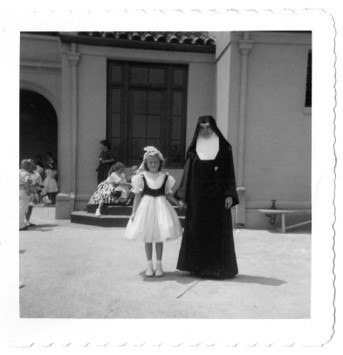
Author with Sr. Mary Agnus, Blessed Sacrament School
I spent my first-communion year at a Catholic school in Hollywood, on Sunset Boulevard. One day on the playground, Sister Mary Agnus asked if I wanted to see the bones of a saint. Yes, I did! She reached into her deep pocket and fetched out a small gold case with red velvet lining and a glass portal. Forget Mary Poppins. I was enthralled. Yet in my secret life, I did not believe in her god. I was a seven-year-old redactor, appalled by the vision of an ocean of children drowning as the ark of animals sails on.
Then years of public school in the suburbs drained the world of mystery. I jumped at the chance to enroll in an all-girls Catholic high school. My notions about nuns changed irrevocably the day I wore a faux zebra coat over my school uniform. Sister Mary Malua asked to try it on. Her Sister friends giggled like girls. And with a shock, I was made aware that they were girls. Like me. These young Sisters, fresh off the boat. Irish – they spoke Gaelic when ruffled — upper-class girls, smart, some of them brilliant, but not very pretty, and not necessarily traditionally gendered.
And none of them as rogue as my creations. Indignant on their behalf, I stepped into the role of fairy Godmother to the Sister Cinderellas — working for no pay, made to obey their priest confessors, denied agency, denied priesthood, doomed to be brides of an indifferent god. Waving my writer’s wand, I de-colonized their minds, redressed them, and sent them invitations to a spiritual ball, the likes of which they had never known.
Toni Morrison said that she wrote the novels she wanted to read. I wrote the world I wanted for my beloveds.
Their mysterious foundling, Conrad Eppler, is home-schooled by the sisters who have widely and wildly varied approaches to his education. Give us a brief description of their curricula.
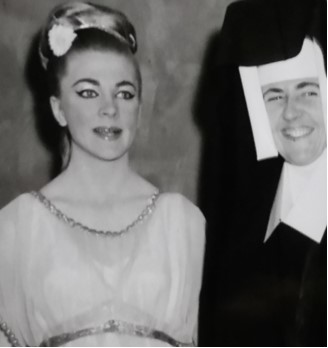
Author costumed as Shakespeare’s Helena with Sr. Mary Joseph, Louisville High School
Paraphrasing Marx, from each according to her gifts. Sister Subordinary, mindful of Conrad’s origins, reads to him from the Ramayana, stories of the monkey god, Lord Hanuman, and the story of Guha, her idea of a perfect devotee. Guha’s practice is to faithfully kick the statue of Shiva that the Brahman priests have brought to his forest. She passes to Conrad the spiritual gifts of discernment and doubt.
Merry Berry gives Conrad the childhood that she never had. This is one of the fascinations of motherhood and mentorhood, how the child/student changes the teacher. Motherhood is actually one of the deep themes of the Chronicles, that and redemption. How we transform and are transformed by what we create, what we give birth to in the world.
Mothering a child, a planet, a poem, a prayer, a god.
Mother Mary Extraordinary teaches Conrad astral travel. She is a visionary, come to grief over dead and dying dreams. She is cranky, reluctant to crank up further investments in the material world that betrayed her. Her most potent gift comes late in the novel. She is the difficult parent. The dark side of the moon.
The sisters have a highly original approach to prayer, which lands them in mortal trouble with the Great Church. Tell us a little about the flowering of the heretical practices.
The Great Church cast out its rebel brides for ordaining sister priests. Unbound, all holy mayhem broke loose at the convent. New sacraments were invented, Sisters married each other, created scrumptious communion breads, and each sister wrote a personal mass, worshiping the gods as she imagined them. Then disaster. The prayer eaters came and licked the pages of the prayer books clean. When a Sister’s prayer book went blank, death soon followed. And then there were three. Mary Extraordinary. Mary Subordinary. Merry Berry.
When the sky-blue baby deity is delivered to the convent, the three survivors crack open one of the old prayer books to enter his name in the litany of infants. Theirs is a radical hospitality. All gods are welcome. Well. Almost. This hospitality doesn’t quite extend to those gods who deny that they have mothers, or that claim one-and-only status, or label their progeny the only begotten. In the Sisters’ theology every child is a coming, and a godsend.
We’ll close with an excerpt from one of the sisters’ prayers:
Litany of the Infants
The infants come
on fresh beds of hay
on sterile hospital sheets
down dark Calcutta streets
on the back seats of taxi-cabs
on the beds of Mack trucks
they come
in woodshed and chateau
in barn and bordello
on the snow belt
and bible belt
on the green veldt
and parched plains of Africa
they huddle
in refugee camps
in quarantined villages
they set sail in Moses-baskets
afloat on the Nile
launched
from Bodrum
from the shores of Vietnam
from the banks of the Rio Grande
let them come
with halo hair
and soft eyes shining
Divine Mother, Sweet Protectoress
shelter each foundling
in the house of your infinite kindness
in the womb of your joyous mystery
Holy of Holies, Mary Mother of God
teach us thy trade.
Isabella Ides was born under the Hollywood sign and attended a Catholic School on Sunset Boulevard. Her father ran search lights for movie openings. Thus she was bent towards stage lights and spirit lights from the get go. A poet and playwright, she considers her debut novel, White Monkey Chronicles, the mother lode. Everything leads to it. And away.
Elizabeth Cunningham is best known as the author of The Maeve Chronicles, a series of award winning novels featuring a feisty Celtic Magdalen. Her novels The Wild Mother and The Return of the Goddess have both been released in 25th anniversary editions. She is also the author of Murder at the Rummage Sale. The sequel, All the Perils of this Night, will be published in 2020. Tell Me the Story Again, her fourth collection of poems, is now in print. An interfaith minister, Cunningham is in private practice as a counselor. She is also a fellow emeritus of Black Earth Institute.
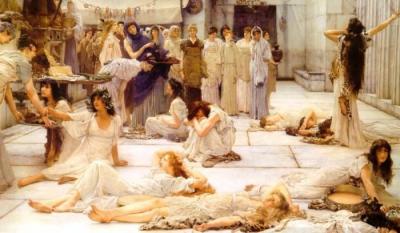
The Women of Amphissa, 1887, by Lawrence Alma-Tadema
Since I began writing for FAR in July 2012, I have written about Mary Magdalen, or excerpted a passage from one of my novels, near or on her July 22 Feast Day. For why I made the controversial choice to depict her as a prostitute, see last year’s post. The below excerpt is from The Passion of Mary Magdalen. I made this selection in remembrance of all the refugees in the world today. In this passage, Judith, a Jewish widow whose family was driven from the land by tax collectors, returns to the place where Maeve (my fictional Celtic Magdalen) and her friends have recently founded a Temple to Isis on the outskirts of Magdala. Maeve has just invited Judith to join them. (Edited for brevity.)
She stared at me, her eyes full of anger and longing.
“I will not be a slave and a whore where I was once a wife, the one who made the challah bread, who said the Sabbath prayers over it. This was our place, my husband’s and mine. We brought the best we had to the temple, the finest oil and wine, the unblemished kid—”
“Goats? You kept goats? You know how to make cheese?”
She sat quietly for a moment before she answered. “How can I live here with you?” she wondered. “I don’t understand.”
As a minister’s daughter, I grew up almost literally in the church, its red door and ivied walls across the driveway from the rectory. On Easter the church was packed; every family received a pink or red geranium. There were Easter egg hunts, baskets stocked with chocolate rabbits and the jelly beans these magical creatures laid. The church rang with triumphant hymns: Jesus Christ is risen today. Although like all children I reveled in holidays involving excessive sweets, it was not the candy or the or the requisite rejoicing that moved me most.
It was the women, or in the Gospel according to John, the woman, bereft and brave, who went to the tomb to tend Jesus’s body. The male disciples had scattered and gone into hiding. In the Protestant Episcopal Church, Christmas Eve and Easter were the only times women played a prominent role in the story. Those were not the loud, triumphant moments. They lived in my child’s imagination as the quiet, mysterious times, Mary giving birth in the night attended by cows, donkeys, and stars. Dawn in a garden, wet with dew, the only sound birds waking and singing, the only people, the women, or the one woman who captured my imagination and, in my story, has her own apotheosis on that morning.
I did not question the miracle of resurrection. Miracles and magic made sense to me as a child. Theology didn’t. My father liked to expound on Jesus’s utterance from the cross “My God, my God why hast though forsaken me.” He insisted that Jesus was not crying out in despair but quoting Psalm 22, which ends in triumph. The Gospel narratives emphasize Jesus’s rising again “in accordance with the scriptures,” implying that he knew he would come back to life on the third day.



 I have a vivid childhood memory of being sick with the stomach flu and standing in the doorway of my parents’ bedroom looking for my mother. Her care for sick children was tender and thorough. She would bring us ginger ale and toast with jelly. When she had time, she read us stories. I can remember her steering me, heavy with fever, back to a bed that she had magically smoothed and cooled. But that day my mother lay in her own bed in an old nightgown, not stirring. She had the flu, too, and could not get up to care for the rest of us. It was a shocking and sobering moment.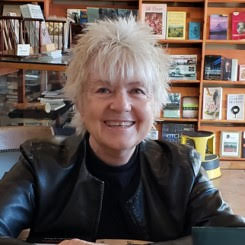

 Feminism and Religion