Hidden Seeds in Laudato Si by Peg Conway

Peg Conway headshot2

The opening two paragraphs of the recent environment encyclical just might be saying even more than the pope intended. Beginning with a quote from the famous Canticle of the Creatures by St. Francis of Assisi, Laudato Si refers to “our sister, Mother Earth,” and compares the earth to “a sister with whom we share our life and a beautiful mother who opens her arms to embrace us”. Sister and mother are seen here as two separate images. But some translations of the Canticle read “Sister Mother Earth” without commas, consistent with the style of the rest of that text, which names Brother Sun and Sister Moon, etc.

Does a little punctuation difference matter? I think it does.

The single term Sister Mother Earth suggests a seamless linkage between all female bodies, whether our sisters, our mothers, our planet. We are brothers and sisters to one another as Christians (and members of the human family), every person has a biological mother, and the earth sustains us all. “Sister Mother Earth” means there are no distinctions among the three; they are one body. This interpretation lends even greater impact to the second paragraph, where the pope speaks of “this sister who now cries out to us” because of abusive treatment:

Continue reading “Hidden Seeds in Laudato Si by Peg Conway”

Black and White Ball: A Poem to Honor Poodle Friends by Alla Bozarth

After Eucharist, the Sea of Galilee - alla
At the sea of Galilee


The following poem is in honor of Hank, the Rev. LouAnn and her wonderful husband Jim Pickering’s new puppy, a gorgeous black standard poodle, and his older brothers who are or were gorgeous and white.

All of them are or have been LouAnn’s pastoral assistants. I like to say they are the curates of her church of St. Gabriel the Archangel, because as therapy dogs whatever might be painful or lonesome in a person’s soul, the pups, at least for their visits, can cure it.


~~~~~~~~~~~~~~~~~~~~~~~~~~~~~~~~~~~~~~~~~~~~~

Black and White Ball

Give your dogs a black and white ball and tell them,
just to say it out loud, what it means.

Black is the color of mysterious things,
of the powerful regeneration and renewal
of Night in which Stars are born,
the universe delivering Beauty.

On Earth’s palette of color, black is all
the colors there are, blended variously
to the depth of Absolute Beauty. Continue reading “Black and White Ball: A Poem to Honor Poodle Friends by Alla Bozarth”

MASKS OF THE GODDESS: Bringing the Divine Feminine to Life by Lauren Raine

lauren_RaineL05_web

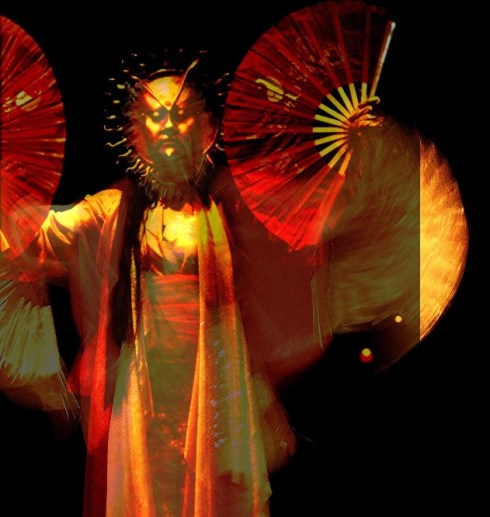
“What the audience saw when a dancer looked through the eyes of the mask was the Goddess Herself, an ancient and yet utterly contemporary presence, looking across time, across the miles.”

Diane Darling,  Playwright

In Salt Lake City in  October  at the Parliament of World Religions a group of women and men will be  will be literally  “bringing the Goddess to life”.  Goddess Alive!” is produced and written by M. Macha NightMare (Aline O’Brien), with Mary Kay Landon.  Participants will use my “Masks of the Goddess” Collection to create a ritual theatre event honoring the many faces of the Divine Feminine throughout the world.

The Masks of the Goddess Project began in 1998, and since then the ever-evolving, multi-cultural collection of masks have travelled around the U.S. to different communities for dance, storytelling, exhibit, and personal invocation, always collaborative.

OLYMPUS DIGITAL CAMERA

Continue reading “MASKS OF THE GODDESS: Bringing the Divine Feminine to Life by Lauren Raine”

Feminism and Faith by Judith Plaskow, Rosemary Radford Ruether, and amina wadud

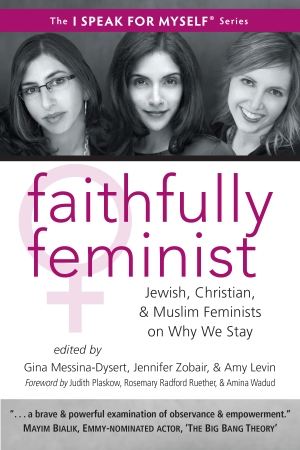
Foreword Image.001 (1)“Feminism saved my faith” is the concluding phrase of one of the writers in Faithfully Feminist, and though not everyone would say it that way, most of these women have found feminism and faith vibrantly interrelated. The contributors to this anthology articulate a range of reasons that feminists might choose to remain within a patriarchal religious tradition. They also remind us that women reconcile their faith and feminist identities in diverse ways. This volume testifies to the dynamism within the religious communities of Judaism, Christianity, and Islam in the United States, and to their internal diversity. This diversity allows for the contributors to engage in a process of their own development as feminists of faith that interacts with similar processes of development going on in their religious communities.

The overriding common bond for these women of faith is the shared conviction that the conflict between religion and feminism is real— even when it is generated by other people’s expectations that those two identities are separate and irreconcilable. Once each woman arrived at a place where she no longer felt an imperative to abide by an either/or dichotomy, she was able to define the terms of her religion and feminism for herself and to own both identities as significant.

Multiply the individual accounts in this volume by tens of thousands, and the effect of these women’s decisions and the concerted actions for change that have flowed from them has been enormous. For example, feminism has profoundly altered American Judaism in the last forty-plus years. Women are ordained in all branches of liberal Judaism and, in all but name, in modern Orthodoxy. New denominational prayer books written in English use inclusive language and incorporate writings by women. Feminists have written Torah commentaries, designed rituals for important turning points in women’s lives, and created new scholarship on women that contributes to a fuller history of the Jewish people.

Likewise, Christianity has been significantly impacted by the work of feminist theology. While some branches continue to refuse leadership roles to women, many others have acknowledged that every person embodies the spirit of Christ and have embraced the ordination of women. In 2006 the Episcopalian Church ordained its first woman bishop, the highest office in the church. Inclusive language has found its way into the prayers and rituals of many churches and feminist commentaries have shifted thinking on scriptural interpretations. Dialogue within and across branches of Christianity are expanding borders, and movements like Woman Church and online feminist spaces have created opportunities for women to claim agency and participate in roles that have been traditionally withheld.

In the long road to Islamic feminism, women have sometimes lacked agency to define either Islam or feminism. Traditional definitions of these words which operate as a constraint on work within Islam towards justice, equality and dignity; feminism was connected to Western imperialism and invasion into Muslim-majority nation states, and centuries of patriarchal control and interpretation stifled women’s efforts to claim Islam for themselves. This is changing, aided by campaigns such as the 2009 launching of the Musawah movement for equality and justice in Muslim family law. A new freedom is emerging that allows Muslim women the dignity and honor of defining Islam and feminism for themselves—no matter how little they might know of global discourses and historical traditions. All that was necessary was to, identify as a believer and expect a life of justice within that belief. Islam has also witnessed women-led prayers and a move toward inclusive prayer spaces.

The profound changes feminists have inspired and worked for do not mean that all problems have been solved and that women’s subordination is a thing of the past; there is plenty of work for a new generation. The difficulties with overcoming the glass ceiling and balancing work and life that women within the larger society face also bedevil women in all three religious communities. Panels, boards, and publications often exclude women’s voices completely or have only token female participation. Ordained women in Judaism are paid less than their male counterparts and rarely become senior rabbis in large or prestigious congregations. If women “choose” to serve smaller synagogues —the explanation often tendered to explain these gaps—that is partly because the expectations surrounding the rabbinate have not kept pace with its changing demographic, and women who want to combine rabbinic work with raising a family face considerable obstacles. Christian ordained women face similar obstacles within the priesthood and continue to be denied leadership roles in some branches, including Catholicism and Mormonism. Similarly, Muslim women are often excluded from panels at religious conferences and are underrepresented on the boards of religious institutions. The idea of women leading Muslim prayers remains controversial. And too often, discussions about women’s role in Islam still revolve around the issue of hijab, or covering.

The challenge for feminists today is passing on feminist insights and gains to the next generation. Is women’s history being incorporated into elementary and high school texts, or are students being taught the same parade of male names and faces? More particularly for Jews, Christians, and Muslims, when a girl or woman wants to mark some nontraditional ritual occasion, is it clear where to turn for resources? Do most Jews, Christians, and Muslims even know that it is possible to create new rituals that feel deeply meaningful and religiously authentic?

Finally, when teachers—and parents—talk about God, how is God imagined? Are children still growing up thinking about God as a distant male figure, or are they offered a range of images, and emboldened to create their own? Are children being encouraged to talk about and challenge passages in and interpretations of the Torah, Bible, and Qur’an that are misogynist or otherwise unethical? Are they developing critical tools that will allow them to engage with and transform difficult parts of tradition?

The next generation of feminists should consider a move beyond rhetoric and terminology towards substance and personal affirmation. Identifying as feminists of faith helps forge global alliances towards meaningful dialogue across difference—even the differences within. It is only when these deeper levels of change are addressed that the question, “Why stay?” will cease to be relevant.

FF_front-cover_FINALThis essay is the Foreword for Faithfully Feminist: Jewish, Christian, and Muslim Feminists on Why We Stay edited by Gina Messina-Dysert, Jennifer Zobair, and Amy Levin.  

For more on Faithfully Feministclick here.

Join the conversation on Twitter using the hashtags #FaithfullyFeminist and #WhyIStay.

Related Articles:

9 Badass Feminists of Faith You Should Know

Mayim Bialik Endorses Faithfully Feminist

Why We Stay

Judith Plaskow is Professor Emerita of Religious Studies at Manhattan College and a Jewish feminist theologian. Co-founder and co-editor of the Journal of Feminist Studies in Religionshe is co-editor of Womanspirit Rising and Weaving the Visions and author of Standing Again at Sinai: Judaism from a Feminist Perspective and The Coming of Lilith: Essays on Feminism, Judaism, and Sexual Ethics 1972-2003.

Rosemary Radford Ruether, Ph.D. is Professor of Feminist Theology at Claremont Graduate University and Claremont School of Theology.  She is also the Carpenter Emerita Professor of Feminist Theology at Pacific School of Religion and the GTU, as well as the Georgia Harkness Emerita Professor of Applied Theology at Garrett Evangelical Theological Seminary. Rosemary has enjoyed a long and distinguished career as a scholar, teacher, and activist in the Roman Catholic Church, and is well known as a groundbreaking figure in Christian feminist theology.  Ruether is the author of multiple articles and books including Sexism and God-TalkGaia and GodWomen Healing Earth and The Wrath of Jonah: The Crisis of Religious Nationalism in the Israeli-Palestinian Conflict. Her most recent books include Catholic Does Not Equal the Vatican: A Vision for Progressive Catholicism(2008), Many Forms of Madness: A Family’s Struggle with Mental Illness(2010), and Women and Redemption: A Theological History, 2nd ed.(2011).

amina wadud is Professor Emerita of Islamic Studies, now traveling the world over seeking answers to the questions that move many of us through our lives.  Author of Qur’an and Woman: Rereading the Sacred Text from a Woman’s Perspective and Inside the Gender Jihad, she will blog on her life journey and anything that moves her about Islam, gender, and justice, especially as these intersect with the rest of the universe.

In Praise of Darkness by Adam F. Braun

Adam Braun Twitter4f6abe6_jpgThis reflection was initially a part of an attempt to create radical liturgies that might connect the frequent theological bias towards ‘light’ and the implicit White Supremacy that such theologies perpetuate.  In addition, this particular reflection was inspired by a friend’s resistance to societal gender norms.


In Praise of Darkness

Bless the Darkness, o my soul,
that part of me that is hidden from the light
The darkness holds me before I am born.
And the moment the light hits, I want to return,
to the darkness.
In the light, I am ever analyzed
every part of me is laid bare
to identify
to categorize
to be understood
Under the light, I am but a mere object to be synthesized
into someone else’s meaning,
into a supporting role in someone else’s story.

There is no light of truth.
The light only manufactures facts and knowledge.
Damn you, light,
I do not want to be understood.

Only in darkness is there truth,
There we are forced to pay attention to that which we cannot see
And there’s nothing like SEEING  to distract from truth.

In the light, I am individual.  Separate and compartmentalized.
But in the darkness, I am and we are more.
In the darkness, we rest.
In the darkness, we transgress the gaze of the Big Other.
In the darkness, we celebrate life.

The darkness is a messianic web,
for in It I do not know where you end and I begin.


Adam F. Braun
is a PhD candidate in New Testament at the Lutheran School of Theology in Chicago.  Previously, he has worked in Emergent communities: a small congregation in NC, a Campus Ministry in Chicago, and most recently as co-facilitator of Boston Pub Church.  His interests are in the Narrativity of Religions, Materialist readings of the Gospels and Paul, and the Deconstruction of Theism within the Christian tradition.  He is completing his dissertation on a deconstruction of “Kingdom” in Luke’s Parable of the Minas.

Katharine Bushnell—The Most Important Christian Feminist You’ve (Probably) Never Heard Of by Kristin Kobes Du Mez

037 DuMez 2015 photo shootKatharine (Kate) Bushnell (1855-1946) was by any measure a remarkable figure in the history of Christian feminism. A global anti-trafficking activist and author of God’s Word to Women, a fascinating feminist theology that recasts the entire biblical narrative as a story of liberation for women, Bushnell was once widely known throughout the late-nineteenth-century Protestant world.
A Midwestern Methodist, Bushnell came of age in Evanston, IL. After a brief stint as a medical missionary to China, she helped launch the American “social purity” movement by leading a dramatic exposé of the trafficking of women in Wisconsin lumber camps. Drawing attention to the injustices women faced under the Victorian sexual double standard, Bushnell helped break the “conspiracy of silence” that inhibited discussion of sexuality among “respectable” women and men. She then took her activism overseas, where she exposed the abusive practices of the British army in colonial India, particularly when it came to the confinement and abuse of local women in military brothels. Continue reading “Katharine Bushnell—The Most Important Christian Feminist You’ve (Probably) Never Heard Of by Kristin Kobes Du Mez”

A Decision To Exist: One Feminist’s Musings on the Transformation of a Catholic Women’s College by Cathleen F.

Last week the oldest Catholic liberal arts college for women in the United States announced it would admit men into its campus-based undergraduate programs for the first time since the institution was founded 175 years ago. As an alumna, I have lived the value and reaped the benefits of all-women’s liberal arts education at a Catholic institution. But throughout the past year, my work of recruiting young women to attend the College revealed in new ways the dissonance between Catholic higher education and women in this time and place. As is the case in most sacred struggles I have more questions than answers, but I will speak to what I have felt and observed.

In the 21st century it has become increasingly difficult for institutions and individuals to identity as both Catholic and pro-woman. As a constituent at a women’s institution, I celebrate the empowerment of women in leadership roles within their careers and families. But as a constituent of a Roman Catholic institution, I am aware of the Church’s patriarchal governance and inconsistent appropriation of power to lay and religious women. As a constituent of a women’s institution, I see women’s diverse expressions of sexuality and gender. But as a constituent of a Catholic institution, I am immersed in binary, sexist language and assumptions at every formal liturgy.  Continue reading “A Decision To Exist: One Feminist’s Musings on the Transformation of a Catholic Women’s College by Cathleen F.”

Does God have Cleavage? The Avengers and Why the Sheroe We Need is Goddess by Trista Hendren

trista_bkgr_greenMost days I am not certain that anyone really cares about what happens to girls. As a mother of a soon-9-year-old daughter, this burns me.
Because I also have a 12-year-old son, I often end up watching movies I wouldn’t chose on my own. Last Friday, we went to see The Avengers sequel, and I left feeling angry. There were two sheroes shadowed by testosterone; both were highly sexualized. After all the hype over Joss Whedon and his “strong female characters” I began to wonder if the Sheroe we really need is Goddess.

Saturday night we had a lively discussion after dinner with my son’s best friend. I shared my observations on the movie and asked for feedback. They told me the only girl heroes they could think of had “huge boobs.” I asked them why they thought there was not equal amounts of sheroes in movies like this and whether they could think of any movies that were comparable in budget to the Superman, Batman, and Spiderman movies that continue to come out year after year. Continue reading “Does God have Cleavage? The Avengers and Why the Sheroe We Need is Goddess by Trista Hendren”

Is it possible that we each have our own personal Divine Twin? by Susan Gifford

Susan by GaryEI recently re-read several books written by Jeffrey Raff, a Jungian analyst with a deep interest in spiritual alchemy.  Raff has a Ph.D. in Psychology from Union Graduate School and a diploma from the C.G. Jung Institute in Zurich.  While studying in Zurich, he was most influenced by Marie-Louise von Franz.  Raff, von Franz and many others feel that Jung was most importantly a spiritual teacher and that Jungian psychology follows in the path of other western esoteric traditions such as Gnosticism, Kabbalah, Sufism and Alchemy.
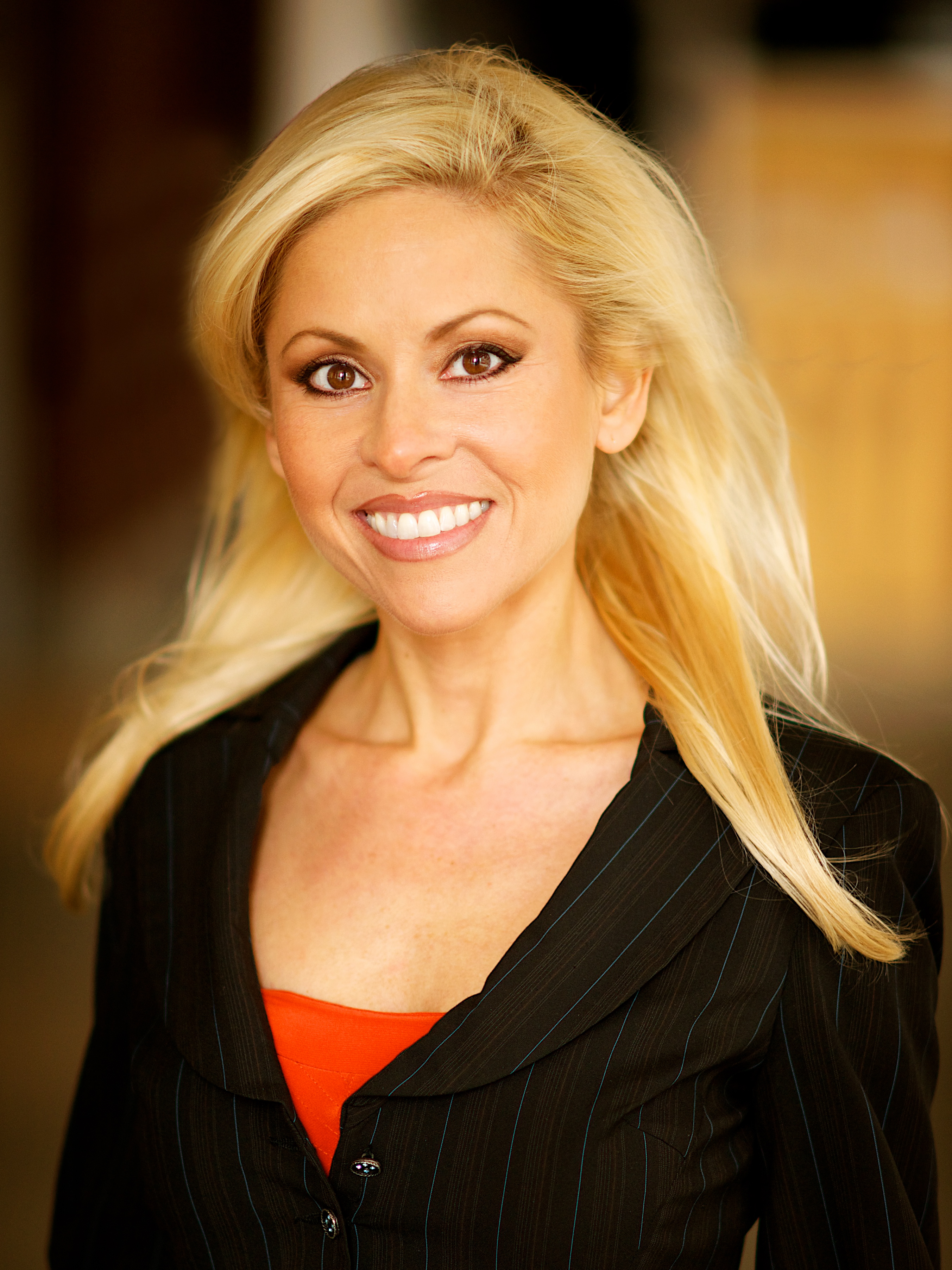
The Divinity in these traditions is very far from the patriarchal god of current organized religions and that is attractive to me.   It is a “God” with both masculine and feminine energy – who relates to all humans – as partners.  Equality and partnership are feminine/feminist qualities.  Surely such a “God” would not be in favor of patriarchal religions that view women as second-class and give men all the religious leadership power.  Continue reading “Is it possible that we each have our own personal Divine Twin? by Susan Gifford”

Femmevangelical: The Modern Girl’s Guide to the Good News by Jennifer Crumpton

Crumpton_2_2I got the idea to write Femmevangelical: The Modern Girl’s Guide to the Good News after a desperate search during a difficult time for a helpful Christian women’s devotional. Yeah, you remember those books that are meant to inspire and comfort, teach and instill spiritual conviction. But I was unable to find a devotional that spoke to me where I was: on a winding, decade-long spiritual journey and finishing my last semester of seminary, clumsily sounding out a feminist theology drastically different from my fundamentalist evangelical upbringing. In a low place, I wondered if my religious tradition even had the ability to raise my hope anymore, much less empower me. Continue reading “Femmevangelical: The Modern Girl’s Guide to the Good News by Jennifer Crumpton”