

 My birthday was last Wednesday. Perhaps more than any other time of the year (yes, even more than Rosh Hashanah and Yom Kippur), the days and weeks leading up to my birthday are filled with personal reflection. Not that religious and secular new years don’t give me pause to reflect, but I think the lack of buzz around this personal event seems to offer me more space and time to think.
This year more than past years, I’ve been thinking about beliefs: what I believe in; how ideas and concepts that were important to me last year are less so this year and vice versa; how beliefs motivate me to act or not; what role belief plays in my life; why some beliefs demand solid resolve and others not so much; and so on. I wanted to share with you some of my personal reflection. Continue reading “On Belief and Action by Ivy Helman”

 In the ancient world, snakes represented fertility, creativity, rebirth, wisdom and, even, death. They were often closely connected to female goddesses, priestesses and powerful human females who were the embodiment of such powers. For example, there is the Minoan goddess/priestess holding the two snakes in her outstretched arms. She is closely linked with fertility and domesticity. Similar figurines, with similar associations and dating to approximately 1200 BCE, have also been founded in the land of what once was Canaan, where Israelites also lived. Medusa, in whose hair lived venomous snakes, turned men who looked at her to stone. Ovid’s account of the creation of Medusa credits the Greek goddess Athena with Medusa’s lively hair. Another Greek legend says Perseus, after killing Medusa, gave her head to Athena who incorporated it into her shield. Athena, the goddess of wisdom, is portrayed often with snakes wrapped around her as a belt and/or on the floor next to her.
  My cat is a hunter. You can see it in her eyes. She plays fetch considerably better than the dog and seems to enjoy playing with her “kill” – throwing it up in the air, batting it around and pouncing on it – long after it is “dead.” If we forget to clean up her toys before bedtime, her prowess invades the night. For such a tiny cat, she can meow at almost deafening volumes.
 Last week Sunday, my partner and I were in Budapest, Hungary. We stopped at the Dohany Street Synagogue, the second largest synagogue in the world and the largest in Europe. After we bought our tickets and proceeded through security, we decided to go into the synagogue first and then the museum.
 Two weeks ago, I spoke at a conference entitled “The Role of Academia and Religious Leaders in Relation to Refugees and the ‘Refugee Crisis,’” in Bratislava, Slovakia. One of the main questions of the conference was: what role do academics play in the refugee crisis? Are academics activists? Many conference presenters and attendees directly linked the two ideas. However, there were some who voiced their concern as to how in-touch academics actually are with reality and surmised that because of this academics probably weren’t activists. Wait! What? How can we not be activists?
 I’m heartbroken by yet another shooting in the United States. I want to believe that all humans are, deep-down, intrinsically good. I want to trust humans to act in the best interests of others. I want peace between and inside human beings. I want animals to be cared for, respected and deemed inherently valuable. I want humanity to live in harmony with nature. And, I want human societies that are just, equal and fair.
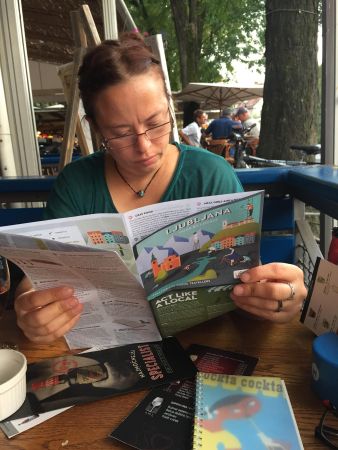 When my dad was in town for the wedding, he asked me a question about Prague. I didn’t know the answer. So, I said, “let me look on my all-knowing phone.” I googled the question, found a reliable website and told him what it said.
 It is quite common, I think, for Jewish feminists to gravitate to the first creation story of Genesis/Bereshit as an example of human equality but struggle to claim this same passage as an example of the goodness of embodiment. Genesis/Bereshit 1:27 reads, “So G-d created humankind in the divine image, in the image of G-d, the Holy One created them; male and female G-d created them.” In this passage, we have not only equality between men and women, in direct contrast to the second creation story, but also a description of human nature.
 Feminism and Religion