

 On Friday, Nov. 6th, the day before the Biden/Harris race was called I spent a day in a deeply meditative state. I live in the NY City metropolitan area and it was a beautiful day. I mostly sat in my backyard in a patch of sunshine musing on the world and seeking a personal sense of balance. I didn’t do anything that day. Well not entirely true, I did a few things, for example I shifted positions a few times to stay in the sun. I grew up in the Puritan based school system which frowned on “doing nothing” as if spending a day not actively achieving anything was somehow wrong, perhaps sinful. For my kids, 30 years after me, it was far worse, codified in hours of homework following a complete school day. And today it’s even harder with afterschool activities (although I must say, to my great pleasure, I have never seen so many children playing on the street in my neighborhood than since this pandemic began.) No wonder Mama Nature is not generally honored. We don’t raise our children to have the time nor space for Her. Continue reading “Election Musings by Janet Maika’i Rudolph”
Author: Janet Rudolph
Janet Maika’i Rudolph. “IT’S ALL ABOUT THE QUEST.” I have walked the spirit path for over 25 years traveling to sacred sites around the world including Israel to do an Ulpan (Hebrew language studies while working on a Kibbutz), Eleusis and Delphi in Greece, Avebury and Glastonbury in England, Brodgar in Scotland, Machu Picchu in Peru, Teotihuacan in Mexico, and Giza in Egypt. Within these travels, I have participated in numerous shamanic rites and rituals, attended a mystery school based on the ancient Greek model, and studied with shamans around the world. I am twice initiated. The first as a shaman practitioner of a pathway known as Divine Humanity. The second ordination in 2016 was as an Alaka’i (a Hawaiian spiritual guide with Aloha International). I have written four books: When Moses Was a Shaman (now available in Spanish, Cuando Moises era un shaman), When Eve Was a Goddess, (now available in Spanish, Cuando Eva era una Diosa), One Gods. and my recently released autobiography, Desperately Seeking Persephone. Latest book, just released on Feb 17th, 2026, The Music of Creation: Exploring Verse and Vibration in the Bible
Yes, there are Goddesses in the Bible, Part 5 by Janet Maika’i Rudolph

As I wrote my last blog post, the Great Goddess of the Canaanites, Ashera was honored and worshipped (according to the bible) within and through groves of trees. Ashera and El, the “great bull god” were deeply connected. In fact, in Canaanite mythology, El and Ashera were married.
But before delving into their relationship, I would like to start in a different (but connected) direction – the lovely archetype of the morning star and the evening star. The planet Venus, named for her namesake Goddess (or vice versa), is both the planetary vision of the morning star and the evening star. Whether She be Goddess, planet or evening/morning star, when She appears in one form, She embodies them all. Continue reading “Yes, there are Goddesses in the Bible, Part 5 by Janet Maika’i Rudolph”
Yes, there are Goddesses in the Bible, Part 4 by Janet MaiKa’i Rudolph
This is the 4th in a series of blog posts about finding goddesses in the bible who had been hidden away through translation or denigration or other means. In my last blog post I discussed Lilith as a Great Goddess symbolized by both tree and bird. You can see it here.
Today I continue with the topic of trees along with an examination of reversals and how many of beautiful, female pagan symbols were changed or removed from the texts. Perhaps the most obvious and pernicious has been that Eve “caused the fall” of humankind through a sinful act. Thus, the logic goes, it was Her action that has created the “grand curse” that we have labored under ever since. As I wrote in my last blog post, Lilith is another example, being portrayed as a demon in order to denigrate her Great Goddess roots. Lilith originally embodied both bird and tree energies. In my last blog post I showed one image of the Goddess in the tree which was a common theme in ancient Levantine cultures. The image today shows the goddess breast in the tree, which is identified as Isis suckling the future pharaoh Tutmose III. These images show the “Goddess in the Tree” as freely bestowing Her gifts and nurturing (not cursing) humankind. Continue reading “Yes, there are Goddesses in the Bible, Part 4 by Janet MaiKa’i Rudolph”
Yes There are Goddesses in the Bible, Part 3
 This blog post is the 3rd in a series of looking for female deities in the bible who have been translated out of easy reach or otherwise hidden within its words. In my last blog post I discussed bird imagery and the bible. It is available here.
You can’t complete a discussion about birds without also bringing up Lilith. She appears by name only in one place in the bible; Isaiah 34:14. Isaiah uses the word liyliyth as a feature in a hellish landscape. Although it is also a name, liyliyth is treated as a common noun. The most prevalent translation is “screech owl” although others have included such names as night creature, night monster, night hag, and she-vampire. Continue reading “Yes There are Goddesses in the Bible, Part 3”
Yes, There are Goddesses in the Bible – Part 2 by Janet Maika’i Rudolph
As I wrote in my last blog post, there are female deities and goddesses sprinkled all throughout the bible. They just aren’t obviously in plain sight.
One example is the Goddess and Her association with birds. Many ancient creation myths have stories about life emerging from a cosmic egg and the Goddess who carries and/or lays that primordial egg-of-life. Like the bird, women carry the eggs of life’s creation within our bodies. This has given rise to numerous cultural symbolisms that have come down to us associating the Goddess with birds. The dove is Venus’ hallmark. Mother Goose is the keeper of our cultural stories. It is the stork who brings us babies. As I will show below, divinity, or the biblical LORD is sometimes depicted as a bird, making this biblical description of god a female. Continue reading “Yes, There are Goddesses in the Bible – Part 2 by Janet Maika’i Rudolph”
Yes, There are Goddesses in the Bible by Janet Maika’i Rudolph
“Freud once asserted that mortals are not made to keep secrets;
what they would like to conceal oozes from all their pores.”
Psychoanalyst Theodore Reik[1]
It’s remarkable how much female imagery there is in the Bible hidden within its wording. The more I delve into its passages, the more that I have found these hidden/not so hidden sacred feminine images, even deities. I have begun a project of digging in and rooting out these little gems. When people think about the sacred feminine or female deities in the Bible the most well known is the Shekinah. The Shekinah is a lovely presence. The word means “dwelling” and usually represents “god’s divine presence” or a place where the divine resides.
The problem is that the Shekinah as a feminine essence of the divine is never stated explicitly, it is an interpretation of how the word is used. I love the concept of the Shekinah but as an essence that upholds the entire weight of the feminine divine in the bible, I find it unsatisfying by itself. Luckily for me, Goddess Shekinah has lots of company. Sometimes they are indeed hiding in plain sight. Sometimes they hide in the translations. The passage I am presenting today has some of both going on. The following is the King James Version of Genesis 49:25. Jacob has been giving blessings to each of his sons and this is part of the blessing he gives to Joseph: Continue reading “Yes, There are Goddesses in the Bible by Janet Maika’i Rudolph”
An Outrageously Strange, Bizarrely Weird, Completely True Tale by Janet Maika’i Rudolph
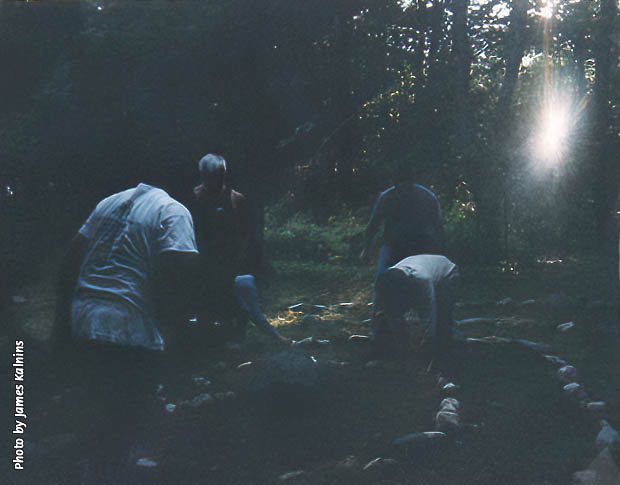
The word apocalypse keeps coming up when I talk to friends about how our present times feel. We’ve all noted how cracks in our society are tearing open and fault-lines are rising to the surface. It is disorienting yet also potentially transforming. I realized I’ve felt this way before:
In January 1997, I became an apprentice to a husband and wife shaman team. They ran an old-style mystery school with regular weekend workshops in Maine and a 4-day in the summer. In August 1997, we met on forested private property that was far from any “civilization.”
Regular weekend meetings began after dinner which gave our small NYC area contingent plenty of time for a leisurely drive up the coast. In August, our teachers wanted us to arrive earlier. We arranged to take the Long Island Sound ferry to Connecticut to avoid the time-consuming drive around the city. About ½ way through our 1 ½ hour ferry ride, a shocking event happened. An elderly woman sitting near us dropped like a rock to the ground. Her daughter began screaming. No one could rouse her. The ferry returned to NY where an emergency crew tried and failed to revive her. She had literally died at our feet. By this time, I was not only thoroughly rattled, I was also deep into contemplating issues of life and death. Because of our delayed arrival in Conn, we began hitting evening rush hour along the major cities of our route. We did not arrive in Maine until well after dark. Continue reading “An Outrageously Strange, Bizarrely Weird, Completely True Tale by Janet Maika’i Rudolph”
The Sacred HU by Janet Maika’i Rudolph
Sing to the LORD, all you godly ones! Praise his holy name.
Psalm 30:4 (New Living Translation)
Therefore I will give thanks unto thee, O LORD, among the heathen, and I will sing praises unto thy name.
2 Sam 22:50
Let them praise the name of the LORD: for this name alone is excellent.
Psalm 148:13
The wording of these passages is very odd. After all, why is God’s name always being praised? It’s like saying to someone, “you must be a wonderful person because you have a lovely name,” or “the LORD must be great because ‘he’ {sigh} has such a great name.” Actually though, as I began to go deeper into my own personal practices of spirit work and chanting, I found that there is a profound truth to this use of praise. Most, if not all, of the ancient names of deities are made up of power syllables. By this I mean certain sounds that have a vibrational essence which not only resonate within our bodies but connect us with all the vibrations that surround us. Sounds made by these syllables are a bridge between worlds created by our breath.
Mystically speaking we could say that the breath of creation and our own breath interfuse. We can experience this through the vibration of power syllables. The most common syllables in the west are familiar ones – AL LA HA AH YA LO WAH and the mighty HU. Think of all the names of divinity that can be created by experimenting with these syllables. Continue reading “The Sacred HU by Janet Maika’i Rudolph”
What the Mystics Say by Janet Maika’i Rudolph
When Rachel Pollack wrote the foreword to my book, When Moses Was a Shaman, she wrote a haunting line. She was discussing the importance of asking questions as a life practice. She wrote, “Perhaps Questions are the ultimate Homeland for all of us.” Respecting the power of the question, this blogpost poses more questions than answers.
I originally started writing about his idea when it was just authoritarian cruelty and creeping fascism that I had to worry about. Now there is a deadly virus afoot.
It seems to me that living among human suffering (war, famine, disease, inhumanity, abuse, prejudice) throughout history and even today is far more common than living in places and times of stability and abundance. And a goodly amount of it is human-caused. Why are we always drawn to suffering? Is there something to be learned from it? Or are we just an impossibly wounded species that insists on inflicting harm? I wanted to see what the mystics say about it. Continue reading “What the Mystics Say by Janet Maika’i Rudolph”
Beauty, Blessings and Bistros: The Hawaiian Huna approach to dealing with the virus as well as everyday stresses by Janet Maika’i Rudolph
One of my favorite trainings I have received on my spiritual pathway is with Aloha International. I was ordained as an alaka’i (Hawaiian spiritual guide) in 2016. I began studying Huna intensely in 1997. In 2015, I personally met and studied with our Kumu Kupua (founder and shamanic guide) Serge Kahili King. I love the Hawaiian way as it is gentle, loving and teaches us to examine our beliefs, life practices and thought-patterns in a way which heals our wounds and nurtures our lives in many beautiful ways. Huna means secret but not as something we can’t share, rather something that is hard to discover or grasp like the mists of the sea. Dr. King, however, makes it easy and I am happy to share some of his teachings here.
I have several medical people in my family. They study science and closely follow journals to find treatments and cures. I bless those efforts because their findings are wonderful tools when we, ourselves, are in need of medical treatment. The shamans, however, have a different approach to disease. Instead of looking to see what medications work, we like to explore why other methods work. Placebos, for example, are so powerful that scientists must go to extreme measures to avoid activating them with practices such as double-blind studies. What if instead of working to eliminate the placebo effect, we work to strengthen it? What if our goal is to harness the power of our minds to explore how our expectations, beliefs and thoughts affect our health and well-being? Continue reading “Beauty, Blessings and Bistros: The Hawaiian Huna approach to dealing with the virus as well as everyday stresses by Janet Maika’i Rudolph”
 Feminism and Religion