

“Free-Speech or Speech-Free?” by Kile Jones

Kile Jones, atheist[This post is written in response to the chilling effect taking place in the U.K. since the Woolwich Attack.  It is also in response to the uses of the Public Order Act of 1986.]

In any “liberal democracy” that has constitutional protections for “free speech,” there will also be laws against “inciting violence,” “hate speech,” “threats,” “slander,” “libel,” “harassment,” and other “speech codes.”  This is because the government, or those who voted on the passing of such laws, worry about the potential threat un-regulated speech will have on the levels of violence and disharmony in society.  They worry about people being able to yell “fire!” in a theatre, which can cause (which is a key word here for legal reasons) physical harm, not being held liable for such speech.  As much as I understand these worries, I am of the opinion that the potential evils brought about by a lassez-faire approach to speech morally outweigh the evils of blasphemy laws and censorship. Continue reading ““Free-Speech or Speech-Free?” by Kile Jones”
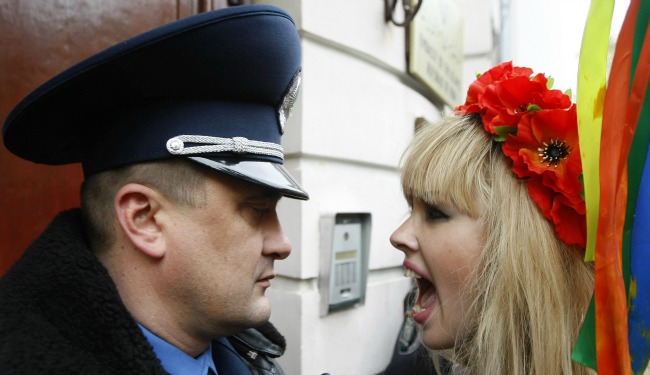
(Femen)ism? by Kile Jones

Kile Jones, atheistAs most of us are aware by now, there is a “feminist-sextremist” group from Ukraine called “Femen.”  This group has been very controversial by their public demonstrations of nudity, the words they paint on their bodies, and their explicit condemnations of political structures and organized religions.  They were started by Anna Hutsol in 2008 and have now spread throughout Europe and the Middle East.  The question I pose for this post is: Does Femen harness or hinder the power of the feminist critique?

Image from Konstantin Chernichkin/Reuters

Femen is precisely the kind of movement that pushes us in our understanding of feminism, the means by which it is best expressed, and the issues surrounding moral condemnation and religious sensitivity. Continue reading “(Femen)ism? by Kile Jones”

Grief Beyond Belief and Rebecca Hensler by Kile Jones

Kile Jones, atheistIn my last post, “A Pro-Science, Skeptical Woman Speaks” I interviewed a woman with whom I share many views in common.  One of my goals here at Feminism and Religion is to introduce different secular, atheistic, liberal feminists who share many of the same ethical views as regular contributors and readers, but not the same “religious” or “spiritual” ideas.  In this post I examine an online support network for unbelievers, Grief Beyond Belief, and ask a few questions to its founder, Rebecca Hensler.

I met Rebecca in February in San Francisco while on a visit I made to meet with the Unitarian Universalist Association in regards to my ordination.  My girlfriend and I met Rebecca in North Beach, San Francisco for dinner and drinks.  I experienced her as a compassionate, friendly, and genuine person.  Her experiences and insights inspired me to think more about the role of grief and pain among unbelievers.  I mean, atheists cry, agnostics experience loss, skeptics lose family members, and we do it all without a “God” or “spirit” to help us.  And if we were to meet C.S. Lewis, we would make

sure to exclaim, “No…pain is not some megaphone for God to rouse a deaf world.”

R Hensler

Why did you start Grief Beyond Belief?

The original idea was born of my own grief.  After my son died, I found a group in which to share comfort and compassion with other grieving parents: The Compassionate Friends, a mainstream parental grief support organization with a strong online presence.  It was so close to exactly what I needed, but I frequently felt alienated by the religious and spiritual content — not just the offers of comfort that depended on beliefs I do not hold, but the assumption that everyone there held some sort of belief in life after death. And the assumption, so common in mainstream grief support, that even if I am not the same religion as you are, I have a religion, and I believe in some sort of afterlife was equally alienating and hurtful. Continue reading “Grief Beyond Belief and Rebecca Hensler by Kile Jones”

A Pro-Science, Skeptical Woman Speaks by Kile Jones

Kile Jones, atheistIn my last post, “Feminism and Religion: Where Do I stand?” I talked about how I support an atheistic, secular, and liberal feminism that criticizes organized religion and certain religious beliefs.  After reading the comments and responding to them, I figured that having a brief interview with a woman who holds these sorts of views would be a good way to introduce them to this blog.  I met Anondah Saide at a course at Claremont Graduate University titled, “Evolution, Economics, and the Brain,” taught by the Executive Director of the Skeptics Society and Founding Publisher of Skeptic Magazine, Dr. Michael Shermer.  Anondah was the TA for the course, and I found her comments in class to promote science, reason, and skepticism towards religious and spiritual claims of all kinds.  So without further ado, here is the interview: Continue reading “A Pro-Science, Skeptical Woman Speaks by Kile Jones”

Feminism and Religion: Where Do I Stand? by Kile Jones

Kile JonesHaving recently become a “regular contributor” to this blog, I feel that my first post should be about how I situate myself and my beliefs in this environment. One of the first things I noticed about this blog, is that is has many Catholic, liberal Protestant, and pagan/nature religion/Goddess-followers who contribute (a journal I edit has an excellent article on Thealogy and worship of the Goddess). There are also a few Buddhist, Mormon, and New-Age contributors. In this eclectic mix, I stick out quite a bit. Not only am I a primarily white (my Abuelita was born in Chihuahua) heterosexual man, but I am also a secular humanist and an atheist. In an earlier post I wrote a piece titled “Reformer, Revolutionary, and Rationalist: Three Types of Feminism,” in which I find myself at home with the cultural critiques of the revolutionary and the logical critiques of the rationalist. As somebody who will be contributing my voice, here is where I am situated. Continue reading “Feminism and Religion: Where Do I Stand? by Kile Jones”

Morals, Malala, and Mapping by Kile B. Jones

Kile Jones

Once again, recent events have me thinking of the ethical paradigms people utilize to comprehend and explain violent acts against women. These violent acts galvanize our moral compasses and beg for answers to our most fundamental moral questions. Do cultural relativism, pragmatism, divine command theory, utilitarianism, quasi-realism, virtue ethics, or moral realism better map on to the sentiments that arise in us when faced with misogynistic violence? Can we honestly say that an act is morally wrong when it is tangled up in the cultural and political characteristics of a certain country or group? Or can we justify, in the manner of moral realism, that certain acts are inherently wrong no matter what the context or culture? As you can tell, my ethical plate is full.

The first event that had me thinking of issues is the shooting of Malala Yousafzai. Malala, who I think should have won “Time Person of the Year” instead of President Obama, was gunned down on her school bus by members of the Taliban for being, amongst other threats, the “symbol of the infidels.” Malala survived a shot to her head and neck, and has since received innumerable awards and honors for her efforts to promote women’s education. Recently, 5 female school teachers were shot and killed by Islamic militants in the same province where Malala was shot. These teachers are thought to have been killed for their work fighting polio, since some Muslim extremists in that area think polio vaccines are a Western way of sterilizing Muslim children. Continue reading “Morals, Malala, and Mapping by Kile B. Jones”

Do We Need More “Ministerial Exceptions”? by Kile B. Jones

In a recent unanimous and precedent-setting Supreme Court ruling, a “ministerial exception” was given to Hosanna-Tabor Evangelical Lutheran Church and School regarding employment discrimination.  Cheryl Perich, a “called teacher” at Hosanna-Tabor, was fired after issues surrounding her narcolepsy developed.  As is well known in the United States, innumerable federal, state, and local laws exist to protect employees from discrimination based on race, sex, age, disability, and so forth.  Title VII of the Civil Rights Act (1964) prohibits employment discrimination based on race, color, sex, religion, or national origin.  In the Americans with Disabilities Act (ADA, signed in 1990), employers are also held liable for discrimination based on an employees’ disability.  The “ministerial exception” excludes religious institutions and ministers from the ADA.  It is important to note that the ADA protects employees hired by private companies as well as public ones.

In the slip opinion, the Supreme Court argues that, “The Establishment and Free Exercise Clauses of the First Amendment bar suits brought on behalf of ministers against their churches, claiming termination in violation of employment discrimination laws.”  The opinion sites other cases where it was ruled that religious institutions are their own arbiters of employment and termination and cannot be compelled by the State to comply with certain national laws (see Watson v. Jones, Kedroff v. Saint Nicholas Cathedral of Russian Orthodox Church in North America, and Serbian Eastern Orthodox Diocese for United States and Canada v. Milivojevich).  Justice Alito concurs by saying, “The “ministerial” exception gives concrete protection to the free “expression and dissemination of any religious doctrine.”  The Constitution leaves it to the collective conscience of each religious group to determine for itself who is qualified to serve as a teacher or messenger of its faith.” Continue reading “Do We Need More “Ministerial Exceptions”? by Kile B. Jones”

Reformer, Revolutionary, or Rationalist? Three Types of Feminism By Kile Jones

What do Martin Luther and Mary Daly have in common? They both realized that they could not reform the Roman Catholic Church from “the inside-out.”  They came to believe that some institutions, even those dear to the heart, are not worth saving.  One of the most significant differences between Luther and Daly—aside from the obvious differences in time, culture, race, class, and sex—is that Luther’s faith in God remained intact whereas Daly’s did not.  Mary Daly, due to her positions on Catholic thought, came to represent what is now referred to as Post-Christian Feminism (or Post-Religious Feminism).  Post-Christian feminism, as seen in the writings of Mary Daly, Daphne Hampson, and Sarah Sentilles (each with differing takes), argues that there are certain incompatible values between Christianity and feminism, and as a result of this, Christian feminists ought to consider how to respond to this incompatibility.  As Rita M. Gross states in Feminism and Religion, “The most difficult question facing a feminist who discovers her traditional religion to be patriarchal and sexist is what to do next” (107).

So the question remains: should feminists reform Christianity from the Inside-out or abandon the Church altogether?  Continue reading “Reformer, Revolutionary, or Rationalist? Three Types of Feminism By Kile Jones”