Exploring the F-word in religion at the intersection of scholarship, activism, and community.
Author: Michele Stopera Freyhauf
Michele Stopera Freyhauf is a Doctoral Student in the Department of Theology and Religious Studies and a Member of the Centre for Catholic Studies at Durham University as well as an Instructor at John Carroll University’s Department of Theology and Religious Studies. Michele has an M. A. in Theology and Religious Studies from John Carroll University, and did post-graduate work at the University of Akron in the area of History of Religion, Women, and Sexuality. She is also a Member-at-Large on the Student Advisory Board for the Society of Biblical Literature and the student representative on the Board for Eastern Great Lakes Biblical Society (EGLBS). Michele is a feminist scholar, activist, and author of several articles including “Hagia Sophia: Political and Religious Symbolism in Stones and Spolia” and lectured during the Commission for the Status of Women at the United Nations (2013). Michele can be followed on Twitter @msfreyhauf and @biblicalfem. Her website can be accessed here and is visible on other social media sites like LinkedIn and Google+.
The story of Thecla is an intriguing one – it is above all a story that demonstrates a woman in active ministry – a story that shows a woman as an Apostle. The story found is found in the apocryphal literature called Acts of Thecla (sometimes found in “The Acts of St. Paul and Thecla) and seemed to attract the ire of Tertullian and the writers of the Pastoral Epistles. In fact, some of the names in this story also appear in the New Testament writings. Thecla used to be a Saint in the Catholic Church, and is still a Saint in the Byzantine Rite. Please note that what I say here is not my original work but a compilation of various interpretations of stories about St. Thecla.
St. Paul was travelling in Iconium with his two companions, Demas and Hermogenes. They were offered hospitality at the house of Onesiphorus. Paul was giving a sermon praising virginity, stating that eternal reward awaits anyone who lives a chaste life. Thecla overheard his sermon from her window and became enamoured by his teaching to the point that she was unable to move from her window for three days and three nights. Continue reading “St. Thecla: Transvestite Saint and Woman Apostle by Michele Stopera Freyhauf”
I came across an abhorrent display of ignorance Saturday when reading an article quoting the Pope’s theologian, Dominican priest Wojciech Giertych, on why women cannot be ordained. This man is in charge of reviewing speeches and texts submitted to the Pope to ensure that they are free of doctrinal error. Once you read this, I am sure that many of you will have the same thoughts that I do ranging from – that explains a lot — to — we are in serious trouble!
Giertych touted the common arguments made against ordaining women – Jesus was a man, Jesus chose only male disciples, etc. However, then he put forth statements about, (1) the theologian’s task, (2) why maleness is essential to the priesthood, and (3) what the vocation of women is and is not.
What is the Theologian’s Task?
According to Giertych, the theologian’s task in determining the definition of priesthood:
“In theology, we base ourselves not on human expectations, but we base ourselves on the revealed word of God” without the freedom “to invent the priesthood according to our own customs, according to our own expectations.”
“Theologians throughout history have promulgated the riches of the Catholic tradition by venturing new ways to imagine and express the mystery of God and the economy of salvation revealed in Scripture and Tradition. This is a Catholic style of theological reflection that very many Catholic theologians continue to practice today. The teaching of the Second Vatican Council in its Pastoral Constitution on the Church in the Modern World (Gaudium et Spes) is especially eloquent on this responsibility” (See Gaudium et Spes #44).
We are familiar with the covenant God made with Abraham and Moses, but are you aware that God also made a covenant with Hagar?
In the wilderness Hagar encounters a deity at the well named Beer-lahai-roi (Genesis 16). Water and wells are important because they symbolize fertility and life. Wells for women are common places where they met their future spouses. Because wanderers in the desert need water to survive, water itself becomes a symbolic of life-giving or life.
In the seemingly barren dessert, the fertile Hagar finds out that she is pregnant and going to be the mother of many children. Hagar is promised progeny in a motherless state. According to Pamela Tamarkin Reis, this is called the “after-me” descendants, which guarantees Hagar that her children will live for “immeasurable generations;” a pattern that fits within the scope of this promise. This same promise of progeny is also given to Eve in Genesis 3:20, providing and interesting parallelism between Eve and Hagar.
It is worth pointing out the irony exists in this promise. Sarai uses Hagar to “build her up.” According to Nahum Sarna, to be built up in terms of the number of children that you have, implies that you are mother to a dynasty. In this pericope, however, it is Hagar, not Sarai that is built up through this divine promise.
This patterns of promise exists within the birth narrative through the annunciation of Ishmael and the promise of progeny. It is through this narrative that Hagar enters into a covenantal relationship with the deity. According to J. H. Jarrell, birth narratives have six common elements that establish this relationship: mother’s status, protest, offer, son’s future forecast, Yahweh naming, and acceptance of the contract. Hagar’s story contain these elements:
Mother’s Status: Hagar is without child because she is a virgin (16:1).
Protest: Hagar flees from her mistress (16:8).
Offer: Return to your mistress and submit to her authority (16:9).
Son’s Future Forecast: He will live at the east of all his brothers (16:12).
Yahweh Naming: You will bear a son Ishmael because the Lord has given heed to your affliction (16:11).
Acceptance of the Contract: She called the name of the Lord (16:13).
“In my teaching I want to get students excited about that notion of, you know, you’re not just here to get a Yale degree and have it on your diploma and be able to hang it on your wall…You should be here thinking about what kind of contributions can I make to society….What are you doing that helps enhance the lives of all of us, as opposed to (our) own little idiosyncratic research interests.” – – Emilie M. Townes
“Emilie Townes is the towering womanist ethicist of our time….In this ice age of indifference and evasion, her powerful voice and viewpoint summon us. And we thank her for her vision and courage.”
At an opening address at the Convocation in 2005, Townes stated that there is a need to live in a “deep walking hope” that shapes lives “in ways that are not always predictable, not always safe, rarely conventional” and protests “with prophetic fury the sins of a world, and sometimes theological world views, that encourage us to separate our bodies from our spirits, our minds from our hearts, our beliefs from our actions.” Continue reading “Monthly Highlight: Emilie M. Townes”
In 2007, I had a conversation with a professor who felt that change was in the air for the Roman Catholic Church. The basis of this opinion was based on language. The words and the context used in writings that emerged from the Vatican were changing and somehow different – a difference that went beyond personal writing styles of Pope John Paul II and Pope Benedict XVI. This professor was hopeful that positive change for women could be coming. He was right about change in the Church, however, the changes surrounding women that emerged have not been positive.
An example of this can be seen clearly in the changes in the liturgy that occurred last year. First, the teaching comes out with the rationale as to why the liturgy needs to change. From there a discussion, especially through the media, addressing the upcoming modifications are followed by subtle changes in the liturgy beginning with the call – response and the language in the creed. Next, the language of the celebrant began to change. Finally, the full implementation of changes is made with the addition of new gestures or movements. When I discussed the mass changes with a family member, there was an admittance that the changes no longer affect them – the changes were no longer noticeable. Their memory was impacted because the routine is now second nature.
In order to come to grips with the issue of language and the observation of my professor, I wanted to do a cursory review of the writings issued by the Vatican during this period. Admittedly, with a blog post, there is a limitation as to the depth and breadth of information that can be disseminated. It is my hope to eventually complete a thorough review of the modification of language used during Pope Benedict XVI’s papacy. For now, I want to address a few observations.
If you are reading this, then we survived another apocalypse. People are fixated on end-times; especially predictions, prophecies, etc. Specials on Nostradamus, the Book of Revelation, TV Evangelists looking for end signs plague television shows, movies, and writings. Countdown clocks and reminders to repent are all around us.
What is unnerving is how we obsess about the end of the world instead of living in the world we have right now.
I would like to share a Mayan poem that I came across. It is called “Imix”- a Mayan Oracle Interpretation translated by Ariel Spilsbury and Michael Bruner and I am drawn to it due to the imagery and symbolism:
I Am Imix, Primal Mother.
Still, dark womb of the patterned potential of becoming, sacred, interstellar genesis, I Am.
“The Lord loves everyone and died for everyone, and He wants all to be saved…the best lesson that can be learned from everything that has happened is that one finds happiness, joy and satisfaction in obedience to the Church.” – Bishop Bruskewitz
One of the most misunderstood concepts in the Catholic Church is excommunication. Many believe that excommunication is a complete termination or separation from the Catholic Church. To say this another way, if excommunicated, you are no longer Catholic or part (a member) of the Catholic Church. None of these statements are true. By baptism, you are a member of the Catholic Church and no one can take that away.
Much of the misunderstanding stems from the way excommunication was used in the Middle Ages; a means of coercion to control kings and other high ranking officials. Obedience to the Church meant that you will spend eternal life in heaven. Disobedience to the Church meant a complete separation from the Church; a ban against receiving Eucharist, a banishment of your soul to the eternal flames of hell. Excommunication was the highest form of punishment and the most meaningful (and effective) tools of control. When a person was excommunicated, there was even a public ceremony – a bell tolled for the excommunicant, as a bell that would chime for the dead, the Gospels were closed, and a (baptismal) candle would be extinguished. This ceremony signified eternal darkness and death. Continue reading “The Impact of Excommunication in the 21st Century (Part I) – Spiritual Redemption or Hegemonic Power by Michele Stopera Freyhauf”
It is very disappointing to share that Fr. Roy Bourgeois was excommunicated, dismissed, and laicized by the Vatican as a result of his support for women’s ordination and the eradication of sexism in the Catholic Church. The following was sent out for immediate release by Maryknoll on November 19, 2012. Additional information will be shared once released.
FOR IMMEDIATE RELEASE
The Congregation For The Doctrine Of The Faith
Canonically Dismisses Roy Bourgeois
Maryknoll, New York – November 19, 2012 – The Vatican’s Congregation for the Doctrine of the Faith, on October 4, 2012, canonically dismissed Roy Bourgeois from the Catholic Foreign Mission Society of America, also known as the Maryknoll Fathers and Brothers. Continue reading “BREAKING NEWS: Fr. Roy Bourgeois Excommunicated”
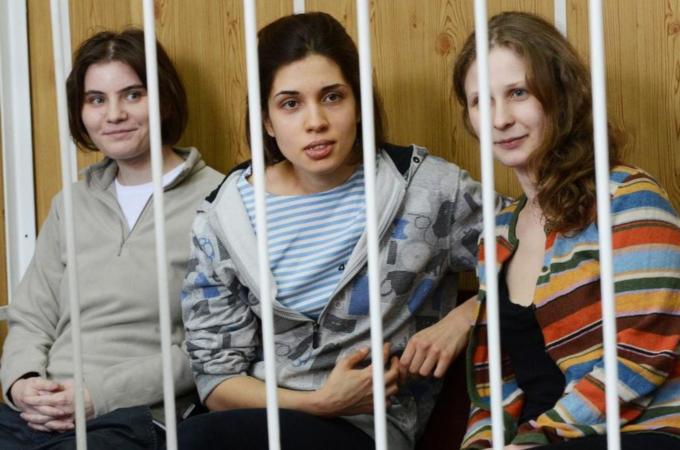
In a country that was willing to [sic] its secular court on a “religious” cause, Pussy Riot are true revolutionaries. Nonetheless, it was not until they delivered these closing statements that their supporters—and opponents—heard what these three brave women stand for. Although they are being crushed in the jaws of the system—and know it!—their courage and steadfast sincerity are sufficient cause for (impossible) hope. If not for the Russian state, then at least for the Russian people. —Bela Shayevich
“When religion puts people in jail it’s unjust” – David Gross
The intermix of religion and politics are familiar, especially after this year’s presidential election. Many supported Mitt Romney out of concern for religious freedom; a stance that had the potential to marry religion and politics in a dysfunctional union. We also witnessed a veiled attempt by the Catholic Church to emphasize and sway the faithful to vote for the one true moral candidate; a stance contradicted by Obama’s ability to carry the Catholic vote. I believe what we see in Russia is a shining example that shows what happens when regulations and laws do not segregate between secular law and church law. Freedoms do not exist, rather, rules and restrictions are imposed creating an institutional prison.
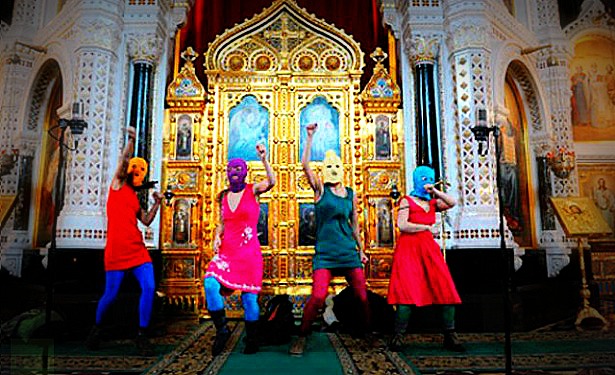
The prosecution of an all girl punk band named Pussy Riot [i] demonstrates a “complete fusion of the institutions of the state and church,” which devalues “women’s rights and freedom of speech.”Members of Pussy Riot are serving a two year sentence of hard labor for “hooliganism motivated by religious hatred.” What was their crime? They went into a Cathedral in Moscow and started singing a punk prayer – “Mother of God, Chase Putin Out!”
They danced, kneeled, and crossed themselves in front of the Church’s high altar. This occurred the day before the re-election of Vladimir Putin. While I do not support going into a sacred space with relics to make a protest, what I find problematic is their harsh sentence. However, it should be noted that with the coverage of the trial and the outpouring of support received from many organizations, and musicians, they did manage to bring to the forefront issues surrounding the government and the Church.
As I enter this world, I know that I am so very blessed. My life will be one of worth. As hard as people fought to see me take my first breath, they will fight for my life to be one of dignity and worth. I am protected in a world that is pro-life – or so I thought.
My mother was raped, but the law did not recognize this violent act as rape because she became pregnant with me. The law only recognizes legitimate rape as one that does not result in pregnancy. I entered the world amidst controversy. I was named Magdalene Rose. Magdalene because of the shroud of controversy that surrounded her – the false accusations of prostitution, the stigma that history assigned to her, and the hope of those who have tried to reclaim her as the first witness to the resurrection, a faithful disciple, and devoted minister. Rose was chosen for the flower that can bloom even in the face of adversity; one that can push through the snow to reach the sun and spread its petals.
My mother is a single mom She does the best she can – trying to keep us clothed and fed. She works so much and I stay many nights with my grandmother or a neighbor. She seems so tired, so worried, but yet always has a smile to share with me. I am her blessing, a miracle born out of darkness.
We go to church every Sunday, but strangely, no one will sit by us. We have to sit in the back. I wonder why. Certainly our clothes are a little worn – we rely on hand-me-downs and the thrift shop. My mother dresses me in the finest dresses she can find, I feel so special. In God’s house, we are shunned. People refuse to shake our hand even during the sign of peace. This is the place where we should be welcomed. This is where they proclaim the Gospel and teachings of Jesus. Yet, the only sign of Jesus that seems to exist in this community is symbolized on the cross.


 The story of Thecla is an intriguing one – it is above all a story that demonstrates a woman in active ministry – a story that shows a woman as an Apostle. The story found is found in the apocryphal literature called Acts of Thecla (sometimes found in “The Acts of St. Paul and Thecla) and seemed to attract the ire of Tertullian and the writers of the Pastoral Epistles. In fact, some of the names in this story also appear in the New Testament writings. Thecla used to be a Saint in the Catholic Church, and is still a Saint in the Byzantine Rite. Please note that what I say here is not my original work but a compilation of various interpretations of stories about St. Thecla.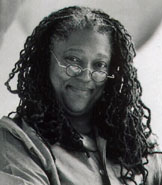
 In 2007, I had a conversation with a professor who felt that change was in the air for the Roman Catholic Church. The basis of this opinion was based on language. The words and the context used in writings that emerged from the Vatican were changing and somehow different – a difference that went beyond personal writing styles of Pope John Paul II and Pope Benedict XVI. This professor was hopeful that positive change for women could be coming. He was right about change in the Church, however, the changes surrounding women that emerged have not been positive.


 Feminism and Religion