From the Archives: Careful Criticism: Resisting Hetero-Patriarchy while Resisting Trump by Sara Frykenberg

This was originally posted on May 2, 2017

My students are taking their final exams this week, which means I will be spending the week frantically, but attentively grading in order to make our grade submission deadline next week. End of semester grading is a mountain of careful criticism we educators scale one step at a time, with deliberateness, towards an ultimate goal of student success (if not in our classes, then in the next, or in life, relationships, etc.). Thus, I often find myself returning to the question: what am I hoping to create in what I say and write, and in how I critique?

One of the goals of feminist pedagogies is to help us prevent recreating the domination of kyrio-patriarchy in classroom spaces. While activism is not the same thing as education, and strategies of resistance are different than pedagogy in important ways, the concern for careful critique is warranted in both praxes. What do we create in how we critique, resist, and protest? What do we recreate, wittingly or no? I have found myself concerned with this since the election of Trump, DT (cause I can only write that name so many times), to the presidency. Continue reading “From the Archives: Careful Criticism: Resisting Hetero-Patriarchy while Resisting Trump by Sara Frykenberg”

Mothers and Dragon-ing by Sara Frykenberg

But what if there was a space for the danger of dragon-ing? What if society expected it, welcomed it, and made room for our, women’s, subsequent growth? It might still be hard and risky, as is all growth and change. But as I believe Barnhill is trying to suggest, it might also be less traumatic, less splitting, and give us so much more space to be.

Knowing that I like dragons and feminism, a friend of mine recently recommended the book, When Women Were Dragons (2022) by Kelly Barnhill. I have been reading it (okay listening to it on audiobook, but that counts right?) all week. The premise of the book is that women dragon, as an act, and can do so by choice or spontaneously; and in the “Mass Dragon-ing of 1955” over 600,000 women flew away from American homes, “wives and mothers all” (Barnhill, 2022). But despite the destruction, eaten husbands and bosses, and destroyed homes that dragons leave in their wake, society, the government, and individual families do everything they can to forget it happened. The history is repressed. Individual memory is policed and repressed. The dragon-ing goes on.

 Beginning this book the week before Mother’s Day, I found the recommendation timely, or even fateful, because with every chapter and hour that I listen, I find myself thinking of my mother. And I wonder if or when she would have dragon-ed if given the chance.

Continue reading “Mothers and Dragon-ing by Sara Frykenberg”

Is “Barbie” Feminist Media?

Is Barbie a kind of counter-apocalyptic feminism? I am quick to embrace liminal violence in my own theories. Why not liminal joy or fun? Or, is Barbie just product placement?

Lately I’ve been thinking a lot about the idea of feminist media in light of all the hype around the Barbie movie and the backlash over the fact that neither director Greta Gerwig nor Margot Robbie (Barbie) received Oscar nominations. And while America Ferrera did receive a nomination for best supporting actress, a lot of critical attention has gone to the fact that Ryan Gosling (Ken) received a nomination for best supporting actor. I see the point. I understand the feminist critique here: female power is given an “atta girl,” but her creative contribution and leadership is overlooked. All that said: I didn’t really love the movie and the performance of the “I’m Just Ken,” song was my favorite part. Ferrera’s “iconic” monologue fell flat for me. Haven’t I read those words before, all over social media? The Barbie movie leaves me wondering, not for the first time, just what is feminist media?

When Game of Thrones was at its height of popularity, I saw so many online posts about the amazing female power (read feminism) of the show. But, having read the books, I took great issue with this characterization of the HBO blockbuster. Book five of The Song of Ice and Fire features, from what I recall, a double-digit number of sexual assaults against women. Every strong female in the story uses power as violence and dominance, and then of course, they are punished for it (as I wrote about in another blog). HBO’s Girls received similar feminist (and/or “post-feminist”) cred, featuring women who were supposedly friends but clearly seemed to disdain or ignore one another. Carter Hayward’s concept of “alienated power,” runs rampant in these two shows, and we enjoy it, because, as she explains, we have a hard time seeing power as anything else in a patriarchal system.

Continue reading “Is “Barbie” Feminist Media?”

The Pleasure of Education and New Beginnings

BUT GOD/DESS—it is also enjoyable, passionate, and fun. Learning and teaching is fun; and I love having fun with my students. Even when the topics are hard and when the lessons hurt, it is the pleasure of relatedness to them, to text, to new understanding that facilitates the process. And without that pleasure, the work is unsustainable.

In graduate school, I fell in love with the book Teaching to Transgress by bell hooks. My memory of what I specifically loved about that book has blurred over time, particularly as I read more and more of her work. But what remains is a sense of how challenging and how real the writing was—how inclusive of whole experiences and truths, comfortable and uncomfortable.

hooks doesn’t shy away from the pain or pleasure of education, indicating how learning and those we learn from can induce passion: Audre Lorde’s erotic, which is so hard to distinguish from the sexual because, as Lorde explains, we are taught to limit our sense of the erotic to the sexual or pornographic.

Continue reading “The Pleasure of Education and New Beginnings”

Gratitude

This is a privilege of being a teacher: to walk along the side, to journey with another while he (she/they) navigates his (her/their) own road, to see how far he (she/they) has come.
And I am so grateful for it.

I hooded my first graduate advisee this week; and I am so happy for him. My student worked hard for over a year; and as the date for his final draft submission approached, I was privileged to witness his growing excitement and pride. I felt my own growing pride. Over that year, I had talked about my advisee many times with my family, “going to a meeting with so and so again,” “so and so sent me an updated draft that I need to get to” etc., so much so that on the day of his defense my older sister said she was crossing her fingers for him and my brother asked me if I’d told him that they were rooting for him. I hadn’t; though clearly working with this man had touched me in a way that also touched them.

This is a privilege of being a teacher: to walk along the side, to journey with another while he (she/they) navigates his (her/their) own road, to see how far he (she/they) has come.
And I am so grateful for it.

Continue reading “Gratitude”

Love and The Last of Us

I was excited and thought I knew what to expect. I know what happens in the game after all. But after watching episode three, Long, Long Time (aired Jan. 29, 2023), I found myself considering what seems like something new in a zombie story as well.

Warning: Contains spoilers for The Last of Us video game and HBO series! (Oh, and for The Walking Dead… And maybe a few other zombie films too.)

I remember when Naughty Dog released the first iteration of its popular game, The Last of Us (2013) because a friend of mine worked with the sound design team for the game. This friend started out as a game tester and through years of effort, was eventually creating game sound and dialogue. The release was a BDF for his personal success and at the time, felt like something new in gaming: it was realistic, cinematic, and emotional. (And incidentally, it was reviewed very, very well.) This past month HBO released The Last of Us as a TV series. I was excited and thought I knew what to expect. I know what happens in the game after all. But after watching episode three, Long, Long Time (aired Jan. 29, 2023), I found myself considering what seems like something new in a zombie story as well.

Continue reading “Love and The Last of Us”

From the Archives: New Year and Sustainable Resolution by Sara Frykenberg

This was originally posted on January 3, 2017

I am writing this blog on New Year’s Day, so Happy New Year! Today I say these words as both a statement of hope and as invocation. Happy New Year: may it be! My twin told me that our horoscope said that 2017 would be a party: we should throw our energies into anything and everything we want to see happen in our worlds because it can and will happen this year—may it be! Because it certainly doesn’t feel like a time for flourishing. I echo the introductory sentiments of Kate’s blog last Friday:

I am fried. These last two years proved personally & professionally exhausting. And yet, another year looms ahead unavoidably — another incredibly demanding year which will require more than I can fathom I actually have to give at this moment.”

Yes Kate. Oh my god/dess yes. This is exactly how I feel… and sitting down to write this blog this morning, I felt overcome with a wave of anxiety and stress, focused on all the things I have to do, the lack of time I have to do them, and the lack of energy I feel. Lurking beneath this stress is real pain and fear. What should we expect this year, in light of what’s already happening, in light of the hate already ignited? I think I have been locked in this pain and this fear.

Continue reading “From the Archives: New Year and Sustainable Resolution by Sara Frykenberg”

From the Archives: Thanksgiving and Service by Sara Frykenberg

This was originally posted on December 3, 2103

Growing up in an evangelical Christian church, I was taught that human beings should serve one another and put others before themselves.  These two different teachings, paired with patriarchal misogyny, have sometimes been very problematic for me.  I tend(ed) to give too much.  Too many demands with which I complied were self-negating (which after all, helped me to make other people more important than myself).  It took me a long time to learn how to appropriately prioritize my own needs, to stop mistaking self-esteem for the”‘sin of pride,” and how to say no when I needed to… Actually, I am still learning some of these lessons.

Conversely, my ritualized service to the church was sometimes confusing, awkward or embarrassing.  I clearly remember having the opportunity to serve as something like an usher during Thanksgiving at our family’s church as a child.  This involved wearing a pilgrim costume, which for me meant finding a Puritan style costume in the church’s closet that fit my overweight childhood frame.  This was not an easy task and left me feeling ashamed.  Later as an adolescent, my youth group asked us to wash one another’s feet as Jesus did for his disciples.  Now, don’t misunderstand me here— I do believe that this ritual has the potential to be very powerful and meaningful for those involved.  However, my teenage self could not identify with the symbolic gesture beyond realizing that:

1)    I thought touching other people’s feet was gross, as was having my dirty feet touched and,
2)    I knew I ‘should’ get something out of the ritual but did not, so I felt spiritually guilty or inadequate.

Overall, I often associated Christian service with guilt, inadequacy, my role as a daughter or woman or my sacrificial duty.

Despite these issues, I usually genuinely enjoy serving others and giving to other people.  I love to host people and care for them.  I like to help.  I even prefer to help.  Serving one another we can express and allow others to express love.  But this past week, one day before Thanksgiving, a dear friend of mine gently challenged me to allow myself to be served or, as she put it, “to give someone else the gift of giving to me.”  Specifically, she was referring to a pending holiday meal for which I expressed my anxiety and frustration with not being allowed to help—which somehow makes me feel like a child.  Even writing this phrase, “makes me feel like a child,” I know that I have touched deeper feelings of helplessness or vulnerability that at some point, I learned to battle with competence and over-achievement.  I do often feel like a child or guilty when other people do for me what I think I could or should do for myself; and my friend’s brief words encouraged me to explore this relationship to being served.

“Service” can sometimes feel uncomfortable for the reasons I mention above, but more so, for its connection to the coercive “servitude” required by existent hierarchies within andro-kyriarchal oppressive systems.  I have been subject to this coercive servitude, and also, its beneficiary.  As a white, middle class, Western woman I have far too much privilege that is contingent upon the forced labor and oppression of other people.  This kind of forced servitude is very wrong; and I am still learning how and where to choose other than to be complicit in this abuse.  But, there have also been many distinctive instances in my life where I have felt reciprocally and undeniably “served” by people around me, without abuse and without manipulation.

Driving to Colorado one summer to see the friend I mentioned above, my two companions and I served one another.  The individual in the back seat was responsible for cutting bagels and spreading cream cheese on them for the driver and navigator, while the navigator held the drink, food or whatever other item that the driver could not.  This may sound like a small thing, but it wasn’t.  I felt taken care of and loved in this small and traveling community.  We also had a safe word that meant, “leave me alone, I’m grumpy” on our long trip.  We made agreements to account for one another’s  discomfort and effort.  We respected one another and cared for each other.

Beginning my work as an adjunct professor, I encountered a great deal of stress and often long and awkward work hours.  Many times I felt like I needed help, but there was nothing I could ask for help with when it came to my job: I needed to grade my own papers, plan my own lectures, and yes, write my own blogs.  My husband has responded by taking care of me in other ways.  He makes me dinner, goes to the store and makes sure I take breaks.  We take turns taking care of one another, and I am grateful for him.

This past week after talking to my friend, I noticed how willing people were to touch me to soothe aching muscles.  I’m not sure how to describe what I felt, but it was like something invisible in certain spaces was suddenly visible.  I also realized that it had been a very long time since I had freely and openly received this touch.  Later during the weekend, a friend came to my house  and she made me dinner!  My husband rubbed my chest after a long night of coughing yesterday because I still haven’t completely rid myself of the smoldering in my lungs.  I was defensive for so long.  Shedding my defender allows me to rediscover all those things for which I am thankful.

Gratefulness is an action.  It can be found in those expressions that return, receive and allow for mutual loving.  I am learning new rituals that help me to remember that this kind of mutual serving and being served is sacred.  In a summer ritual, my friend and I washed one another’s hair instead of our feet.  I am still learning to ask for assistance from the goddess after freeing myself from an abusive omnipotent god, but I am starting to ask.

I am starting to pray again.

BIO: Sara Frykenberg, Ph.D.: Graduate of the women studies in religion program at Claremont Graduate University, Sara’s research considers the way in which process feminist theo/alogies reveal a kind transitory violence present in the liminal space between abusive paradigms and new non-abusive creations: a counter-necessary violence.  In addition to her feminist, theo/alogical and pedagogical pursuits, Sara is also an avid fan of science fiction and fantasy literature, and a level one Kundalini yoga teacher.

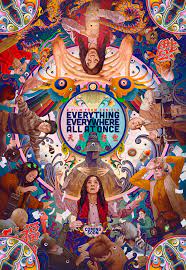
Considering “Everything Everywhere All at Once”

The multiverse as a metaphor for trauma is rather compelling to me. It speaks to the way in which different realities and experiences impose themselves on others as a matter of fact rather than malintent. These realities necessarily co-exist in interrelationship but may compound the weight and confusion of present experience.

Warning: Spoilers Ahead!

Everything.

Everywhere.

All at Once.

I remember thinking, this is kind of a weird name for a movie, even if it is about the multiverse and shifting realities. But I’m a big sci fi fan, so of course, I jumped at the chance to see it when my friend said she wanted to see the movie, again, with me specifically. Mom’s day out for both of us. Check. A… m.o.v.i.e. I remember movies from a time pre-pandemic: there’s a big screen, right? And food? I like food. Sign me up. (j/k). I seem to remember movie theaters being more crowded though—my friend and I had almost a private viewing. And sitting practically on top of my friend by the end of the film, after laughing so hard I cried, crying because I was so sad, gaping in shock, horror, and even disgust, and wondering what I just saw, I reflected: this movie was perfectly named.

Continue reading “Considering “Everything Everywhere All at Once””

My Daughter’s Religions by Sara Frykenberg

I find it interesting how certain or settled we often expect our little ones to be instead of getting curious about them or acknowledging that they are curious.

My daughter, Hazel, is six years old and will be starting first grade next week. She loves cats, swimming, her cousin, and food. Purportedly, Chinese style barbecue pork buns come first in her heart, even before mommy and daddy (though we are a close second). She also prefers to run instead of walk; and has recently declared that she is Taoist and Shinto. This determination came after some discussion which went something like this:

Sitting at the kitchen table one morning, Hazel declares “My best friend asked me if I was a Christian and I told her I was. I am a Christian.”

Mommy the agnostic is a little surprised. Daddy, the atheist, is biting back a retort—he is somewhat hostile towards Christianity. I am only hostile to abusive, hetero-Patriarchal Christianity. I say to Hazel, “Oh. That’s interesting. Do you know what that means?”

“No. What do Christians believe,” she asks.

Continue reading “My Daughter’s Religions by Sara Frykenberg”