Teaching and talking with my daughter, I find myself revisiting the subtle and not so subtle kyriarchial language in my own upbringing in ways that I do not when speaking to other adults with my very intentional and well-trained adult language. Parenting sometimes feels like a trip back in time where I remember and more readily feel my joy of singing particular songs or reading particular stories, simultaneously feeling my inner feminist and adult self cringe at the messages in too many of these stories.
 Last month I shared a lesson a student of mine taught me about subjugated knowledge and the colonized mind. This month, I would like to continue in a similar grain and consider how we share the practice of oppression through language, and particularly, as we teach language to our children. Working to counter kyriarchy in my parenting, I often find myself asking, what I am really saying, reading, or singing to my daughter?
I walk with my daughter almost every morning, and as new parents are often encouraged to do, I try to talk to her continuously about a variety of topics. While I do talk to Hazel about meaningful things, like my hopes for her, stories about her family, the joys of reading, etc.; most days my monologues are inspired by whatever we happen to walk by at the moment.
One morning we talked about the differences between fences, gates and walls, their purposes, and the different materials from which they are constructed—I was really reaching on this day. We repeatedly talk about the flora and fauna. I have discovered that there is what feels like an inordinate number of avocado trees in the say, six square blocks surrounding our apartment. How do the people who live here eat all of these avocados? Do they eat them? Do they let them rot on the tree? This seems like a terrible waste of avocados, though there is one home with a bin in the front yard with a sign that says “free avocados,” in which the homeowners leave the fruit for neighbors and passers by like Hazel and myself.
This may seem silly and often, the discussions are silly, but taking to heart what I have learned from liberative feminists, post colonial scholars, and semiotics, I also critically observe how and what I say. One day, trying to make it fun to point out different plants and bushes, I pretended to be an announcer for kind of a nature show. Somewhere in-between introducing the “the deadly oleander,” and “a lovely variety of cacti,” it occurred to me that I was actually engaging in a kind of trope for a travel narrative. It wasn’t that I was saying anything particularly oppressive or colonial; rather, I realized my tone, my ‘how,’ came from the stories of my own youth—it was a kind of cross between stories related to “Dr. Livingston, I presume,” and Crocodile Dundee. Continue reading “Parenting with the ‘Same Words’ by Sara Frykenberg”


 Participating in the Women’s March on Jan. 21st in Los Angeles fed my soul deeply. I didn’t realize how much I needed to protest in this way, how stuck I had been in grief and despair after the election, and the way that coming together as a community would help me to mourn. There’s nothing quite like standing together with hundreds of thousands of people who also care deeply with hope, humor, and real power. Marching helped me to find the energy to fight back. It refilled a reservoir, so depleted in 2016, much as the badly needed winter rain in my home state of California has helped to abate the severe drought. Continue reading “You Can’t Debate Mutuality by Sara Frykenberg”
 I am writing this blog on New Year’s Day, so Happy New Year! Today I say these words as both a statement of hope and as invocation. Happy New Year: may it be! My twin sister told me that our horoscope said that 2017 would be a party: we should throw our energies into anything and everything we want to see happen in our worlds because it can and will happen this year—may it be! Because it certainly doesn’t feel like a time for flourishing. I echo the introductory sentiments of
 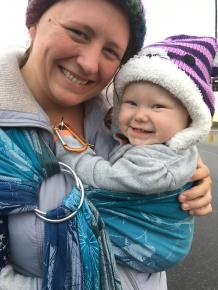 This month I turn one as a mother. My daughter, consequently, is also turning one—a first birthday I am excitedly planning. Specifically, I want to make Hazel a rainbow cake with lots of colored layers and white frosting. I’m not even sure she’ll be able to eat the cake (avoiding lots of sugar for a one-year-old and all), but among those family pictures I treasure, my mother held a cake for her little ones. I want to be like my mother. I am going to make a cake.
 I wasn’t sure I wanted to watch the debate between presidential candidates last Tuesday. As
  This semester I am teaching Myth, Religion and Culture, which is by far one of my favorite courses to teach. On the first day of class, I usually ask my students what they think is the purpose and importance of myth. I receive a wide variety of answers ranging from myth being rather unimportant or only important historically, to myth being necessary for teaching lessons (particularly to children) or even critical as a foundation for society and communication. I then, over the next several weeks, introduce students to many theories of mythology and its significance:
  I love reading fiction, particularly science fiction and fantasy literature. However, since the birth of my daughter
  In
In  Recently, a friend of mine sent me a journal article entitled,
 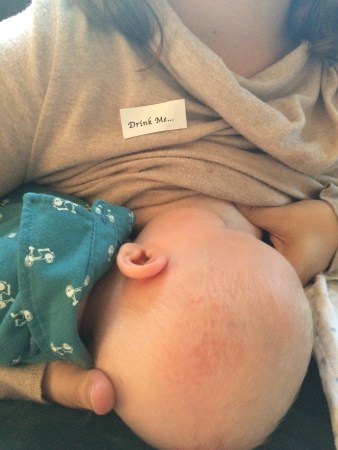 Once upon time formula companies and complicit medical experts launched a serious campaign to sell more formula, telling a generation of mothers that this product was both superior to breast milk and far better for baby and mother. Some were convinced, others found formula a good alternative to breast milk given their employment status, hormonal changes, their particular baby’s needs,personal choice, difficulty producing their own milk, or the like; and still others chose to breastfeed despite criticism, like my mother-in-law, who received scorn and derision from medical personnel as the only breastfeeding mother in the hospital in which she gave birth in 1970.
 Feminism and Religion