


When I see them
I enter the Dreaming.
In the background
a jagged coat of barren
reptilian mountains
frames bountiful bodies
standing on stilts as
undulating necks,
crimson crowns
beaded eyes
dive below the surface
in search of last year’s grain.
Each deliberate step is taken
in syncopated rhythm
with those of nearby neighbors
Each three toed talon
pierces still waters. Continue reading “Daughter of the Cranes by Sara Wright”
Author: Sara Wright
I am a writer and naturalist who lives in a little log cabin by a brook with my two dogs and a ring necked dove named Lily B. I write a naturalist column for a local paper and also publish essays, poems and prose in a number of other publications.
Tree Talk: Dr. Susan Simard by Sara Wright
 Scientist Susan Simard is a professor of forest ecology at the University in Vancouver, British Columbia, who has been studying the below-ground fungal networks that connect trees and facilitate underground inter-tree communication and interaction. Over a period of more than thirty years this field scientist and her students have learned how fungi networks move water, carbon and nutrients such as nitrogen between and among trees as well as across species. Her research has demonstrated that these complex, symbiotic networks in our forests — at the hub of which stand what she calls the “mother trees” — mimic our own neural and social networks. This groundbreaking work on symbiotic plant communication has far-reaching implications that include developing sustainable ways to ‘manage’ forests, and to improve tree and plant resistance to pathogens. Although much of Simard’s research occurs in forests, she has also studied the underground systems of grasslands, wetlands, tundra and alpine ecosystems.
Under our feet there is a whole world of biological pathways that connect trees and allow them to communicate and share resources and information. Other scientists who study these networks (like Dr. Merlin Sheldrake) agree with Susan who suggests that the forest behaves as though it’s a single cohesive organism. Continue reading “Tree Talk: Dr. Susan Simard by Sara Wright”
Born Again by Sara Wright
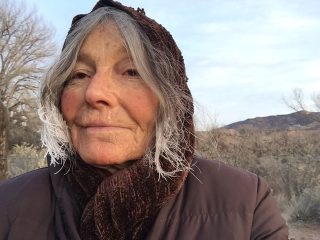 “Let me sing to you about how people turn into other things.” (Ovid)
Years ago I placed my brother’s ashes in a shallow depression that I had dug near a granite fern and moss covered boulder. The brook flowed just a few feet away and at the last minute I scattered a few filaments over the shallow waters, returning them to the sea. A week later I planted a hazel nut tree nearby. A fossilized spiral ammonite marks my brother’s grave.
Thanks to the underground highway created out of millions of tree/plant roots, the extensive net of fungal hyphae and this communal system’s miraculous ability to exchange nutrients/minerals/sugar, my brother lives on as part of this forest…The gracefully spreading hazel and all the other trees (spruce, maple, balsam, hemlock, ash) that are scattered around this hallowed woodland grove have been nourished by the bones of one I loved.
Yet only recently have I been possessed by revelation. Continue reading “Born Again by Sara Wright”
The Storyteller by Sara Wright
 When I walked into the space a bolt of light shot across the room and struck me so forcibly that it felt like it shattered the cells beneath my skin. Did this occur before I glimpsed her bronzed moon shaped face? I will never know. I sat down almost in front of her, sizzling with the uncomfortable buzz that seizes my nervous system when what I call, the Powers of Nature, have taken over my body/mind. I gazed at her in a dazed sort of way. She wore silver and white, and the two sharply contrasting hues shone so brilliantly my eyes ached…
As she began to speak about the Navajo Blessingway, I drifted effortlessly into a light trance in spite of the static. Honeyed words poured out of her mouth as she slipped from her Native Dine’ language into English and back again; creating a profound musical intonation that made it difficult for me to concentrate on the stories. Initially. All that music. Layers upon layers. I had entered the Forest of Enchantment. Continue reading “The Storyteller by Sara Wright”
Flicker’s New Year Gift – Part 2 of 2 by Sara Wright
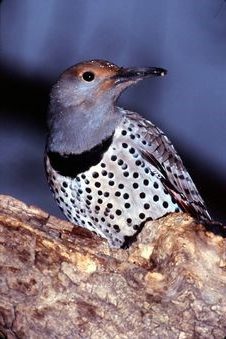 [
[All sentient creatures are negatively affected by the deaths of one species.
And still people refuse to see.
As I wrote about the loss of trees and woodpeckers old tree memories surfaced without warning. Resolutely, I faced my past…
Thirty five years ago I left the coast of Maine because trees were being slaughtered and their insides ground up so million dollar homes could be built. Initially, I believed that I escaped tree carnage by moving to the edge of the wilderness in the western hills only to discover that whole mountains were being strip logged around me. The stench of pitch nauseated me. I wept, helpless in the face of such violence. Continue reading “Flicker’s New Year Gift – Part 2 of 2 by Sara Wright”
Flicker’s New Year Gift – Part 1 of 2 by Sara Wright
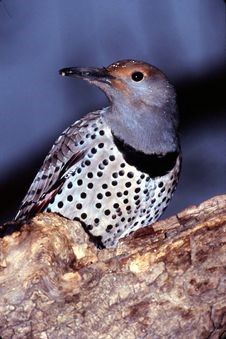 January 1st dawned clear and cold as I meandered through the frosted scrub and under the graceful Cottonwoods that line the Bosque by the river. I hadn’t planned on a walk because it was so frigid but the ethereal light that precedes the dawn often becomes a “calling” I cannot resist, pulling me towards the river regardless of practical intentions.
With the snow crunching under my feet I entered my usual meditative state without effort as I circled the bog, celebrating this time of deep inner stillness. Suddenly, an intention popped into the open space in my mind, one that I had not made as part of my ritual during this fluid turning of the seasons. The words flowed directly from the trees into my body without sound. Continue reading “Flicker’s New Year Gift – Part 1 of 2 by Sara Wright”
Winter Solstice Drama by Sara Wright
Last year I attended a bonfire on the night of the winter solstice at a friend’s house. As my companion and I walked towards the ledge where the fire had been the year before we were both astonished. Where was everybody? We stood in the dark confused. Minutes passed.
After suggesting we leave, my companion remarked with annoyance, “What the hell is going on here?” A Rhetorical question. I sure didn’t know.
Sudden hooting split the night and some dissonant musical sounds seemed to be coming from out of the bushes below us.
Following the sounds we descended the steep hill and discovered that the fire was at the river’s edge, and that a few people were already gathered there.
Unbeknownst to either of us the location had changed, and from our vantage point on the hill we couldn’t see the fire or hear any sounds. I had been looking forward to this celebratory turning, and liked the idea of sharing it with friends. Yet, now I felt uneasy.
Becoming Scrub by Sara Wright
In the precious hour before dawn I walk down to a river that no longer empties into the sea – the circle of life has been broken – the earth’s veins and arteries are hopelessly clogged by human interference (stupidity) – the birds and animals that used to be able to rely on the river waters for food and resting places can no longer do so because dams control the water flow and westerners “own” the water. This morning black stone sculptures appeared overnight because the water level has been dropped another foot. And yet, acknowledging the flowing waters in their death throws seems like an important thing to do. For now, at least, the river turns crimson, reflecting the raging beauty of a pre dawn sky, and I am soothed by water rippling quietly over round stone.
I open the rusty gate to enter the Bosque, a place of refuge, for the cottonwoods and for me. Now I am surrounded by desert scrub and graceful matriarchs arc over my head. As I traverse the well – trodden path I enter a meditative state without effort. Soon I am walking in circle after circle passing through the same trees and desert scrub hearing voices.
Navajo Night Chant and the Sacred Dark by Sara Wright
 With Winter Moon’s passage and the approach of the winter solstice just a little less than a week away I am much aware of the (potential healing) dwelling place that I inhabit that also characterizes these dark months of the year.
Unfortunately, even those who acknowledge our seasonal turnings rarely honor the dark as sacred. At the winter solstice the emphasis is still on light.
This attitude reveals to me an inability to be present to dark, in both its generative and non-generative aspects. The original inhabitants of this country honored the dark months of the year very differently than westerners do. Their most important ceremonies occurred during the winter months. Both aspects of the dark were acknowledged and explicated through ceremony. What follows is a history of one of the Navajo healing ceremonies that occur only during the winter months of the year. Continue reading “Navajo Night Chant and the Sacred Dark by Sara Wright”
The Circle of Life and Death by Sara Wright
 This morning the sky was on fire before dawn even as I approached the river whose ripples reflected a purple so deep it was almost inked in charcoal – In the Bosque I noticed that one mule deer had used a juniper to scrape his antlers. Otherwise the Earth emanated precious predawn stillness except for the sound of receding river waters slipping over cobbled stones. It was mild; I thought today might be the day…
The greens I had tipped in prayer and gratitude on ‘the mountain where bears live’ were waiting to be woven into wreaths, and by afternoon the temperature was warm enough for me to sit on the porch under a milky December sun with my clippers and bag of greens.
The sweet scent of pinion wafted through the air as I began to weave my circle of life with pinion, fir, and spruce. I wove carefully cutting smaller fronds without thinking about what I was doing, but beneath my quiet mind an intention was being set to weave a new kind of wholeness back into the trees, back into our broken Earth; S/he who is crying out to be heard through each raging fire, crackling drought, mud ridden flood. My greatest fear is that no one is listening.
My intention is that I will listen; I will be present for the trees. Continue reading ” The Circle of Life and Death by Sara Wright”
 Feminism and Religion