What do you get when you have two ladies, one a Baptist Minister living in KY and one an agnostic living in LA, making jokes and talking about the Bible? Don’t know? You get the new and exciting podcast Bible Bitches!
What do you get when you have two ladies, one a Baptist Minister living in KY and one an agnostic living in LA, making jokes and talking about the Bible? Don’t know? You get the new and exciting podcast Bible Bitches! We hope that you’ll take a moment to check out this new and exciting podcast that explores the F-word in Religion (among many other topics) and read the Q&A below with the creators Rev. Laura Barclay and Sara Hof! Click here to listen to the podcast (now on episode 5)!
In their purest form, “egalitarian matriarchies” place the mother principle at the center of culture and society. Their highest values are the love, care, and generosity they associate with motherhood. These values are not limited to women and girls. Boys and men are also encouraged to honor mothers above all, to practice the traits of love, care, and generosity, and to value them in others.
“Egalitarian matriarchal” societies are matrilineal which means that family membership and descent are passed through the female line. They are also usually matrilocal, which means that women live in their maternal home all of their lives. Family groups are usually extended rather than nuclear. Often there is a “big house” in which groups of sisters, brothers, and cousins live together with mothers, aunts, grandmothers, and great-aunts. In what I imagine to have been the original form of the system (still practiced by the Mosuo of the Himalayas), men also live in their maternal house, visiting their lovers at night, and returning home in the morning.
Mosuo women at festival
These societies practice small-scale agriculture. The women are owners and guardians of the land, which is held in common by maternal clans. They are also the guardians of the secrets of agriculture, food storage, and food preparation, which are passed down from mothers to daughters through songs, dances, rituals, and stories that celebrate the Earth as a great and giving Mother. The powers of women as birth-givers and as the guardians of the mysteries of the agricultural cycles are symbolically related to the powers of birth, death, and regeneration in nature and in all creative processes.
Women seated under trees in place of honor at Minoan festival
These social and cultural systems must have first developed at the beginning of the Neolithic era, when “woman the gatherer” first discovered the secrets of agriculture that allowed people to settle down and farm the land. If women discovered agriculture, then it makes sense that they would have been leaders in the first settled communities and guardians or owners of the land they farmed. They would have been the ones to build the first homes on or near the farmland. Sons as well as daughters would have been born in these early settlements.
The males of the families or clans continued to hunt. Over time they became responsible for building and heavy farm labor and for grazing flocks and seeking raw materials away from the settlement. It makes sense that they would be the ones to venture away from the community to gather information and to trade. In a recent documentary, Mosuo men stated that they don’t work as hard as women. This may not have been the case in the past. Today products and raw materials are brought in through the capitalist economy: traditional roles of traders are obsolete. Information gathering was an important part of trade expeditions: this is how new technologies spread rapidly in the Neolithic era; religious and cultural symbols were also shared by traders. Today there are books, newspapers, television, and the internet. Nor are Mosuo men involved in inter-clan negotiations in the People’s Republic of China.
From the division of labor in these societies, an egalitarian system of governance developed in which the elder women or grandmothers supervised the “internal” life of the house or clan. The “internal” domain included family and farm and all of the rituals surrounding birth, puberty, and death, as well as planting and harvesting. Women played central roles in creating and enacting all of these rituals. Through their expeditions and trade activities, elder men, the brothers of the grandmothers and uncles of the next generations, became responsible for the “external” relations of the clan, meeting people from other cultures when they were away from home, and welcoming visitors who arrived on their home territory.
Because of this division of labor, the elder men would have been the ones to meet and greet colonists and invaders and also to speak with storytellers, historians, and anthropologists, most often also men, who were interested in learning about their culture. If foreign men came from patriarchal cultures, they would have assumed that the men who met them were the leaders of their groups. The party line in the field of anthropology, which is followed by academics in other disciplines, is that “men wield the power” in matrilineal societies. I was disappointed to read this when I first started learning about matrilineal societies as a graduate student and to find it repeated in a recent article arguing that Minoan culture might have been matrilineal and matrilocal.
Those of us who have been socialized in patriarchal societies in which “men wield the power” cannot easily imagine alternative systems. When we begin to think about female power, we immediately conjure up pictures where “women wield the power” by going to war, keeping men as slaves, sexually abusing and raping them, and forcing them into subordinate positions. Such images are so abhorrent that we may conclude that patriarchy is not so bad after all. And this stops us from looking for or wanting to envision alternatives.
In 1981 anthropologist Peggy Reeves Sanday challenged these conventional views in her ground-breaking Female Power and Male Dominance. Examining all of the pre-urban societies documented in anthropological records, she discovered that societies that celebrated and valued female power were not female dominant but egalitarian. She also found that societies that celebrated and valued male power were almost always male dominant. They tended to develop in times of external threat (when men became warriors) or environmental crisis (when the female power of the earth was viewed as having failed the community). Though Sanday’s arguments are convincing, they failed to change that anthropological consensus that “men wield the power” in all human societies, including those that celebrate female power and are matrilineal and matrilocal.
What the consensus that “men wield the power” in matrilineal, matrilocal, and matrifocal societies does not recognize is the power women hold in the internal relations of the group. For example, in the Iroquois culture, the councils of female elders that managed the day to day life of the clan were just as important as the councils of male elders that through their “chief” met with European settlers and invaders. In fact, the councils of female elders were slightly more powerful than those of the male elders. Iroquois women could remove male leaders they did not approve of and reject decisions of the male council to go to war. This power of the female council did not mean that Iroquois women dominated Iroquois men. Rather it was an important check-and-balance ensuring that men’s councils could not unilaterally take actions that would negatively affect the internal relations of the clan.
What should we call societies such as these? Obviously we should continue using the terms “matrilineal” and “matrilocal” where they apply. But what term should we use to describe these cultures as a whole? Archaeologist Marija Gimbutas called the egalitarian societies of Old Europe “matrifocal” because she recognized that the term “matriarchal” is usually (mis)understood to mean female dominant; this decision did not protect her work from being criticized for its challenges to the patriarchal consensus.
I dared to use the “m” word after reading Peggy Reeves Sanday and Heide Goettner-Abendroth. I define egalitarian matriarchy as a society and culture organized around the mother principle of love, care, and generosity, in which mothers are honored and women play central roles, and in which men also have important roles and every voice is heard. My new suggestion is that the “m”word always be preceded by the “e” word, in other words that we not use “matriarchy” unmodified, but always write and speak of “egalitarian matriarchies” in order to make it clear that we are not talking about female-dominated societies. This will be my practice in the future.
If I had been asked to write the words that introduce visitors to the Heraklion Archaeological Museum of Crete to its earliest inhabitants, I would have said something like this:
While there is evidence that human beings visited Crete as early as 150,000 years ago, the first permanent settlers arrived from Anatolia in the New Stone Age or Neolithic era, about 9000 years ago, bringing with them the secrets of agriculture and soon afterward learning the techniques of pottery and weaving. As the gatherers of fruits, nuts, and vegetables and as preparers of food in earlier Old Stone Age or Paleolithic cultures, women would have noticed that seeds dropped at a campsite might sprout into plants. Women most likely discovered the secrets of agriculture that enabled people to settle down in the first farming communities of the New Stone Age. As pottery is associated with women’s work of food storage and preparation, and as weaving is women’s work in most traditional cultures, women probably invented these new technologies as well. Each of these inventions was understood to be a mystery of transformation: seed to plant to harvested crop; clay to snake coil to fired pot; wool or flax to thread to spun cloth. The mysteries were passed on from mother to daughter through songs, stories, and rituals. Continue reading “The Heraklion Museum: A Critique of the Neolithic Display by Carol P. Christ”
As a public school administrator, and a human, I feel tremendous grief for the tragedy generated in the latest school shooting. The impact is devastating and disastrous. Immediately after such a calamity is the public outcry for change and the immediate backlash from others who don’t want to lose their perceived rights under the constitution. Blaming federal agencies isn’t the answer either.
I find it critical to recognize that school shootings are not isolated events. Despite the outcry and current tug-of-war, stricter gun laws will only serve as a Band-Aid to one aspect of a major debilitating world problem. In just over 15 years of serving children and communities as a school administrator, I have witnessed extreme violence, rape, racism, walkouts orchestrated by teachers, administrators engaged in illegal behavior, parents abusing children, bullying, decay, outrageous political power struggles, and more.
Public schools are a microcosm of society; they are not stand-alone programs independent of the larger world. Truthfully, I am sometimes quite taken with how successful school programs are across the nation in spite of these immense pressures and misguided criticisms. Increasing student achievement in math and the English language arts is our charge; sometimes the realities and tragedies of life make this very difficult. But, that isn’t the point of this conversation.
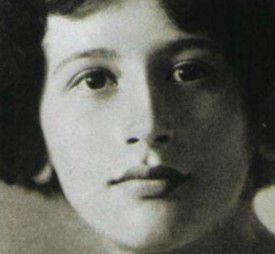
French philosopher and mystic Simone Weil, in Gravity and Grace, says forgiveness is knowing I am other than what I imagine myself to be (9). For Weil, our true selves seem to be inextricably intertwined with each other, with the universe; knowing this can bring compassion for the self and world.
Upholding the constructed self that needs to be justified, protected, and admired can cause a lot of stress within our bodies and perhaps violence in relationships. Weil says that the cause of war is that we do not know we have access to the universe in our own bodies (86). Sometimes I feel that we avoid each other, looking in to each other’s eyes, because we cannot bear the weight of energy, the collision of spinning vortex that might occur the closer we move. Our DNA might hold memories, shared vibrations with ancient mountains, and the bodies we inhabit feel so intensely. Every cell seems alive with sensation, and most of us want to avoid the pain that cannot always be extracted from the pleasure that is also ready to be encountered.
One of my students asked me, as we discussed Weil in class, why we should improve, try to become better people, what the point was of anything. I don’t always know the answer to these questions or what might prompt them, but what I think for the time being is that we get up off the floor because there are these moments of intimacy where the universe is felt through our veins, and to experience that, even occasionally, might be worth everything. To do what we might be destined to do, to co-create and do that in healing, pleasurable ways, is to align with something beyond, but not excluding, ourselves.
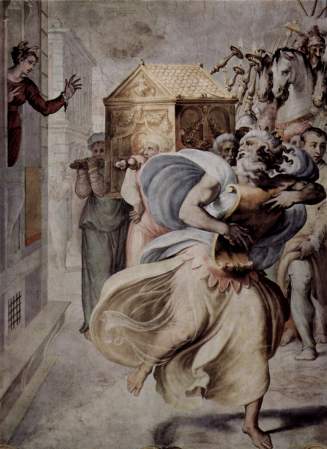
When I was in my late teens, I discovered midrash: the Jewish exegetical process by which commentators weave creative and additive interpretations into the sacred text. Midrash comes from the word “to ask,” “to seek,” or “to divine.” For example, the tale in which a well follows the prophetess Miriam through the wilderness is an ancient midrash. The story in which God stops the angels from singing as the Egyptians drown in the Sea of Reeds is a midrash. Each of these stories derives from a particular close reading of text, whether a Torah text or a verse elsewhere in the Bible. Each of them allows a new generation to add its own perspectives to the tradition.
Contemporary feminists, and many other contemporary artists, writers, and exegetes, have used a modern form of midrash to add liberatory perspectives to Jewish tradition and to biblical lore. From Miriam to Vashti, female biblical characters shine in the creative interpretations of feminist midrashists. Judith Plaskow’s “The Coming of Lilith” made a huge impact on the reading of the story of Eve and the legend of Lilith. Anita Diamant’s The Red Tent changed the conversation on Dinah forever. Alicia Ostriker, Norma Rosen, Veronica Golos, and many others have joined in this creative play which highlights marginalized voices within the text. Wilda Gafney has made contributions to a Christian and womanist form of midrash. Voices like Andrew Ramer and Joy Ladin have invited us to see queer and trans themes in the text. And of course many others, from poet Yehuda Amichai to bibliodramatist Peter Pitzele, have added to this rich tapestry.
Right now, I’m between semesters so find myself in Las Cruces, New Mexico, nestled into the house I plan to retire in—whenever that time comes. Best to leave it all open.
While traveling here, I began feeling lighter and lighter—not unlike the sensation I got as a kid when school let out for summer recess. Time stretched out forever, holding infinite possibilities. Now that I’ve been in New Mexico three weeks, I wish time would slow down. Christmas and New Year have come and gone with minimal fanfare. I did not hang a single decoration, nor did I attend a single party. Blessed relief.
The disdain with which the work of archaeologist Marija Gimbutas has been held in the field of classics and archaeology was shown to me when I stated quietly at a cocktail party at the American School of Classical Studies in Athens that I was interested in her work. This comment, tentatively offered, unleashed a tirade from a young female archaeologist who began shouting at me: “Her work is unscholarly and because it is, it is harder for me and other women scholars in the field to be taken seriously.”
Responding to the backlash against her theories, Gimbutas is said to have told a female colleague that it might take decades, but eventually the value of her work would be recognized. It is now more than twenty years since Marija Gimbutas died in 1994, and the value of her work is beginning to be recognized by (at least some of) her colleagues—including one of her harshest critics. In a lecture titled “Marija Rediviva: DNA and Indo-European Origins,” renowned archaeologist Lord Colin Renfrew (allied with the British Conservative Party**), who had been one of Gimbutas’s most vociferous antagonists and a powerful gate-keeper, concluded the inaugural Marija Gimbutas Lecture at the Oriental Institute of the University of Chicago with these words: “Marija [Gimbutas]’s Kurgan hypothesis has been magnificently vindicated.” Continue reading “Marija Gimbutas Triumphant: Colin Renfrew Concedes by Carol P. Christ”
A few weeks ago, I was asked to give the invocation for a luncheon at my university. Baylor University was celebrating our presidential inauguration and there were several events leading up to the installation of the university’s 15th president. The inauguration was historic because it ceremonially marks the beginning of a term for our first female president, Dr. Linda A. Livingstone.
As I write, it is a year after Hillary Rodham Clinton lost the election for President of the United States of America. Like many of us, I’m still coming to terms with the choice my nation made, and how we came to it. I’m thinking about women in leadership, especially occasions such leadership marks a first, a departure for an institution or system marked by male privilege.
What does it mean when an institution is willing to deviate from its long-established patterns of leadership and entrust its governance to women?
Last winter FAR contributor Glenys Livingstone lovingly and professionally edited all of the interviews for the film on Marija Gimbutas’ life and work, Signs Out of Time, by Donna Read and Starhawk, and posted them on youtube. Though I received a link to my interview from Glenys, I was too busy (or too depressed?) to watch it at the time.
As I watched and listened to my twenty years younger self yesterday, chills went up and down my spine. How, I wondered, did she know so much way back then? Maybe (I thought) she really was drawing on the underground spring described by Marija Gimbutas as bursting forth from time to timε to bring us wisdom from the ancestors of Old Europe.



 In their purest form, “egalitarian matriarchies” place the mother principle at the center of culture and society. Their highest values are the love, care, and generosity they associate with motherhood. These values are not limited to women and girls. Boys and men are also encouraged to honor mothers above all, to practice the traits of love, care, and generosity, and to value them in others.

 If I had been asked to write the words that introduce visitors to the

 The disdain with which the work of archaeologist
 Feminism and Religion