The Impact of Marija Gimbutas on My Life and Work by Carol P. Christ

Last winter FAR contributor Glenys Livingstone lovingly and professionally edited all of the interviews for the film on Marija Gimbutas’ life and work, Signs Out of Time, by Donna Read and Starhawk, and posted them on youtube. Though I received a link to my interview from Glenys, I was too busy (or too depressed?) to watch it at the time.

As I watched and listened to my twenty years younger self yesterday, chills went up and down my spine. How, I wondered, did she know so much way back then? Maybe (I thought) she really was drawing on the underground spring described by Marija Gimbutas as bursting forth from time to timε to bring us wisdom from the ancestors of Old Europe.

Thank you Glenys for the fantastic editing job.

* * *

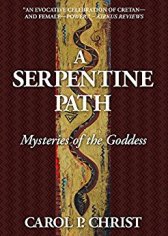
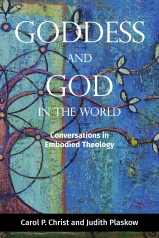
a-serpentine-path-amazon-coverGoddess and God in the World final cover designCarol’s new book written with Judith Plaskow, is  Goddess and God in the World: Conversations in Embodied Theology.

FAR Press recently released A Serpentine Path: Mysteries of the Goddess.

Join Carol  on the life-transforming and mind-blowing Goddess Pilgrimage to Crete. Sign up now for 2018! It could change your life!

Carol’s photo by Michael Honegger


Announcing the 2017 Rosemary Radford Ruether Conference by Grace Yia-Hei Kao

On October 7, 2017, five distinguished panelists will speak at a one-day event: the Rosemary Radford Ruether Conference for Justice and Peace. Co-sponsored by the Friends of Sabeel—North America (FOSNA), Claremont Area FOSNA, Claremont School of Theology, and the Women’s Studies in Religion program at Claremont Graduate University, the conference will be held at Pilgrim Place (Decker Hall)–the retirement community for folks serving in religious or charitable organizations where Dr. Ruether currently resides.

Continue reading “Announcing the 2017 Rosemary Radford Ruether Conference by Grace Yia-Hei Kao”

Cleaning and Cleansing: Rituals of Embodied Life by Carol P. Christ

While the world is falling apart all around me, I have been slowly engaged in a major cleaning and cleansing of my home.

It started when I began to move my summer clothes to my main closet in June.  Here in Greece we have no tradition of second-hand stores, Goodwill, or Salvation Army. This makes it difficult to get rid of anything: often the garbage can is the only option. Still, I began with my clothes, tossing out even some much loved and still beautiful things that no longer fit. My Greek-Albanian cleaning lady took all of them, and I didn’t ask her what she did with them.

Then I moved on to the kitchen. Continue reading “Cleaning and Cleansing: Rituals of Embodied Life by Carol P. Christ”

Fostering Conversation and Connection in Community by Katie M. Deaver

I recently began a new job as the Associate Director of Admissions for the Lutheran School of Theology at Chicago, one of the seminaries of the Evangelical Lutheran Church in America.   This week was orientation for our new and returning students and much of the time has been focused on getting to know one another as well as getting to know the corner of Chicago in which we are located.  There have been so many life giving conversations as well as so many questions!

Our mornings featured speakers who helped us to engage one another in conversation as well as to start thinking about the unique reality of our place within not only the LSTC community but also within the rest of the Chicago community and the larger world.  Throughout these presentations  and getting to know you activities my thoughts continued to be pulled back to the question of how to have life-giving conversations in a time when so many of us feel emotionally and spiritually drained by the world around us.

Continue reading “Fostering Conversation and Connection in Community by Katie M. Deaver”

Reclaiming My Time: A Meditation about Mindfulness and Faithfulness to One’s Purpose by Elise M. Edwards

elise-edwardsYou may have seen the viral video of Congressional Representative Maxine Waters’ demands for “Reclaiming my time!”  Video was taken during a proceeding in which Representative Waters is questioning Treasury Secretary Steven Mnuchin, who responds with long-winded answers and indirect statements.  Ms. Waters appears annoyed, and she is not interested in flattery.  She wants a direct response to her question.  When she does not get it, she appeals to protocol, which allows her to “reclaim” the time allotted to her (intentionally) wasted by a man who wants to dodge her questions.

The video was very popular on my social media feeds.  I know of preachers who used “Reclaiming my Time” in their sermons the following Sunday.  There were memes, of course.  There was even another viral video of Mykal Kilgore singing his gospel composition of Waters’ words.  He and Waters appeared on a TV show soon after.

It’s fairly obvious why this video–and the sentiment behind it–struck such a chord with so many people.  We wish we could reclaim our time in situations where we are moving forward with a purpose, only to be met with delays and roadblocks from those who want to deter us.  Sometimes, these delays are unintentional.  But too often, they are strategic attempts to wear us down, distract us, and redirect our energy away from our goal.  Ms. Waters wasn’t having it.  She called out the delay tactics and held firm to what was rightfully hers.  Her time.

Continue reading “Reclaiming My Time: A Meditation about Mindfulness and Faithfulness to One’s Purpose by Elise M. Edwards”

#NotYourWedge: Asian Americans and Affirmative Action by Grace Yia-Hei Kao

Asian Americans are making headline news as the nation once again grapples with affirmative action.

There are two precipitating incidents this time around:

Continue reading “#NotYourWedge: Asian Americans and Affirmative Action by Grace Yia-Hei Kao”

Woman and Nature: Our Bodies Are Ourselves by Carol P. Christ

This earth is my sister; I love her daily grace, her silent daring, and how loved I am how we admire the strength in each other, all that we have suffered, all that we have lost, all that we know. We are stunned by this beauty, and I do not forget: what she is to me, what I am to her.

These words are from Susan Griffin’s Woman and Nature which I often recommend as one of my favorite books. Over the years I have read this passage and others from Woman and Nature aloud with my students, and we have always been moved, most  of us to tears. More recently these words have become the center of the “Morning Blessing” on the Goddess Pilgrimage to Crete.

In the epigraph to the book Griffin writes,

These words are written for those of us whose language is not heard, whose words have been stolen or erased, those robbed of language, who are called voiceless or mute, even the earthworms, even the shellfish and the sponges, for those of us who speak our own language . . .

Continue reading “Woman and Nature: Our Bodies Are Ourselves by Carol P. Christ”

A Beginning: Atonement Theology and the Feminist Critique by Katie M. Deaver

Since many of the comments on my last post expressed interest in my dissertation topic I will use my next couple of posts to talk a little bit more about my work and research in that area.  When we talk about theories of the atonement we are trying to describe a narrative structure of what took place within the Christian cross event.  Generally speaking, Christians believe that atonement serves at the reconciliation between God and humanity and that this reconciliation is realized through the person of Jesus Christ.  The three primary theories that try to explain this event are Substitutionary/Satisfaction, Moral Influence, and Christus Victor.

The Substitutionary/Satisfaction theory of atonement suggests that Christ takes on the guilt and punishment that humanity deserves because of our sinfulness and so becomes our substitute, paying the debt we owe for our sins.  Because of humanity’s sinfulness we deserve death, but instead of giving us what we deserve God instead offers God’s son as a sacrifice to pay our debt, to atone for our sinfulness, and to save us from the eternal punishment of death.

The Moral Influence theory of the atonement focuses primarily on the life and ministry of Christ rather than on his suffering and death.  This theory is centered on the belief that God loves God’s creation so much that God would hold back nothing from us, God would even give God’s own Son in order to save us and remain in relationship with us.  As a result this theory encourages Christians to live as Christ lived and focuses on imitating his life and ministry in order to bring about justice in our own world.

Continue reading “A Beginning: Atonement Theology and the Feminist Critique by Katie M. Deaver”

How do you feel about me now? by Natalie Weaver

How do you feel about me now?

I was talking to an old friend the other day, and when I asked how he was, he said, “I’m getting by.”  “Getting by?  Not tearing it up, not taking ‘em down, and taking names?”  I joked. “No,” he replied too dryly, “not at my age.”

“Well, how old are you now?” I inquired playfully.  “Eighty-three,” he said.  “Oh,” I paused.  “And, I tell you, Nat,” he continued, “I don’t know about these last twenty years.  I just don’t know what happened to me.  Never imagined my life would turn out like this…” he spoke, trailing off.

His talk prompted me to wonder about the girl I once was, the woman I used to be, the mother I had imagined in myself at the outset, the scholar I prepared, the indefatigable friend I was to my peers as a teenager, the filial duty I felt in my youth, the honor I ascribed to my vocation as an educator, the family I tried to create.  I have changed too, I realized.  These last twenty years have been markedly transformational for me as well.  As I considered, I saw in all of the things I tried to do how my spirit and my faith walked alongside my life unfolding as companion and guide and interlocutor.

At each step along the way, my faith both informed and framed the meaning of my choices and my disposition toward the outcomes of my efforts.  For a long time, there was a harmony and an alignment between my meaning, my disposition, and my experience of living purposefully.  But then, sure as rain, the wheel turned, and I began to lose clarity on that alignment.  The idealism I had brought to each of my roles and endeavors was tested and tried as a matter of course.  But, in some instances, the trial was egregious.

I concluded that some disappointments run so deep they change who we are.  Some wounds are structural enough that they scar the tissue permanently and alter the curvature of our spines.  Some blows are so devastating that our speech transforms and our thinking must be rewired to survive.  Whether they are inflicted by the self or by others, whether by accident or intent or illness, injury has a common thread – it calls the Spirit to awaken and challenges it with the question: “How do you feel about me now?” Continue reading “How do you feel about me now? by Natalie Weaver”

Becoming Myself by Katie M. Deaver

Last weekend was a special one for me.  After many years of study and dedication I graduated with my Ph.D. and am now, officially, Dr. Katie Deaver.  The weekend was filled with celebrations to mark the completion of a milestone that I have spent years working toward.  The amazing outpourings of love, support, and care that I have experienced throughout the last few days is quite humbling.  The happiness and pure joy of my family, friends, professors, mentors, and multiple church communities have left me in awe.  As I reflect on this love and support it helps to heal the wounds and scars that have accumulated throughout the process of earning this degree.

The undertaking of a Ph.D. program is significantly more difficult than anyone tells you.  This difficultly lies not necessarily in the course work or the dedication to constant reading, writing, and learning but rather in the personal growth and vocational affirmation that takes place within the process.  My dissertation explored the primary understandings of the doctrine of atonement and addressed how this doctrine can, and has, been used in ways that perpetuate, and in some cases even encourage, domestic violence.

My own fascination with the topic of atonement and its links to domestic violence was brought about at the suggestion of one of my undergraduate professors at Luther College, Dr. Jim Martin-Schramm.  From the moment that Dr. Martin-Schramm explained the links between theologies of the cross and domestic violence I knew that I had found my new passion.  Writing a dissertation on the topics of domestic violence, theology and women of faith was an extremely personal, and intimate experience for me.  This topic forced me to accept my own lived experience.  To claim myself… out loud… as a survivor of domestic violence. As a result the writing of my dissertation was particularly personal, and painful, as well as extremely life giving.

Continue reading “Becoming Myself by Katie M. Deaver”