Sunday Shaming by Alison Downie

On a recent Friday, I learned that the 43 year old husband of someone I went to graduate school with, parent of four young children, died suddenly. Though I had been out of touch with my grad school friend for some years, I felt deeply for her loss, her unexpected plunge into single parenting, the way her life and the lives of her children would forever be shaped by this grievous tragedy.

I carried this family in my heart as I drove to my weekly Sunday visit with one of my adult sons, who lives about 75 miles from me. At this time, disabled by mental illness, he lives in an AA recovery house, surviving on Supplemental Security Income of $740.00/month and SNAP food allotments. Now 27, he dropped out of college after one semester, has never held a job for more than a month, and has been hospitalized three times for psychiatric care.

I usually enjoy our weekly visits, during which we sit at a coffee shop or do an errand. But I never know how he will be doing. When he is doing poorly, my own tendency to depression means that being present as best I can, even for just a few hours, to his deep suffering may utterly deplete me for the rest of the day or several days following. Continue reading “Sunday Shaming by Alison Downie”

Women Religion Revolution and its Political Theological Orientation by Xochitl Alvizo

I introduced the volume  Women Religion Revolution,  the collected works that Gina Messina and I co-edited, in a previous post. I now write about the political theological orientation with which we entered the project of the book.

The very first thing to note is that this work was, from beginning to end, a collaborative effort at multiple levels. First is the personal, relational. The idea for the book was Gina’s, but she invited me to join her in the project very early on. We brainstormed contributors and hit the ground running. Next, with the help of Kate Ott, we partnered with Feminist Studies in Religion, Inc. and its newly launched FSR Book Series. We were excited for the opportunity to have our book be among the first ones published. Organizationally, FSR Inc. partners with the Carter Center and its Mobilizing Action for Women and Girls Initiative. The Carter Center helped support the launch of the FSR Books series out of its concern to support works that make a difference to women and girls. And so, by way of FSR, this project was also made possible by the Carter Center (more on that in a bit). Continue reading “Women Religion Revolution and its Political Theological Orientation by Xochitl Alvizo”

The Making of Women Religion Revolution by Xochitl Alvizo

Last month in Boston during the American Academy of Religion (AAR) Annual Meeting I presented on Women Religion Revolution, a volume of collaborative work with fifteen other women that Gina Messina and I co-edited. The book is the third one published with FRS Books, the new book series of Feminist Studies in Religion, Inc. (FSR, Inc.) – a project with which we are very proud to partner.

FSR Books organized a panel featuring these first books. Serving as a backdrop of the whole panel was Elisabeth Schüssler Fiorenza’s own book, Congress of Wo/men: Religion, Gender, and Kyriarchal Power, which was FSR Books’ first publication. In this book, Schüssler Fiorenza introduces the concept and vision of the ekklēsia of wo/men as kosmopolis. Defining the ekklēsia of wo/men as “the decision-making assembly of the kosmopolis,[1] she explains the kosmopolis as the polis/city-state “governed by the egalitarian values and visions of justice and well-bring for everyone without exception” (106). She calls feminists in religion to “build a global, transcultural, cosmopolitan organizations for articulating a wisdom spirituality of cosmic world citizenship and for securing the welfare of everyone in the kosmos/world and of the kosmos itself” (111-112). In other words, Schüssler Fiorenza’s volume is a renewed call for feminists to think big and think together beyond the binary of secular/religious so as to more effectively counter the neoliberal domination of our current global context. Continue reading “The Making of Women Religion Revolution by Xochitl Alvizo”

Another Season of Reflection and Review by Elise M. Edwards

elise-edwardsI turn inward and become reflective at this time of year.  It’s the Advent season in the Christian liturgical year, which encourages practices of piety focused on preparation, examination, and hopeful longing.  It’s the end of a semester and a calendar year, which provokes review of the months before.  In the northern hemisphere, it’s a time of darker days and longer nights, which suggest a retreat indoors, in silence or in stillness.

During this time of year, I’m typically exhausted, and so I seem to enact annual rituals with a recurring sense of ambivalence.   I really love the celebration of Christmas, but preparing for it takes a lot of energy.  So I do some decorating, but not as much as I planned.  I attend some parties and celebrations, but end up missing or cancelling others.  I start a new devotional book, only to set it aside within a week or so.  I want this time of year to be both reflective and celebratory.  I want it to be spiritual and religious.  I want to be sociable with friends and family and also find time to rest and recover in solitude.  At some point, those goals seem too contradictory to be realizable and then I start practical negotiations:  How much decorating will I do? What kind of time will I set aside for solitude and self-care?  Will I have enough energy to be joyful and present with my family and friends?

“Some, but not enough” is the answer I seem to come to every year.

Some decorating, but not enough.  Some time for solitude and self-care, but not enough.  Some energy for social occasions, but not enough.  This year, I want to let go of that voice that says it’s not enough.  That voice that says I am not enough.

To help myself let go of the guilt and self-deprecation, while retaining the reflective focus of the season that may be life-affirming, I reviewed my previous years’ December writings on this blog.  What might I discern from this pattern of yearly reflection?

In 2012, I wrote about why women might be tempted to cancel Christmas.  I was in my final year of the Ph.D. program when I wrote that, and was prompted to do so when I heard that friends and colleagues were planning to skip Christmas preparations or scale them back dramatically.  That year, I sought to maintain “religious and social rituals associated with Christmas” so that I could be “spiritually grounded, emotionally provoked, mentally rested, and physically fed.” I don’t have a vivid memory of that year’s holidays, but as I read it again, I wonder if I was carrying a sense of religious obligation rather than release.  Did I feel free or beholden to social custom? I’ve learned that I will only be able to let that “not enough” voice go when I let go of the expectation that Advent and Christmas should look a certain way or I should be present to it in a certain way.  I’m more willing this year to let peace and joy ebb and flow  in celebrations and moments of sadness and mourning that accompany the season, too.

In 2014 and 2016, my Advent reflections were more focused on justice and peace at the societal level than in the household.  They were mournful.  In December 2014, I was trying to stave off despair after Michael Brown’s killer was not indicted by a grand jury.  The police officer would not stand trial for killing the black teen.  That year, I was mourning Michael Brown and Trayvon Martin and the loss of my own naivete as I became more conscientized about racial violence. I had a similar wake-up call last year when Hillary Rodham Clinton lost the US presidential election and I working through the anger and dread I felt at 45’s approaching presidency.  This year, the struggle continues as we anticipate changes to the tax code and DACA.  But at least Roy Moore lost.  We do continue to work for progress and systemic change, and sometimes, it works.

Feminists have long asserted that the personal is political and that the political is personal.  I’m acknowledging this holiday season that my perpetual weariness during Advent and Christmas is legitimate, as it emerges from personal and political struggle.  I am frustrated with the injustices and hardships I encounter at home, work, and the broader community.  I would not be weary if I was not awakened to the suffering.  This year, I accept that the exhaustion is part of the cost of my work and my calling.  The weariness will ebb and flow, as will joy and peace. Being able to teach and write is a blessing that allows me to help others become more aware of injustice and more involved in addressing it.  This year, I’m acknowledging that I’ve done what I can do.  I’m resisting the impulse to assess whether it was enough.  In previous years, I’ve been trying to hold on to hope; this year I’m resting in God’s grace.

As Christmas approaches, I’m embracing the Christian teaching that the divine meets humanity where we are.  The beauty of the Incarnation is that the eternal meets the temporal and that God unites with human to bring light to a suffering world.  That’s a gift for me this year, a comfort to be able to shift the focus from my own action and being to divine action and being.

I can see the sacred work and presence in this online community and other communities of faith.  Holiday blessings to you all.

Elise M. Edwards, PhD is a Lecturer in Christian Ethics at Baylor University and a graduate of Claremont Graduate University. She is also a registered architect in the State of Florida. Her interdisciplinary work examines issues of civic engagement and how beliefs and commitments are expressed publicly. As a black feminist, she primarily focuses on cultural expressions by, for, and about women and marginalized communities. Follow her on twitter, google+ or academia.edu.

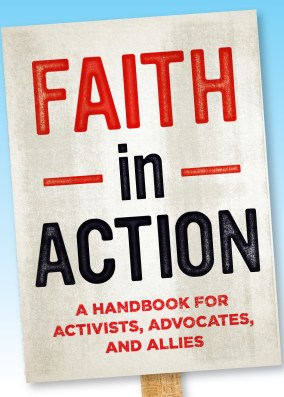
Faith in Action by Lisa Kloskin

Nearly a month ago, American voters showed up at the polls and delivered some big wins: the first openly transgender person was elected to a statehouse—Danica Roem in Virginia. Roem defeated an incumbent candidate who authored an anti-trans bathroom bill. Also in Virginia: the boyfriend of a reporter shot and killed on live TV, Chris Hurst, won a seat to the statehouse on a gun-control platform, defeating the three-term NRA-backed incumbent. And Hoboken, New Jersey, got its first Sikh mayor: Ravi Bhalla. These and others are encouraging signs that love and tolerance are gaining ground in the public sphere. But there’s still so much work to do. White Supremacists and Nazis still walk boldly in the streets, LGBTQIA teens still face bullying and higher rates of self-harm, women are still paid less for equal work and harassed in every arena, sea levels are rising at faster rates than we previously thought, people of color are still being killed by police, mass shootings are still a regular part of our news cycle, refugees are still waiting in camps around the world for a chance at a better, safer life.

Activists and advocates have been working for justice in these and other areas for decades. In the last year, spurred on by events like the Women’s March, a growing group of would-be activists has emerged. These allies are a welcome addition to the justice movement, but many worry they won’t do or say the right things, and want to have their perspectives deepened on important issues. They need guides and resources to give them the knowledge, tools, and confidence to make a real impact.

Continue reading “Faith in Action by Lisa Kloskin”

Why We Don’t Tell by Gina Messina

Roy Moore is the next in line to be exposed as a sexual predator in a long list that has unfolded since the Harvey Weinstein scandal. I find it both comical and distressing that Moore has attempted to justify his behavior by saying “I’ve never dated a girl without her mother’s permission.” In addition, he argued that such claims against him could not be true; it was so long ago; who would wait forty years to tell?

Apparently Moore has not heard the term rape culture – one he is clearly a product of – and how it leaves victims feeling silenced and ashamed. Perhaps he has not listened to the woman he assaulted sob on television as she spoke of her fear, embarrassment, and pain? Recounting her victimization, Beverly Young Nelson said she didn’t speak out because Moore told her no one would believe her. At only sixteen, Nelson knew that reporting the assault would lead to more trouble for her and no consequences for Moore. Continue reading “Why We Don’t Tell by Gina Messina”

It’s (the American Academy of Religion) Conference Time by Grace Yia-Hei Kao

I received an e-mail today thanking me for supporting the American Academy of Religion for the past 20 years and accordingly inviting me to pick up an “appreciation gift” at the upcoming meeting in Boston (Nov 18-21).

Last week, my colleague Monica A. Coleman and I also led our (Claremont School of Theology’s) monthly PhD Colloquium wherein we spoke to doctoral students about academic conferences in general and the AAR in particular.

Both of those events has gotten me thinking about this year’s AAR.

Continue reading “It’s (the American Academy of Religion) Conference Time by Grace Yia-Hei Kao”

Academics and Activism by Ivy Helman

unnamedTwo weeks ago, I spoke at a conference entitled “The Role of Academia and Religious Leaders in Relation to Refugees and the ‘Refugee Crisis,’” in Bratislava, Slovakia.  One of the main questions of the conference was: what role do academics play in the refugee crisis?  Are academics activists?  Many conference presenters and attendees directly linked the two ideas.  However, there were some who voiced their concern as to how in-touch academics actually are with reality and surmised that because of this academics probably weren’t activists. Wait!  What?  How can we not be activists?

On the way to the first night’s dinner, I had a conversation with someone who did not see academics as activists.  Why?  The response I got was that academic research functioned in a way that was largely inaccessible to the public and therefore academic work, academic participation in conferences as well as publishing was, for lack of a better word, unrealistic and impractical.  It would seem that some people are quite convinced that most academics are quite content being situated in that proverbial ivory tower. Continue reading “Academics and Activism by Ivy Helman”

High Stakes for Women in Leadership: A Reflection and a Prayer by Elise M. Edwards

elise-edwardsA few weeks ago, I was asked to give the invocation for a luncheon at my university.  Baylor University was celebrating our presidential inauguration and there were several events leading up to the installation of the university’s 15th president. The inauguration was historic because it ceremonially marks the beginning of a term for our first female president, Dr. Linda A. Livingstone.

As I write, it is a year after Hillary Rodham Clinton lost the election for President of the United States of America. Like many of us, I’m still coming to terms with the choice my nation made, and how we came to it.  I’m thinking about women in leadership, especially occasions such leadership marks a first, a departure for an institution or system marked by male privilege.

What does it mean when an institution is willing to deviate from its long-established patterns of leadership and entrust its governance to women?

Continue reading “High Stakes for Women in Leadership: A Reflection and a Prayer by Elise M. Edwards”

The Spirit and Jarena Lee: Inspiration to Break Boundaries by Elise M. Edwards

elise-edwardsI am so frustrated that we are still fighting to affirm women’s place in leadership.  I’ve been thinking about this struggle in the context of church ministries (especially preaching) and social activism, seeing a stark contrast between the way institutional churches and universities promote and subvert women’s authority and the ways movements like Black Lives Matter do.

Particularly, I’ve been struck by the ways that more radical movements employ language and practices that are based in spirit more than hierarchical authority.  I have found a theme emphasizing equality in humanity’s access to spirit in both historical and contemporary movements and writings about religious experience.  I’m certainly not the first one to notice or discuss how appeals to Spirit have empowered those excluded from dominant systems of power to challenge constrictive social structures, but I would like to share how this dynamic has become more visible to me so that, together, we might find encouragement, inspiration, and food for thought.

Continue reading “The Spirit and Jarena Lee: Inspiration to Break Boundaries by Elise M. Edwards”